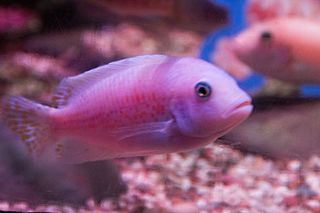
Cichlids are fish from the family Cichlidae in the order Cichliformes. Traditionally Cichlids were classed in a suborder, the Labroidei, along with the wrasses (Labridae), in the order Perciformes, but molecular studies have contradicted this grouping. On the basis of fossil evidence, it first appeared in Tanzania during the Eocene epoch, about 46–45 million years ago. The closest living relative of cichlids is probably the convict blenny, and both families are classified in the 5th edition of Fishes of the World as the two families in the Cichliformes, part of the subseries Ovalentaria. This family is large, diverse, and widely dispersed. At least 1,650 species have been scientifically described, making it one of the largest vertebrate families. New species are discovered annually, and many species remain undescribed. The actual number of species is therefore unknown, with estimates varying between 2,000 and 3,000.
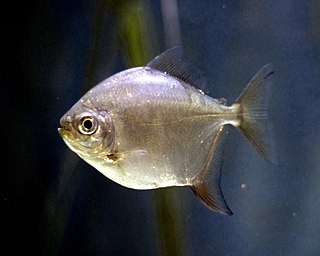
Silver dollar is a common name given to a number of species of fishes, mostly in the genus Metynnis, tropical fish belonging to the family Serrasalmidae which are closely related to piranha and pacu. Most commonly, the name refers to Metynnis argenteus. Native to South America, these somewhat round-shaped silver fish are popular with fish-keeping hobbyists.

The firemouth cichlid is a species of cichlid fish native to Central America. They occur in rivers of the Yucatán Peninsula, Mexico, south through Belize and into northern Guatemala.

The terms shell dwellers or shelldwellers, shell-breeding, or ostracophil are descriptive terms for cichlid fish that use the empty shells of aquatic snails as sites for breeding and shelter. The terms have no taxonomic basis, although most shell-dwelling cichlids are from Lake Tanganyikas lamprologine lineage. Many shell dwelling cichlids are popular with fishkeepings and are frequently kept in aquaria.

The fork tailed paradisefish, or paradise gourami is a species of gourami found in most types of fresh water in East Asia, ranging from the Korean Peninsula to northern Vietnam. This species can reach a standard length of 6.7 cm, though most are only about 5.5 cm . Paradise gouramis were one of the first ornamental fish available to western aquarium keepers, having been imported 1869 to France by the French aquarium fish importer Pierre Carbonnier in Paris. The paradise fish is one of the more aggressive members of its family. It is more aggressive than the three spot gourami, yet less pugnacious in nature than the less commonly kept combtail.
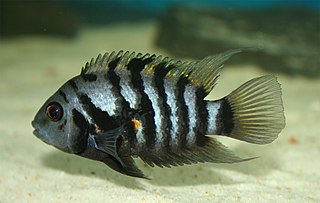
The convict cichlid is a fish species from the family Cichlidae, native to Central America, also known as the zebra cichlid. Convict cichlids are popular aquarium fish and have also been the subject of numerous studies on fish behaviour.

Julidochromis is a genus of cichlids in the subfamily Pseudocrenilabrinae. They are commonly called julies and are endemic to Lake Tanganyika in eastern Africa. This genus includes six formally described species, some with a number local variants of uncertain taxonomic status. Further taxonomic work is required to determine how many species exist; the closely related Chalinochromis with two more species is sometimes included here and this may be correct. Hybridization makes attempts to determine relationships with molecular phylogenetic methods difficult.

Mayaheros urophthalmus, also known as the Mayan cichlid or Mexican mojarra is a species of cichlid.

The keyhole cichlid is a cichlid fish endemic to tropical South America, occurring in the lower Orinoco Basin in Venezuela and river basins in The Guianas. It is the only species in the genus Cleithracara. The species is popular with fishkeeping hobbyists and is frequently kept in aquariums.
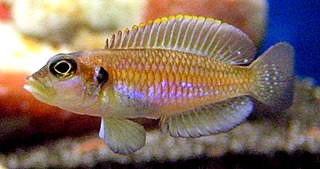
Lamprologus ocellatus is a species of shell dwelling cichlid endemic to Lake Tanganyika. It is a popular aquarium fish due to its small size, appearance, and intelligence.

Archocentrus is a genus of cichlid fish from Central America. It currently contains a single species, the flier cichlid, which is found in stagnant and slow-moving freshwater habitats such as lakes, ponds, ditches, swamps and rivers in Honduras, Nicaragua and Costa Rica. It is up to 11 cm (4.3 in) long and feeds on invertebrates and detritus.

Mikrogeophagus altispinosus is a species of fish endemic to the southern Amazon River basin in Brazil and Bolivia. The species is part of the family Cichlidae and subfamily Geophaginae. It is a popular aquarium fish, traded under the common names Bolivian butterfly, Bolivian ram, Bolivian ram cichlid, and ruby crown cichlid.

Amatitlania sajica, the T-bar cichlid or Sajica cichlid, is a Central American species of cichlid found in freshwater streams and lakes on the Pacific slope of Costa Rica. The fish is tan colored with seven indistinct bars on the body. The third bar is usually prominent and coupled with a dark lateral stripe running from the gill cover results in a horizontal T-shaped mark, hence the common name of T-bar cichlid.

Herotilapia multispinosa also known as the rainbow cichlid is a Central American freshwater fish of the cichlid family. It is found on the Atlantic slope of Honduras, Nicaragua, and Costa Rica from Patuca River (Honduras) south to Matina River, and on the Pacific slope of Nicaragua and Costa Rica from Guasaule River south to Tempisque River. Specimens are also reported from the Choluteca River on the Pacific side of Honduras. This species is found in lakes and swamps with muddy bottoms, where it uses its specialized teeth and only 3.5% jaw protrusion to feed mostly on algae. It is commercially important as an aquarium fish. The rainbow cichlid prefers a pH range of 7.0–8.0, water hardness of 9-20 dGH and a temperature range of 21–36 °C.
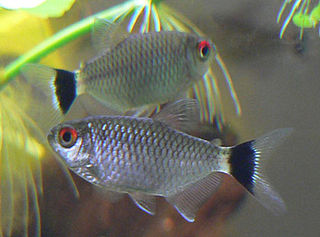
The redeye tetra, is a species of tetra from the São Francisco, upper Paraná, Paraguay and Uruguay river basins in eastern and central South America. This freshwater fish is commonly kept in aquariums and bred in large numbers at commercial facilities in Eastern Europe and Asia. The redeye tetra is one of the more popular aquarium fish due to their schooling capability.

Laetacara curviceps, the Flag acara, Dwarf flag cichlid, is a species of cichlid that lives in slow-moving rivers and streams as well as ponds and lakes of the Amazon Basin. This species can reach a total length of 10 cm (4 in).
Parachromis motaguensis, the false yellowjacket cichlid, is a species of cichlid native to Central America, where it can be found in Guatemala, El Salvador, and Honduras. This species grows to a length of 30 centimetres (12 in) TL. This species is farmed.

The nkhomo-benga peacock, also known as the new yellow regal peacock, is a species of haplochromine cichlid which is endemic to Lake Malawi. This species is threatened by capture for the aquarium trade.
Amatitlania is a genus of cichlid fishes native to freshwater habitats in Central America from El Salvador and Guatemala to Panama. They are fairly small cichlids, typically reaching up to 6.4–10 cm (2.5–4 in) in standard length depending on exact species, although captives may grow larger.
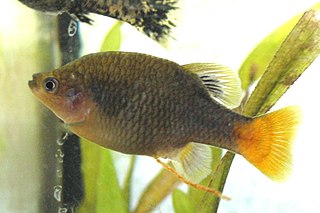
The redtail splitfin or redtail goodeid is a species of goodeid fish from the family Goodeidae and subfamily Goodeinae. Like other members of Goodeinae, the redtail splitfin is native to Mexico and a livebearer. However, the goodeid mating system differs in several ways from the more common livebearing fish from the family Poeciliidae that includes guppies and swordtails. While no goodeid species is a very popular aquarium fish, the redtail splitfin is one of the most popular. Only the male has the red-orange tail for which it is named. Its specific name honours the collector of the type, Gustav Eisen (1847–1940) who was Curator of Marine Invertebrates at the California Academy of Sciences in San Francisco, California.