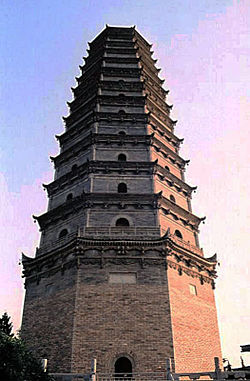
After the introduction of Buddhism to China from India in the 1st century during the Han dynasty, the Chinese pagoda was developed during the Southern and Northern dynasties era, and became mature and diverse in form during the Tang dynasty.[1] Its evolution included a variety of architectural sources for its design, including the Indian stupa, the Chinese residential towers developed during the Han dynasty, and Chinese elevated rammed earth platforms lined with stone or brick and crowned with timber structures developed during the Zhou dynasty.[2] Pagodas of the Tang period were mostly constructed of wood but were already being replaced by brick structures due to flammability,[3] while the Song dynasty and Liao dynasty witnessed major improvements in the masonry construction of pagodas.[4]
By the Ming dynasty, masonry was the preferred building method for both Buddhist pagodas and Confucian "Wenfeng" pagodas that contained stone bases with brick towers for greater structural stability and avoiding erosion by moisture.[5] Buildings constructed of both brick and stone were typical of Ming residential and religious structures, and led to the extensive construction of Wenfeng pagodas due to the prominence of both Buddhism and Confucianism.[6]Dry climate zones such as those in northern provinces like Shanxi where earthquakes are also more common led to the higher frequency of wooden pagodas constructed there, whereas the more humid climate in the southern Jiangnan region where earthquakes are less common spurred the widespread building of brick and stone pagodas that survive more easily there.[7]
The Chinese believed that building pagodas on certain sites according to geomantic principles brought about auspicious events.[8] Buddhist pagodas were often constructed within temples, while those built at the mouths of rivers or around towns were built with fengshui geomantic principles in mind.[6]
The Ming tombs, also known as the Thirteen Tombs, are a collection of tombs in a large building complex in the mountains just north of Beijing that house the remains of the Ming royal family. Built during the Ming period, the tumulus structures holding the remains of emperors and royal family members were built along the slopes of valleys and adjacent to structures that include halls, temples, gate towers, and barrel vaulted tunnels.[9] One of the centerpiece structures include a colossal pavilion that contains four great archway entrances, four ceremonial columns, and the largest inscribed stele in China, built in 1420 and mounted on a sculpture of a stone tortoise.[10] The sacred way winding through the tomb complex is lined with various stone statues depicting military and civil officials, horses, and mythological creatures, and leads to the ruins of bridges that are now partially destroyed.[11]
↑Needham 1971, pp.128–129 for development of pagodas from the Indian stupa, Zhou dynasty rammed earth platforms lined with brick and stone, and Han dynasty wooden residential towers that are known through intricate tomb models, p. 137 for information about Buddhist relics being housed within stupas and pagodas alike, p. 138 for more information about evolution of Chinese pagodas during the Six Dynasties period and their mention in the Book of Later Han, p. 139 for further development of the pagoda during the Tang dynasty, p. 140 for more information about the evolution of the Chinese pagoda from the Indian stupa.
↑Chen, Wu & Dong 2025, pp.2, p. 4 for definition of Wenfeng pagodas and how they are "mostly built in connection with the development of Confucianism, particularly prevalent in the Jiangnan region during the Ming and Qing dynasties".
Needham, Joseph (1971). Science and civilisation in China, Vol. 4: Physics and Physical Technology, Part 3: Civil Engineering and Nautics (1978 Caves Books, Ltd. Reprinted.). Cambridge: Cambridge University Press. ISBN0-521-07060-0.
This page is based on this Wikipedia article Text is available under the CC BY-SA 4.0 license; additional terms may apply. Images, videos and audio are available under their respective licenses.