
The indigenous peoples of Western New Guinea in Indonesia and Papua New Guinea, commonly called Papuans, are Melanesians. There is genetic evidence for two major historical lineages in New Guinea and neighboring islands: a first wave from the Malay Archipelago perhaps 50,000 years ago when New Guinea and Australia were a single landmass called Sahul and, much later, a wave of Austronesian people from the north who introduced Austronesian languages and pigs about 3,500 years ago. They also left a small but significant genetic trace in many coastal Papuan peoples.
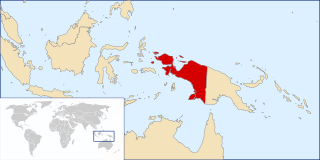
Western New Guinea, also known as Papua, Indonesian New Guinea, Indonesian Papua, is the western, Indonesian half of the island of New Guinea. Since the island is alternatively named Papua, the region is also called West Papua.

Papua New Guinea, a sovereign state in Oceania, is the most linguistically diverse country in the world. According to Ethnologue, there are 840 living languages spoken in the country. In 2006, Papua New Guinea Prime Minister Sir Michael Somare stated that "Papua New Guinea has 832 living languages ."

New Guinea is the world's second-largest island, with an area of 785,753 km2 (303,381 sq mi). Located in Melanesia in the southwestern Pacific Ocean, the island is separated from Australia by the 150-kilometre wide Torres Strait, though both landmasses lie on the same continental shelf. Numerous smaller islands are located to the west and east. The island's name was given by Spanish explorer Yñigo Ortiz de Retez during his maritime expedition of 1545 due to the resemblance of the indigenous peoples of the island to those in the African region of Guinea.
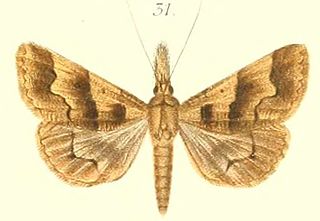
Ophyx is a genus of moths of the family Erebidae.

Asota is a genus of moths in the family Erebidae first described by Jacob Hübner in 1819. Species are widely distributed throughout Africa, India, Sri Lanka, Myanmar, the Malayan region and tropical parts of the Australian region.

Asota caricae, the tropical tiger moth, is a species of noctuoid moth in the family Erebidae. It is found from the Indo-Australian tropics of India and Sri Lanka to Queensland and Vanuatu.

Asota egens is a species of noctuoid moths in the family Erebidae. It is found from Japan and the Oriental tropics, east to New Guinea.

Asota heliconia is a moth in the family Erebidae. It is found from the Indo-Australian tropics east to Queensland and the Solomons.

Asota plana is a moth in the family Erebidae first described by Francis Walker in 1854. It is found from the Oriental tropics east to New Guinea.
Asota strigosa is a moth of the family Erebidae first described by Jean Baptiste Boisduval in 1832. It is found in Indonesia and the Papua New Guinea.
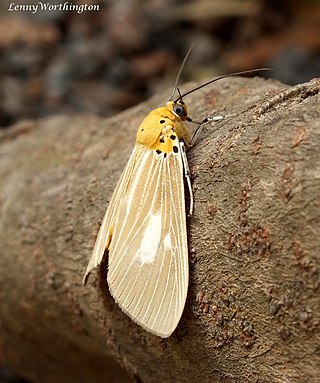
Asota plaginota is a moth of the family Erebidae first described by Arthur Gardiner Butler in 1875. It is found in China, India, Indonesia, Myanmar, Malaysia, Nepal, Papua New Guinea, the Philippines, Sikkim, Singapore, Sri Lanka, Thailand and Vietnam. In Northeast India, it is recorded as a millet pest.
Asota orbona is a moth of the family Erebidae first described by Samuel Constantinus Snellen van Vollenhoven in 1863. It is found in Indonesia, Papua New Guinea and Queensland.
Asota isthmia is a moth of the family Erebidae first described by Francis Walker in 1856. It is found in China, Indonesia, Papua New Guinea and the Philippines.
Asota australis is a moth of the family Erebidae first described by Jean Baptiste Boisduval in 1832. It is found in Australia, Indonesia and Papua New Guinea.

Eurema alitha, the scalloped grass yellow, is a butterfly species in the genus Eurema. It was first described as Terias alitha by father and son entomologists Cajetan and Rudolf Felder in 1862. It is found in Southeast Asia.

Papilio albinus is a species of swallowtail butterfly from the genus Papilio that is found in west Western New Guinea and Papua New Guinea. The species was first described by Alfred Russel Wallace in 1865.
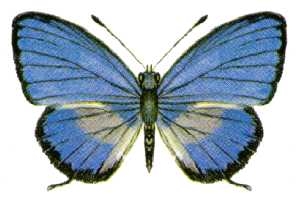
Nacaduba cyanea, the tailed green-banded line-blue, is a species of butterfly in the family Lycaenidae, and formerly considered a member of the genus Danis. It is found in the Indonesia, Papua New Guinea, the Solomon Islands and Australia (Queensland).

Notagonum is a genus in the beetle family Carabidae. There are more than 80 described species in Notagonum.
Ophyx crinipes is a moth of the family Erebidae. It is found in Indonesia and Papua New Guinea.


