
Asota is a genus of moths in the family Erebidae first described by Jacob Hübner in 1819. Species are widely distributed throughout Africa, India, Sri Lanka, Myanmar, the Malayan region and tropical parts of the Australian region.

Herochroma is a genus of moths in the family Geometridae. The genus was described by Charles Swinhoe in 1893.
Asota spadix is a moth of the family Erebidae first described by Charles Swinhoe in 1901. It is found in Micronesia and the Solomon Islands.
Asota albiformis is a moth of the family Erebidae first described by Charles Swinhoe in 1892. It is found in Borneo, the Philippines, Sulawesi and the Moluccas.
Asota avacta is a moth of the family Erebidae first described by Charles Swinhoe in 1892. It is found in Indonesia and Malaysia.
Asota carsina is a moth of the family Erebidae first described by Swinhoe in 1906. It is found on Nias.
Asota concolora is a moth of the family Erebidae first described by Charles Swinhoe in 1903. It is found on Madagascar.
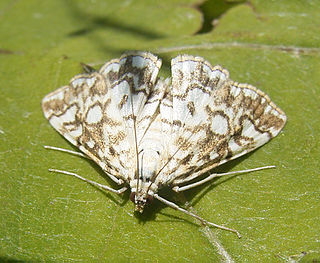
Acentropinae is a fairly small subfamily of the lepidopteran family Crambidae, the crambid snout moths. Species of this subfamily are exclusively found in wetlands and aquatic habitats.

