August Pott

Last updated
August Pott AugustPott.jpg
August Pott

August Friedrich Pott (14 November 1802 in Nettelrede, Hanover  5 July 1887 in Halle) was a German pioneer in linguistics.

Linguistics is the scientific study of language. It involves analysing language form, language meaning, and language in context. The earliest activities in the documentation and description of language have been attributed to the 6th-century-BC Indian grammarian Pāṇini who wrote a formal description of the Sanskrit language in his Aṣṭādhyāyī.

Pott was a theology student at the University of Göttingen, where he became interested in philology. He became a schoolmaster in Celle, [1] but completed his doctoral dissertation in 1827 and went to the University of Berlin to study with Franz Bopp, an important pioneer in Indo-European linguistics. He became an unsalaried lecturer in general linguistics there in 1830 and became the professor of general linguistics at the University of Halle in 1833, where he remained for the rest of his life.

University of Göttingen university in the city of Göttingen, Germany

The University of Göttingen is a public research university in the city of Göttingen, Germany. Founded in 1734 by George II, King of Great Britain and Elector of Hanover, and starting classes in 1737, the Georgia Augusta was conceived to promote the ideals of the Enlightenment. It is the oldest university in the state of Lower Saxony and the largest in student enrollment, which stands at around 31,500.

Philology is the study of language in oral and written historical sources; it is the intersection between textual criticism, literary criticism, history, and linguistics. Philology is more commonly defined as the study of literary texts as well as oral and written records, the establishment of their authenticity and their original form, and the determination of their meaning. A person who pursues this kind of study is known as a philologist.
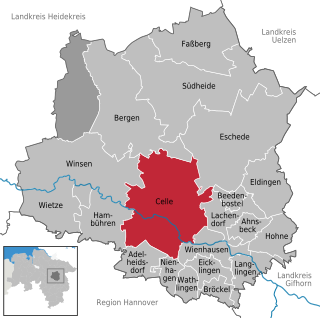
Celle Place in Lower Saxony, Germany

Celle is a town and capital of the district of Celle, in Lower Saxony, Germany. The town is situated on the banks of the river Aller, a tributary of the Weser and has a population of about 71,000. Celle is the southern gateway to the Lüneburg Heath, has a castle built in the Renaissance and Baroque style and a picturesque old town centre with over 400 timber-framed houses, making Celle one of the most remarkable members of the German Timber-Frame Road. From 1378 to 1705, Celle was the official residence of the Lüneburg branch of the dukes of Brunswick-Lüneburg who had been banished from their original ducal seat by its townsfolk.

His works, notably Etymologische Forschungen (1834–1836), [1] established the modern etymological studies on the basis of the correspondence of sounds occurring in related words in the Indo-European languages. He is also considered the nineteenth century's most important philologist of Romany, the language of the Romani people.

Romani is any of several languages of the Romani people belonging to the Indo-Aryan branch of the Indo-European language family. According to Ethnologue, seven varieties of Romani are divergent enough to be considered languages of their own. The largest of these are Vlax Romani, Balkan Romani (600,000), and Sinte Romani (300,000). Some Romani communities speak mixed languages based on the surrounding language with retained Romani-derived vocabulary – these are known by linguists as Para-Romani varieties, rather than dialects of the Romani language itself.

Romani people ethnic group living mostly in Europe and the Americas

The Romani, colloquially known as Gypsies or Roma, are an Indo-Aryan ethnic group, traditionally itinerant, living mostly in Europe and the Americas and originating from the northern Indian subcontinent, from the Rajasthan, Haryana, and Punjab regions of modern-day India.

Related Research Articles

Ferdinand de Saussure Swiss linguist

Ferdinand de Saussure was a Swiss linguist and semiotician. His ideas laid a foundation for many significant developments in both linguistics and semiology in the 20th century. He is widely considered one of the founders of 20th-century linguistics and one of two major founders of semiotics/semiology.

Indo-European languages family of several hundred related languages and dialects

The Indo-European languages are a language family of several hundred related languages and dialects.

Roman Jakobson American linguist, philosopher and educationist

Roman Osipovich Jakobson was a Russian linguist and literary theorist.

Linguistics is the scientific study of language. It involves an analysis of language form, language meaning, and language in context.

Friedrich August Wolf German philologist

Friedrich August Wolf was a German Classicist and is considered the founder of modern Philology.

August Schleicher German philologist

August Schleicher was a German linguist. His great work was A Compendium of the Comparative Grammar of the Indo-European Languages, in which he attempted to reconstruct the Proto-Indo-European language. To show how Indo-European might have looked, he created a short tale, Schleicher's fable, to exemplify the reconstructed vocabulary and aspects of Indo-European society inferred from it.

Indo-European studies Subfield of linguistics

Indo-European studies is a field of linguistics and an interdisciplinary field of study dealing with Indo-European languages, both current and extinct. Its goal is to amass information about the hypothetical proto-language from which all of these languages are descended, a language dubbed Proto-Indo-European (PIE), and its speakers, the Proto-Indo-Europeans, including their society and mythology. The studies cover where the language originated and how it spread. This article also lists Indo-European scholars, centres, journals and book series.

Mario Alinei was an Italian linguist and professor emeritus at the University of Utrecht, where he taught from 1959 to 1987. He was founder and editor of Quaderni di semantica, a journal of theoretical and applied semantics. Until 1997, he was president of Atlas Linguarum Europae at UNESCO.

Tamaz (Thomas) Valerianis dze Gamkrelidze is a distinguished Georgian linguist, orientalist public benefactor and Hittitologist, Academic and President of the Georgian Academy of Sciences (GAS), Doctor of Sciences (1963), Professor (1964).

Berthold Gustav Gottlieb Delbrück was a German linguist who devoted himself to the study of the comparative syntax of the Indo-European languages.

Karl Brugmann German philologist

Karl Brugmann was a German linguist. He is noted for his work in Indo-European linguistics.

Winfred Philip Lehmann was an American linguist noted for his work in historical linguistics, particularly Proto-Indo-European and Proto-Germanic, as well as for pioneering work in machine translation.

Celtic studies academic discipline

Celtic studies or Celtology is the academic discipline occupied with the study of any sort of cultural output relating to the Celtic people. This ranges from linguistics, literature and art history, archaeology and history, the focus lying on the study of the various Celtic languages, living and extinct. The primary areas of focus are the six Celtic languages currently in use: Irish, Scottish Gaelic, Manx, Welsh, Cornish, and Breton.

Eric Pratt Hamp was an American linguist widely respected as a leading authority on Indo-European linguistics, with particular interests in Celtic languages and Albanian. Unlike many Indo-Europeanists, who work entirely on the basis of written materials, he conducted extensive fieldwork on lesser-known Indo-European languages and dialects, such as Albanian, Arbëresh and Arvanitika; Breton; Welsh; Irish; and Scots Gaelic.

Suniti Kumar Chatterji Bengali linguist

Suniti Kumar Chatterji was an Indian linguist, educationist and litterateur. He was a recipient of the third-highest Indian civilian honour of Padma Bhushan.

Richard Pischel was a German Indologist born in Breslau.

Gustav Meyer was a German linguist and Indo-European scholar, considered to be one of the most important Albanologists of his time, most importantly by proving that the Albanian language belongs to the Indo-European family.

Friedrich Bechtel German philologist and linguist

Friedrich Bechtel was a German philologist and linguist of Indo-European languages, known for his research of Greek dialects.

Calvert Watkins was an American linguist and philologist, known for his book How to Kill a Dragon. He was Professor Emeritus of linguistics and the classics at Harvard University and later went to serve as professor-in-residence at UCLA.

References

  1. 1 2 Wikisource-logo.svg Chisholm, Hugh, ed. (1911). "Pott, August Friedrich". Encyclopædia Britannica . 22 (11th ed.). Cambridge University Press. p. 210.