Related Research Articles

Microalgae or microphytes are microscopic algae invisible to the naked eye. They are phytoplankton typically found in freshwater and marine systems, living in both the water column and sediment. They are unicellular species which exist individually, or in chains or groups. Depending on the species, their sizes can range from a few micrometers (μm) to a few hundred micrometers. Unlike higher plants, microalgae do not have roots, stems, or leaves. They are specially adapted to an environment dominated by viscous forces.

Phycocyanin is a pigment-protein complex from the light-harvesting phycobiliprotein family, along with allophycocyanin and phycoerythrin. It is an accessory pigment to chlorophyll. All phycobiliproteins are water-soluble, so they cannot exist within the membrane like carotenoids can. Instead, phycobiliproteins aggregate to form clusters that adhere to the membrane called phycobilisomes. Phycocyanin is a characteristic light blue color, absorbing orange and red light, particularly near 620 nm, and emits fluorescence at about 650 nm. Allophycocyanin absorbs and emits at longer wavelengths than phycocyanin C or phycocyanin R. Phycocyanins are found in cyanobacteria. Phycobiliproteins have fluorescent properties that are used in immunoassay kits. Phycocyanin is from the Greek phyco meaning “algae” and cyanin is from the English word “cyan", which conventionally means a shade of blue-green and is derived from the Greek “kyanos" which means a somewhat different color: "dark blue". The product phycocyanin, produced by Aphanizomenon flos-aquae and Spirulina, is for example used in the food and beverage industry as the natural coloring agent 'Lina Blue' or 'EXBERRY Shade Blue' and is found in sweets and ice cream. In addition, fluorescence detection of phycocyanin pigments in water samples is a useful method to monitor cyanobacteria biomass.
Algaculture is a form of aquaculture involving the farming of species of algae.
The Aquatic Species Program was a research program in the United States launched in 1978 by President Jimmy Carter and was funded by the United States Department of Energy, which over the course of nearly two decades looked into the production of energy using algae. Initially, the funding of the Aquatic Species Program was to develop renewable fuel for transportation. Later, the program focused on producing bio-diesel from algae. The research program was discontinued in 1996. The research staff compiled their work and conclusions into a 1998 report.
Neochloris oleoabundans is a microalga belonging in the class Chlorophyceae. Due to its high lipid content, it has been considered as a candidate organism for cosmetics and biofuel production, as well as feed stock for freshwater mussels.
Pyrolysis oil, sometimes also known as bio-crude or bio-oil, is a synthetic fuel under investigation as substitute for petroleum. It is obtained by heating dried biomass without oxygen in a reactor at a temperature of about 500 °C with subsequent cooling. Pyrolysis oil is a kind of tar and normally contains levels of oxygen too high to be considered a pure hydrocarbon. This high oxygen content results in non-volatility, corrosiveness, immiscibility with fossil fuels, thermal instability, and a tendency to polymerize when exposed to air. As such, it is distinctly different from petroleum products. Removing oxygen from bio-oil or nitrogen from algal bio-oil is known as upgrading.

Botryococcus braunii is a green, pyramid-shaped planktonic microalga that is of potentially great importance in the field of biotechnology. Colonies held together by a lipid biofilm matrix can be found in temperate or tropical oligotrophic lakes and estuaries, and will bloom when in the presence
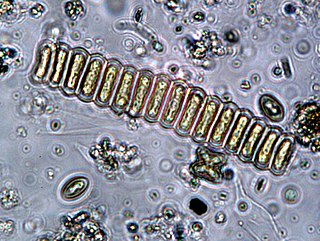
Scenedesmus is a genus of green algae, in the class Chlorophyceae. They are colonial and non-motile.

Algae fuel, algal biofuel, or algal oil is an alternative to liquid fossil fuels that uses algae as its source of energy-rich oils. Also, algae fuels are an alternative to commonly known biofuel sources, such as corn and sugarcane. When made from seaweed (macroalgae) it can be known as seaweed fuel or seaweed oil.
Many microorganisms can naturally grow together on surfaces to form complex aggregations called biofilms. Much research has been done on methods to remove biofilms in clinical and food manufacturing processes, but biofilms are also used for constructive purposes in a variety of industries. One distinctive characteristic of biofilm formation is that microorganisms within biofilms are often much tougher and more resistant to environmental stress compared to individual microorganisms. The cells are stationary and are able to adapt to adverse environments. This phenomenon of enhanced resistance can be beneficial in industrial chemical production where microorganisms within biofilms may tolerate higher chemical concentration and act as robust biorefineries for various products. These microbes have also been used in bioremediation to remove contaminants from freshwater and wastewater. More novel uses of biofilms include generating electricity using microbial fuel cells. Challenges to scaling up this technology include cost, controlling the growth of biofilms, and membrane fouling.

Nannochloropsis is a genus of algae comprising six known species. The genus in the current taxonomic classification was first termed by Hibberd (1981). The species have mostly been known from the marine environment but also occur in fresh and brackish water. All of the species are small, nonmotile spheres which do not express any distinct morphological features that can be distinguished by either light or electron microscopy. The characterisation is mostly done by rbcL gene and 18S rRNA sequence analysis.
Algae fuel in the United States, as with other countries, is under study as a source of biofuel.
Nasrin Moazami is an Iranian medical microbiologist and biotechnologist. She received her Ph.D. in 1976, from the Faculty of Medicine at Laval University. Moazami is the pioneer of biotechnology and microalgae-based fuels in Iran.
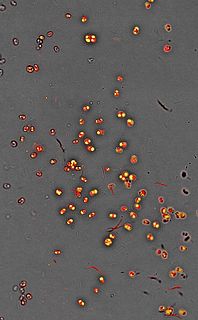
Nannochloropsis is a genus of alga within the heterokont line of eukaryotes, that is being investigated for biofuel production. One marine Nannochloropsis species has been shown to be suitable for algal biofuel production due to its ease of growth and high oil content, mainly unsaturated fatty acids and a significant percentage of palmitic acid. It also contains enough unsaturated fatty acid linolenic acid and polyunsaturated acid for a quality biodiesel.

Microalgae or microscopic algae grow in either marine or freshwater systems. They are primary producers in the oceans that convert water and carbon dioxide to biomass and oxygen in the presence of sunlight.

Chlorella sorokiniana is a species of freshwater green microalga in the Division Chlorophyta. It has a characteristic emerald-green color and pleasant grass odor. Its cells divide rapidly to produce four new cells every 17 to 24 hours. The alga was found by a Dutch microbiologist Martinus W. Beijerinck in 1890. In 1951, the Rockefeller Foundation in collaboration with the Japanese Government and Hiroshi Tamiya developed the technology to grow, harvest and process Chlorella sorokiniana on a large, economically feasible scale. This microalga has also been used extensively as a model system to study enzymes involved in higher plant metabolism.
Galdieria sulphuraria is an extremophilic unicellular species of red algae. It is the type species of the genus Galdieria. It is known for its broad metabolic capacities, including photosynthesis and heterotrophic growth on over 50 different extracellular carbon sources. The members of the class Cyanidiophyceae are among the most acidophilic known photosynthetic organisms, and the growth conditions of G. sulphuraria – pH between 0 and 4, and temperatures up to 56 °C – are among the most extreme known for eukaryotes. Analysis of its genome suggests that its thermoacidophilic adaptations derive from horizontal gene transfer from archaea and bacteria, another rarity among eukaryotes.
Phycotechnology refers to the technological applications of algae, both microalgae and macroalgae.
Sammy Boussiba is a professor emeritus at the French Associates Institute for Agriculture and Biotechnology of Drylands at the Jacob Blaustein Institutes for Desert Research at Ben-Gurion University of the Negev, Israel.

Chlorella vulgaris is a species of green microalga in the Division Chlorophyta. It is mainly used as a dietary supplement or protein-rich food additive in Japan.
References
- 1 2 M.D. Guiry in Guiry, M.D. & Guiry, G.M. 2013. AlgaeBase. World-wide electronic publication, National University of Ireland, Galway. http://www.algaebase.org; searched on 19 April 2013.
- 1 2 Gao, Chunfang; Zhai, Yan; Ding, Yi and Wu, Qingyu "Application of sweet sorghum for biodiesel production by heterotrophic microalga Chlorella protothecoides." Applied Energy 87.3 (2010): 756-761.
- ↑ Pittman, Jon K., Andrew P. Dean, and Olumayowa Osundeko. "The potential of sustainable algal biofuel production using wastewater resources." Bioresource Technology 102.1 (2011): 17-25.
- ↑ Huss, Volker AR; Ciniglia, Claudia; Cennamo, Paola; Cozzolino, Salvatore ; Pinto, Gabriele and Pollio, Antonino "Phylogenetic relationships and taxonomic position of Chlorella-like isolates from low pH environments (pH< 3.0)." BMC Evolutionary Biology 2.1 (2002): 13.
- ↑ Darienko, T., Pröschold, T. (2015), "Genetic variability and taxonomic revision of the genus Auxenochlorella (Shihira et Krauss) Kalina et Puncocharova (Trebouxiophyceae, Chlorophyta)". Journal of Phycology, 51: 394–400. doi: 10.1111/jpy.12279
- 1 2 Gao C., Wang Y., Shen Y., Yan D., He X., Dai J., et al. (2014). Oil accumulation mechanisms of the oleaginous microalga Chlorella protothecoides revealed-through its genome, transcriptomes and proteomes. BMC Genomics (2014) 15:582–595.
- ↑ Gill,Saba Shahid; Mehmood, Muhammad Aamer; Rashid, Umer; Ibrahim, Muhammad; Saqib, Anam and Rizwan, Muhammad "Waste-water treatment coupled with biodiesel production using microalgae: a bio-refinery approach." Pakistan Journal of Life and Social Sciences 11.3 (2013): 179-189.
- ↑ Heredia-Arroyo, Tamarys, Wei Wei, and Bo Hu. "Oil accumulation via heterotrophic/mixotrophic Chlorella protothecoides." Applied biochemistry and biotechnology 162.7 (2010): 1978-1995.
- ↑ Xu, Han, Xiaoling Miao, and Qingyu Wu. "High quality biodiesel production from a microalga Chlorella protothecoides by heterotrophic growth in fermenters." Journal of Biotechnology 126.4 (2006): 499-507.
- ↑ Shi, Xian-Ming; Liu, Hui-Jun; Zhang, Xue-Wu and Feng Chen "Production of biomass and lutein by Chlorella protothecoides at various glucose concentrations in heterotrophic cultures." Process biochemistry 34.4 (1999): 341-347.
- ↑ Shi, X. M., and F. Chen. "Production and rapid extraction of lutein and the other lipid‐soluble pigments from Chlorella protothecoides grown under heterotrophic and mixotrophic conditions." Food/Nahrung 43.2 (1999): 109-113.
- ↑ Shi, Xian-Ming; Liu, Hui-Jun; Zhang, Xue-Wu and Chen, Feng "Heterotrophic production of lutein by selected Chlorella strains." Journal of Applied Phycology 9.5 (1997): 445-450.
- 1 2 3 Zhou, Wenguang; Li, Yecong; Min, Min; Hu, Bing; Zhang, Hong; Ma, Xiaochen; Li, Liang; Cheng, Yanling; Chen, Paul and Ruan, Roger "Growing wastewater-born microalga Auxenochlorella protothecoides UMN280 on concentrated municipal wastewater for simultaneous nutrient removal and energy feedstock production." Applied Energy 98 (2012): 433-440.