| ||||||||||||||||||||||||||
| Turnout | 51.3% | |||||||||||||||||||||||||
|---|---|---|---|---|---|---|---|---|---|---|---|---|---|---|---|---|---|---|---|---|---|---|---|---|---|---|
This lists parties that won seats. See the complete results below. | ||||||||||||||||||||||||||
| ||||||||||||||||||||||||||
| This article is part of a series on the politics and government of Serbia |
|---|
Legislature |
Judiciary |
The local election for the City Assembly of Belgrade, capital of Serbia, was held on 4 March 2018. The election had to be scheduled by the end of February 2018, since this is when the mandate of the current City Assembly expires. Parties and coalitions ran for 110 seats in the Assembly, with 5% election threshold required to win seats.
The City Assembly of Belgrade is the legislature of the City of Belgrade, capital of Serbia. It is a representative body that executes the essential functions of the local government stipulated by the legislation and the City Charter.
Belgrade is the capital and largest city of Serbia. It is located at the confluence of the Sava and Danube rivers, where the Pannonian Plain meets the Balkans. The urban area of the City of Belgrade has a population of 1.23 million, while nearly 1.7 million people live within its administrative limits.
Serbia, officially the Republic of Serbia, is a country situated at the crossroads of Central and Southeast Europe in the southern Pannonian Plain and the central Balkans. The sovereign state borders Hungary to the north, Romania to the northeast, Bulgaria to the southeast, North Macedonia to the south, Croatia and Bosnia and Herzegovina to the west, and Montenegro to the southwest. The country claims a border with Albania through the disputed territory of Kosovo. Serbia's population is about seven million. Its capital, Belgrade, ranks among the oldest and largest citiеs in southeastern Europe.
Current City assembly was elected in 2014, after Dragan Đilas, mayor at that time, lost a no-confidence motion, and was replaced by a Temporary Council, led by Siniša Mali, then an independent endorsed by the Serbian Progressive Party (SNS). After the election, the Assembly's composition was significantly changed, since Democratic party (DS) lost substantial number of seats, while SNS coalition obtained majority of them. This election marked an ending to 9-year rule of Democratic party in Belgrade.
Dragan Đilas is a Serbian politician and businessman who was the Mayor of Belgrade from 2008 to 2013.
Siniša Mali is a Serbian economist and politician. He serves as the Minister of Finance in the Government of Serbia since 29 May 2018.
The Serbian Progressive Party is a populist conservative political party in Serbia.
Siniša Mali was elected mayor by the City Assembly on 24 April 2014. During his term, Belgrade Waterfront project commenced, a large urban development project, though marked by a number of protests of local population. Key moment in Mali's term was demolition of a city block to make way for Belgrade Waterfront project. This caused massive demonstrations in the City, [1] and almost led to Mali's resignation from the post. However, backed by the then-prime minister Aleksandar Vučić, Mali kept his position, and will complete his term as Mayor, though it remains uncertain whether he will be a mayoral candidate in the upcoming elections. [2] [3]
Belgrade Waterfront, known in Serbian as Belgrade on Water, is an urban renewal development project headed by the Government of Serbia aimed at improving Belgrade's cityscape and economy by revitalizing the Sava amphitheater, a neglected stretch of land on the right bank of the Sava river, between the Belgrade Fair and Branko's bridge. It was started in 2014 with the reconstruction of the Belgrade Cooperative building, which was finished in June of the same year. It is the largest mixed use complex under construction in Europe, worth 3.5 billion dollars. It will have 6.000 apartments, seven hotels including W Hotel and St Regis, 2000 offices, largest shopping mall in South East Europe and other public buildings like libraries, kinder gardens and museums.
Aleksandar Vučić is a Serbian politician who has been the President of Serbia since 31 May 2017. After leaving the ultranationalist Serbian Radical Party in 2008, he became one of the founders of the populist conservative Serbian Progressive Party (SNS) and he has been the party's Chairman since 2012.
It is yet unclear how will the opposition parties organize themselves for the election, but pollsters conduct polls as if there is a relatively united opposition front against the ruling parties, with the exception of Šapić, who is the current head of Novi Beograd municipality, who stated that he is not interested in pre-election coalitions, and that he will compete alone. [4] Besides that, the ruling parties also didn't reveal whether they (SNS and SPS) will form an election coalition, or will they compete separately.
Aleksandar Šapić is a Serbian politician and former professional water polo player. Since 2012, he has served as the president of the New Belgrade municipality.
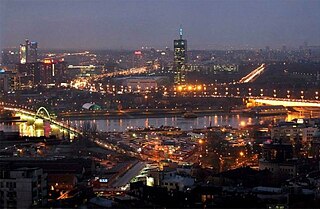
New Belgrade is a municipality of the city of Belgrade. It is the central business district in Serbia and one of the major ones in Southeast Europe. It was a planned municipality, built since 1948 in a previously uninhabited area on the left bank of the Sava river, opposite old Belgrade. In recent years, it has become the central business district of Belgrade and its fastest developing area, with many businesses moving to the new part of the city, due to more modern infrastructure and larger available space. With 212,104 inhabitants, it is the second most populous municipality of Serbia after Novi Sad.
The Socialist Party of Serbia is a political party in Serbia that identifies as a democratic socialist and social democratic party. The Socialist Party of Serbia was the direct descendant of the Communist Party of Serbia. Throughout its existence, the party has utilised some nationalist rhetoric and themes, and has therefore been labelled a Serbian nationalist party, although the SPS has never identified itself as such.
Dragan Đilas stated that he will enter the race for mayor of Belgrade, and gathered support from PSG, NS and other opposition organizations. At the same time, DS is not willing to support its former president yet, but the party remains open for that option after the election. DS agreed to form an electoral alliance with SDS, a party of DS' former president, Boris Tadić, who then called for restoration of the Democratic party. [5] DJB and Dveri also announced a coalition in the run for the City Assembly seats. [6]
The Social Democratic Party is a parliamentary political party in Serbia. The party was founded and is headed by Boris Tadić, who was previously president of the Democratic Party and the former President of Serbia. Between June and October 2014, the name of the party was the New Democratic Party.
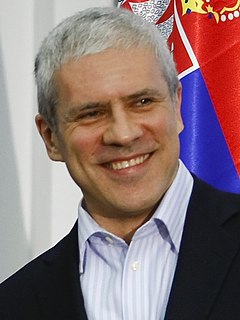
Boris Tadić is a Serbian politician who served as President of Serbia from 2004 to 2012. He was elected to his first term on 27 June 2004, when Serbia was part of Serbia and Montenegro, and re-elected for a second term on 3 February 2008, this time as president of independent Serbia. He resigned on 5 April 2012 in order to trigger an early election. Prior to his presidency, Tadić served as the last Minister of Telecommunications of the Federal Republic of Yugoslavia and as the first Minister of Defence of Serbia and Montenegro. He is a psychologist by profession.
The Democratic Party is a social-democratic and social-liberal political party in Serbia. It is the major centre-left party in Serbia and is the fifth largest party in the National Assembly. The Democratic Party is a full member of the Socialist International, the Progressive Alliance, and is an associate member of the Party of European Socialists.
On the other hand, the citizen organization Ne da(vi)mo Beograd (sr), loosely translated as We Won't Let Belgrade D(r)own, that rose in 2015 from strong opposition of local population to controversial urban and architectural projects such as the Belgrade Waterfront, [7] [8] [9] decided to participate in the local elections as a citizen group. [10] This organization obtained support from similar civil groups in other European countries, notably from Barcelona's mayor, Ada Colau, followed by Yanis Varoufakis, and 'Zagreb je naš' movement from Croatia. [11]
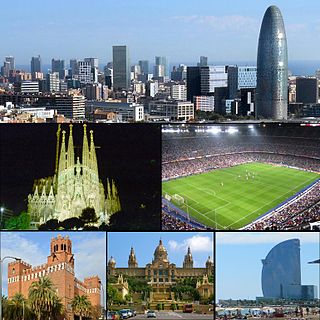
Barcelona is a city in Spain. It is the capital and largest city of Catalonia, as well as the second most populous municipality of Spain. With a population of 1.6 million within city limits, its urban area extends to numerous neighbouring municipalities within the Province of Barcelona and is home to around 4.8 million people, making it the sixth most populous urban area in the European Union after Paris, London, Madrid, the Ruhr area and Milan. It is one of the largest metropolises on the Mediterranean Sea, located on the coast between the mouths of the rivers Llobregat and Besòs, and bounded to the west by the Serra de Collserola mountain range, the tallest peak of which is 512 metres high.
Ada Colau Ballano is a Spanish activist and politician from Catalonia. On 13 June 2015 she was elected Mayor of Barcelona, the first woman to hold the office, as part of the citizen municipalist platform, Barcelona En Comú. Colau was one of the founding members and spokespeople of the Plataforma de Afectados por la Hipoteca (PAH), which was set up in Barcelona in 2009 in response to the rise in evictions caused by unpaid mortgage loans and the collapse of the Spanish property market in the wake of the 2008 financial crisis.
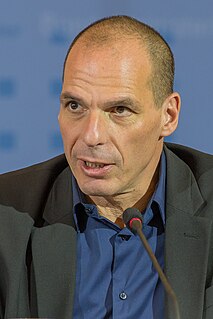
Ioannis Georgiou "Yanis" Varoufakis is a Greek economist, academic and politician, who served as the Greek Minister of Finance from January to July 2015, when he resigned. Varoufakis was a Syriza member of the Hellenic Parliament (MP) for Athens B from January to September 2015.
City Electoral Commission granted observer licences to representatives from Crta, Građani na straži, CeSID and Yucom. Apart from them, party representatives also observe the elections, as well as representatives from the Electoral Commission. [12]
According to Serbian law, election silence begins at midnight, on 1 March, and will last until 4 March, when polls close. During this period, all campaigning is prohibited, in order to maintain a free voting environment. [13]
Voters in Belgrade determine the composition of the City Assembly, which in turn elects the Mayor. This means that the Mayor is only indirectly elected by the voters. Only parties which reach an electoral threshold of 5% may enter the Assembly, although this is waived for minority lists. The Mayor may or may not be a councilor of the Assembly. Assembly's composition is subject to a 4-year election cycle, and it has 110 seats, allocated using d'Hondt system.
In this election, there are 1.606.693 eligible voters, voting in 1.185 polls across the City's district. [13]
The following are the electoral lists in the capital city so far proclaimed by the City Electoral Commission: [14]
| Ballot Number | Ballot Name |
|---|---|
| 1 | ALEKSANDAR VUČIĆ – Zato što volimo Beograd! |
| 2 | Dr VOJISLAV ŠEŠELJ – SRPSKA RADIKALNA STRANKA |
| 3 | IVICA DAČIĆ – Socijalistička partija Srbije (SPS), DRAGAN MARKOVIĆ PALMA – Jedinstvena Srbija (JS) |
| 4 | DA OSLOBODIMO BEOGRAD – Demokratska stranka (DS), Socijaldemokratska stranka (SDS), Nova stranka (NOVA) i Zelena ekološka partija – Zeleni (ZEP – Zeleni) |
| 5 | ALEKSANDAR ŠAPIĆ – GRADONAČELNIK |
| 6 | „Šta radite bre – Marko Bastać” |
| 7 | DOSTA JE BILO I DVERI – DA OVI ODU, A DA SE ONI NE VRATE |
| 8 | DR MILOŠ JOVANOVIĆ – DEMOKRATSKA STRANKA SRBIJE |
| 9 | ZELENA STRANKA SRBIJE |
| 10 | Beograd ima snage – ZAVETNICI |
| 11 | Dragan Đilas – Beograd odlučuje, ljudi pobeđuju! |
| 12 | „INICIJATIVA NE DAVIMO BEOGRAD - ŽUTA PATKA - ČIJI GRAD, NAŠ GRAD - Ksenija Radovanović” |
| 13 | RUSKA STRANKA – MILE MILOŠEVIĆ |
| 14 | PREDRAG MARKOVIĆ – POKRET OBNOVE KRALJEVINE SRBIJE |
| 15 | Dr. Muamer Zukorlić – Stranka pravde i pomirenja |
| 16 | ZELENA STRANKA – Kakav Beograd želiš? Misli |
| 17 | Republikanska stranka – Republikánus párt – Nikola Sandulović |
| 18 | JEDINSTVENA STRANKA PRAVDE (JSP) – JEKHUTNO ĆIDIMOS ČAĆIMASKO (JĆČ) |
| 19 | ZA BEOGRAD – BEOGONDOLA – SAOBRAĆAJ, URBANIZAM, TURIZAM – NOVA REŠENJA, KONKRETNI PROJEKTI – JOVAN RANĐELOVIĆ |
| 20 | NIJEDAN OD PONUĐENIH ODGOVORA |
| 21 | Građanska Stranka Grka Srbije – Vasilios Proveleggios |
| 22 | DOSTA JE BILO PLJAČKE, KORUPCIJE I LOPOVLUKA – Radulović Milorad |
| 23 | Liberalno demokratska partija – LDP – Čedomir Jovanović |
| 24 | Ljubiša Preletačević BELI – Zato što volimo BELOVGRAD |
The highest percentage figure in each polling survey is displayed in bold, and the background shaded in the leading party's color. In the instance that there is a tie, then no figure is shaded. The lead column on the right shows the percentage-point difference between the two parties with the highest figures. When a specific poll does not show a data figure for a party, the party's cell corresponding to that poll is shown empty. Poll results use the date the fieldwork was done, as opposed to the date of publication. However, if such date is unknown, the date of publication will be given instead.
| Pollster | Date | Sample size | SNS coalition | SPS & JS | DS coalition | DSS | PSG-NS-Đilas | Šapić list | SRS | Dveri & DJB | Others | Lead | ||||||
|---|---|---|---|---|---|---|---|---|---|---|---|---|---|---|---|---|---|---|
| Belgrade City Assembly election 2018 | 4 March 2018 | N/A | 44.99 | 6.13 | 2.25 | 1.12 | 18.93 | 9.01 | 2.34 | 3.89 | 11.34 | 26.06 | ||||||
| Ipsos | 1 Mar | ? | 44.1 | 5.8 | 3.9 | 13.4 | 7.9 | 4 | 3.9 | 8.3 | 30.7 | |||||||
| Večernje Novosti | 28 Feb | ? | 43.1 | 6.7 | 4.8 | 13.9 | 7.6 | 4.4 | 4.3 | 7.8 | 29.2 | |||||||
| Informer | 26 Feb | ? | 41.3 | 6.7 | 4.5 | 13 | 9.2 | 5.1 | 4.8 | ? | 28.3 | |||||||
| Alo | 25 Feb | ? | 43 | 6.2 | 4.5 | 13.2 | 10.1 | 4 | 5.0 | ? | 29.8 | |||||||
| NSPM | 26 Jan–3 Feb | 1,200 | 38.1 | 6.2 | 3.9 | 1.0 | 19.0 | 15.2 | 3.8 | 5.0 | 7.8 | 23.8 | ||||||
| Faktor plus | 23–29 Jan | 1,200 | 40.4 | 6.6 | 7.2 | 2.1 | 16.6 | 11.1 | 3.5 | 5.2 | 7.3 | 23.8 | ||||||
| Ninamedia | 3–16 Jan | 1,208 | 37.2 | 7.5 | 9.6 | 1.4 | 14 | 9.2 | 6.1 | 9.9 | 5.1 | 23.2 | ||||||
| NSPM | 24 Dec–4 Jan | 1,200 | 39.8 | 2.5 | 23.8 | 18.6 | 3.1 | 4.4 | 7.8 | 16 | ||||||||
| 2018 | ||||||||||||||||||
| Faktor plus | 15–25 Dec | 1,200 | 39.1 | 5.8 | 6.8 | 15.6 | 15 | 3.5 | 5.7 | 8.5 | 23.5 | |||||||
| Faktor plus | 28 Nov–5 Dec | 1,000 | 39 | 5.9 | 5 | 16 | 16 | 2.5 | 5.3 | 10.3 | 23 | |||||||
| NPSM | 1–10 Nov | 1,200 | 30.9 | 5.5 | 2.2 | 28.3 | 16.8 | 3.6 | 5.8 | 6.9 | 2.6 | |||||||
| NPSM | 25–30 Sep | 1,100 | 33.8 | 5.5 | 2.3 | 27.7 | 16.1 | 3.6 | 4.8 | 6.2 | 6.1 | |||||||
| 2017 | ||||||||||||||||||
| Belgrade City Assembly election 2014 | 16 March 2014 | N/A | 43.62 | 11.49 | 15.70 | 6.39 | Did not exist | Did not exist | 2.02 | 3.74 | 2.06 | 14.57 | 27.92 | |||||
The following are the final results proclaimed by the City Electoral Commission: [15]
| Party | Votes | % | Seats | +/– |
|---|---|---|---|---|
| Aleksandar Vučić — Because We Love Belgrade | 366.461 | 44.99 | 64 | +1 |
| Dragan Đilas — Belgrade Decides, People Win! | 154.147 | 18.93 | 26 | New |
| Aleksandar Šapić — Mayor | 73.425 | 9.01 | 12 | New |
| Ivica Dačić — Socialist Party of Serbia (SPS), Dragan Marković Palma — United Serbia (JS) | 49.895 | 6.13 | 8 | –8 |
| Enough is Enough and Dveri — So That These Leave, and Those Don't Come Back | 31.682 | 3.89 | 0 | — |
| Ne davimo Beograd Initiative — the Yellow Duck — Whose City, Our City — Ksenija Radovanović | 28.017 | 3.44 | 0 | New |
| dr Vojislav Šešelj — Serbian Radical Party | 19.094 | 2.34 | 0 | — |
| Ljubiša Preletačević Beli — Because We Love Beligrade | 19.013 | 2.33 | 0 | New |
| To Free Belgrade — Democratic Party (DS), Social Democratic Party (SDS), New Party (NOVA), Green Ecological Party - Greens (ZEP) | 18.286 | 2.25 | 0 | –22 |
| dr Miloš Jovanović — Democratic Party of Serbia | 9.084 | 1.12 | 0 | –9 |
| Belgrade Has Strength — Oathkeepers | 5.301 | 0.65 | 0 | — |
| Predrag Marković — Movement for the Restoration of the Kingdom of Serbia | 4.291 | 0.53 | 0 | New |
| What are you doing, bre — Marko Bastać | 3.604 | 0.44 | 0 | New |
| Green Party of Serbia | 3.349 | 0.41 | 0 | New |
| Russian Party — Mile Milošević | 3.040 | 0.37 | 0 | — |
| Green Party – What Kind of Belgrade do you want? Think! | 2.695 | 0.33 | 0 | New |
| Liberal Democratic Party – LDP – Čedomir Jovanović | 1.955 | 0.24 | 0 | — |
| None of the Above | 1.498 | 0.18 | 0 | — |
| Citizens’ Party of Greeks in Serbia — Vasilios Proveleggios | 1.493 | 0.18 | 0 | New |
| dr Muamer Zukorlić — Justice and Reconciliation Party | 1.402 | 0.17 | 0 | New |
| Enough Robbery, Corruption and Theft — Radulović Milorad | 1.113 | 0.14 | 0 | New |
| Republican Party — Republikánus párt — Nikola Sandulović | 1.108 | 0.14 | 0 | New |
| For Belgrade – Beogondola – Traffic, Urbanism, Tourism – New Solutions, Real Projects – Jovan Ranđelović | 823 | 0.10 | 0 | New |
| United Justice Party (JSP) – Jekhutno Ćidimos Čaćimasko (JĆČ) | 385 | 0.05 | 0 | New |
| Invalid/blank votes | 12.969 | 1.59 | – | – |
| Total | 814.477 | 100 | 110 | 0 |
| Registered voters/turnout | 1.594.141 | 51.09 | – | – |
| Source: Službeni List Grada Beograda | ||||
Composition of Belgrade City Assembly after 2018 elections.
Clear victory for the ruling party — SNS, meant that this party will determine the City's future mayor. Party leader, and President of Serbia, Aleksandar Vučić, stated that his party's cooperation in the City government with SPS will continue for another 4 years.
On the other hand, a once dominant party in Belgrade — DS, lost all its seats and won't be represented in the City Assembly for the first time since its inception. Its votes went largely to Đilas and Šapić, both of them former members of the party.
Nationalist parties and movements, such as SRS and Dveri were also heavily defeated in this election.
The Mayor of Belgrade is the head of the City of Belgrade. He or she acts on behalf of the City, and performs an executive function in the City of Belgrade. The position of the Belgrade Mayor is important as the city is the most important hub of economics, culture and science in Serbia. Furthermore the post of the mayor of Belgrade is the third most important position in the government after the Prime Minister and President. The current Mayor of Belgrade is Zoran Radojičić (Independent).
The unicameral parliament of the Serbian autonomous province of Vojvodina is known as the Assembly of the Autonomous province of Vojvodina.
Local elections were held in Serbia on 11 May 2008. According to the Constitutional Law adopted by the National Assembly on 30 September 2006 that proclaimed the new constitution, the parliamentary Speaker had to schedule the elections for local administrative units by 31 December 2007. He scheduled them on 2007-12-29. Following the official breakdown of the government on 8 March 2008, early parliamentary elections were held on the same date. A revote was held in three polling stations in Belgrade on 18 May 2008 due to irregularities in the electoral process.
Parliamentary elections were held in Serbia on 6 May 2012 to elect members of the National Assembly, and were held simultaneously with provincial, local, and presidential elections.
Local elections in Serbia were held on 6 May 2012. Pursuant to the Constitution of Serbia, the parliamentary Speaker signed on 13 March 2012 the Decision on calling the elections for councilors of municipal assemblies, town assemblies and the Belgrade City Assembly for 6 May 2012, with the exception of: the councilors of the municipal assemblies of Aranđelovac, Bor, Vrbas, Vrnjačka Banja, Knjaževac, Kovin, Kosjerić, Kosovska Mitrovica, Leposavić, Negotin, Novo Brdo, Odžaci, Peć, Prijepolje and Ruma and councilors of the Priština Town Assembly, which have already had extraordinary elections in the period from 2008 to 2012, while for councilors of the municipal assembly of Kula, the elections were already called earlier on 29 February 2012.
Parliamentary elections were held in Serbia on 16 March 2014, with nineteen electoral lists competing for 250 members of the National Assembly. The election was called early, after tensions in the coalition led by Serbian Progressive Party (SNS) and Socialist Party of Serbia (SPS), who ruled the country since 2012. President of Serbia Tomislav Nikolić scheduled the election at the same time as previously announced Belgrade local election. According to the preliminary results based on 99.08% of counted votes, the turnout was 53.09%, with 3.22% votes invalid.
Parliamentary elections were held in Serbia on 24 April 2016. They were originally due to be held by March 2018, but on 17 January 2016 Prime Minister Aleksandar Vučić called for a snap election claiming Serbia "needs four more years of stability so that it is ready to join the European Union". The elections were held simultaneously with provincial elections in Vojvodina and nationwide local elections.
The local election for the City Assembly of Belgrade, capital of Serbia, was held on 16 March 2014, alongside parliamentary election. The election was scheduled in late 2013, after the mayor Dragan Đilas lost a non-confidence motion in the assembly. Twenty-three parties and coalitions ran for 110 seats in the Assembly, with 5% election threshold required to win seats.
Parliamentary elections are due to be held in Serbia in April 2020, although they may be held earlier if early elections are called.
In the run up to the 2016 parliamentary elections in the Serbia, various organisations carried out opinion polling to gauge voting intention in Serbia. Results of such polls are displayed in this article.

The incumbent Government of Serbia, led by prime minister Ana Brnabić, was elected on 29 June 2017 by a majority vote in the National Assembly. It succeeded the second cabinet of Aleksandar Vučić, formed after the 2016 parliamentary election, after Vučić resigned the prime minister post following his election as the President of Serbia. Vučić appointed Ana Brnabić, previously the Minister of Public Administration, as his successor on 15 June 2017.
Municipal elections were held in Capital City of Podgorica and eleven other municipalities of Montenegro on 25 May 2014.
Nada Kostić is a medical doctor, academic, and politician in Serbia. She briefly served as Serbia's minister of health in the transitional government that was established after the fall of Slobodan Miloševic's administration in 2000. Kostić was awarded a mandate for the National Assembly of Serbia on 17 April 2018. She is a member of the Democratic Party but serves in parliament as an independent deputy.
Andreja Mladenović is a politician in Serbia. He was the deputy mayor of Belgrade from 2014 to 2018 and is currently one of the city's three assistant mayors. For many years a prominent member of the Democratic Party of Serbia, he was expelled from the party in 2015 and subsequently founded his own Independent Democratic Party of Serbia. He is now aligned with the Serbian Progressive Party.
The Independent Democratic Party of Serbia is a possibly inactive conservative political party in Serbia.
Zoran Vuletić is a politician in Serbia. For many years a leading member of the Liberal Democratic Party (LDP), he is now a prominent member of Saša Janković's Movement of Free Citizens.
Vojin Biljić is a politician in Serbia. He has served in the National Assembly of Serbia since 22 January 2019 as a member of the It's Enough – Restart association, better known in English by the name "Enough Is Enough."