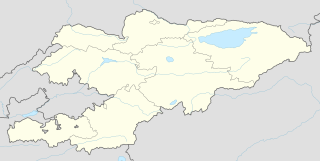
Kyrgyzstan is a landlocked nation in Central Asia, west of the People's Republic of China. Less than a seventh the size of Mongolia, at 199,951 square kilometers, Kyrgyzstan is one of the smaller Central Asian states. The national territory extends about 900 km (560 mi) from east to west and 410 km (250 mi) from north to south.

A nature reserve is a protected area of importance for flora, fauna, or features of geological or other special interest, which is reserved and managed for purposes of conservation and to provide special opportunities for study or research. They may be designated by government institutions in some countries, or by private landowners, such as charities and research institutions. Nature reserves fall into different IUCN categories depending on the level of protection afforded by local laws. Normally it is more strictly protected than a nature park. Various jurisdictions may use other terminology, such as ecological protection area or private protected area in legislation and in official titles of the reserves.
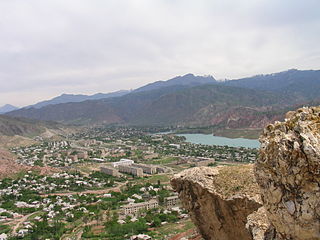
Jalal-Abad Region, also known as Jalalabat, is a region (oblast) of Kyrgyzstan. Its capital is the city of the same name, Jalal-Abad. It is surrounded by Talas Region, Chuy Region, Naryn Region, Osh Region, and Uzbekistan. Jalal-Abad Region was established on 21 November 1939. On 27 January 1959 it became a part of Osh Region, but regained its old status as a region on 14 December 1990. Jalal-Abad Region consist of 8 districts, and includes 5 towns, 8 urba-type settlements, and 415 villages
Ontario Parks is the Ontario government agency in Ontario, Canada, that protects significant natural and cultural resources in a system of parks and protected areas that is sustainable and provides opportunities for inspiration, enjoyment and education. The Ontario Parks system covers over 78,000 square kilometres (30,000 sq mi), which is about 10 percent of the province's surface area or the equivalent of an area approximately equal to Nova Scotia. It falls under the responsibility and mandate of the province's Ministry of the Environment, Conservation and Parks. It was formerly under the mandate of the Ministry of Natural Resources and Forestry.

The wildlife of Burundi is composed of its flora and fauna. The small, landlocked country is home to 2,950 species of plants, 596 birds, 163 species of vertebrates, 52 species of reptiles, 56 species of amphibians, and 215 fish species. The wildlife has been drastically reduced in recent years, mainly on account of intense population pressure, conversion of large areas of forest into agricultural land, and extensive livestock farming. The protected area encompasses little more than 5% of the total area of the country.

The snow leopard, also known as the ounce, is a felid in the genus Panthera native to the mountain ranges of Central and South Asia. It is listed as Vulnerable on the IUCN Red List because the global population is estimated to number fewer than 10,000 mature individuals and is expected to decline about 10% by 2040. It is threatened by poaching and habitat destruction following infrastructural developments. It inhabits alpine and subalpine zones at elevations from 3,000 to 4,500 m, ranging from eastern Afghanistan, the Himalayas and the Tibetan Plateau, to southern Siberia, Mongolia and western China. In the northern part of its range, it also lives at lower elevations.
Ala-Buka a village which is the capital of Ala-Buka District of Jalal-Abad Region, Kyrgyzstan. Its population was 10,813 in 2009.
Protected areas of Indonesia comprise both terrestrial and marine environments in any of the six IUCN Protected Area categories. There are over 500 protected areas in Indonesia, of which 54 National Park are covering 16.4 million ha, and another 527 nature and game reserves cover further 28.3 million ha. The total protected land area represents over 15% of Indonesia's landmass. Marine Protected Areas comprise over 15.7 million ha representing ca. 5% of territorial waters.
Beshtash Nature Park is a nature park in Talas Region, Kyrgyzstan. located 13 km from the city of Talas. Established in 1996, it occupies 13,650 hectares including 5557 hectares of strictly protected area, 2257 hectares of area for regulated recreational use, and 5836 hectares of area for regulated economic activity It surrounds the Besh Tash River.
The Surmatash Nature Reserve is located in Kadamjay District of Batken Province of Kyrgyzstan. It was established in 2009 with a purpose of conservation of unique nature complexes and biological diversity, protection of rare and threatened species of flora and fauna, and extending network of specially protected nature areas.
The Protected areas of Kyrgyzstan cover 1,476,121.6 hectares and account for 7.38% of the country's total area (2017). The first protected area in Kyrgyzstan was established in 1948. According to the Government Decree on Priorities of Conservation of Biological Diversity and the relevant Action Plan for 2014-2024 the target area for the protected areas in Kyrgyzstan is 10 percent of the country’s area by 2024.
The Sarychat-Ertash State Nature Reserve is located in Issyk-Kul Region of Kyrgyzstan. It was established in 1995 with a purpose of conservation of unique nature complexes, rare and threatened species of flora and fauna of syrt area of Issyk-Kul Region, and maintaining regional environmental balance. The reserve currently occupies 134,140 hectares including 72,080 hectares of core area.
The Protected Areas of the Azores are the basic administrative-territorial and conservation structures in the archipelago of the Azores and the surrounding oceans. The areas integrate the entirety of the Azores within its Exclusive Economic Zone, as well as the surrounding waters, under the international agreements and conventions. The network realizes the categorization of management for protected areas adopted by the International Union for Conservation of Nature (IUCN), adapting it to the specific geographical, environmental, cultural and political-administrative territory of the archipelago.

Many parts of Scotland are protected in accordance with a number of national and international designations because of their environmental, historical or cultural value. Protected areas can be divided according to the type of resource which each seeks to protect. NatureScot has various roles in the delivery of many environmental designations in Scotland, i.e. those aimed at protecting flora and fauna, scenic qualities and geological features. Historic Environment Scotland is responsible for designations that protect sites of historic and cultural importance. Some international designations, such as World Heritage Sites, can cover both categories of site.
The Mountain Aygul-Tash Botanical Reserve is located in Batken District of Batken Province of Kyrgyzstan. It was established in 2009 with a purpose of conservation of unique nature complexes and biodiversity of Kyrgyzstan.
Alatay State Nature Park is a park in Toktogul District of Jalal-Abad Region of Kyrgyzstan established in January 2016. The purpose of the park is conservation of the unique natural complexes and biodiversity, protection of rare and endangered flora and fauna, and extension of network of specially protected areas of Kyrgyz Republic. The area of the park is 56,826.4 hectares.
Karakol State Nature Park is a park in Ak-Suu District of Issyk-Kul Region of Kyrgyzstan established in April 1997. The purpose of the park is conservation of the unique nature complexes, forests, and flora and fauna of special ecological and aesthetic value for beneficial combination of natural and cultural landscapes and their use for recreational, cultural and educational purposes. The area of the park is 38,256 hectares including 7,690 hectares of forests. The park is located in 6 km from the regional center Karakol and in 336 km from Bishkek.
Protected Forests are areas of national forest in Japan so designated in an effort to conserve biodiversity. Japan's Protected Forest system includes three categories of protected forests: Forest Biosphere Reserves; Biotic Community Protection Forests; and Rare Population Protection Forests. Some of these national forests are linked by a network of Green Corridors that are also included in the system. Established in 1915, the system was overhauled in 2015 and expanded in 2019.


