Bremen state election, 2007

Last updated
Coat of Arms of Germany.svg
This article is part of a series on the
politics and government of
Germany
Foreign relations

State elections were held in the Free Hanseatic City of Bremen on 13 May 2007 to elect the Bürgerschaft (city and state legislature).
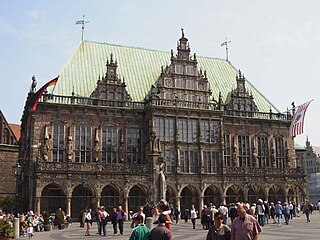
Bremen (state) State in Germany

Bremen, officially the Free Hanseatic City of Bremen, is the smallest and least populous of Germany's 16 states. A more informal name, but used in some official contexts, is Land Bremen.
Bürgerschaft of Bremen parliament of the state of Bremen, Germany

The Bremische Bürgerschaft is the legislative branch of the Free Hanseatic City of Bremen in Germany. The state parliament elects the members of the Senate (executive), exercises oversight of the executive, and passes legislation. It currently consists of 83 members from eight parties. The current majority is a coalition of the Social Democratic Party and the Alliance '90/The Greens, supporting Mayor and Senate president Carsten Sieling. The 68 delegates of the city of Bremen also form the Stadtbürgerschaft, while Bremerhaven has its own local parliament.

After the elections, Jens Böhrnsen, the SPD prime minister, was able to pick his future coalition partner. He could either continue the grand coalition with the CDU (since 1995) or form a red-green coalition (SPD and Greens). Chancellor Angela Merkel (CDU) was said to be annoyed that Böhrnsen hadn't opted for either a grand coalition or a red-green coalition before the election; she claimed that he "had to say how it should go on" with Bremen. [ permanent dead link ]. This election is thought to be a landmark for The Left Party.PDS since it is their first success on state level in the former West. Negotiations on a red-green government began after the elections and were successfully concluded on 16 June 2007, resulting in the first red-green state government since the red-green coalition ended on the federal level.

Jens Böhrnsen German politician (SPD) and mayor of Bremen (2005-)

Jens Böhrnsen is a German politician of the SPD. From 2005 to 2015, he has served as the President of the Senate and Mayor of the Free Hanseatic City of Bremen, that is, the head of government of the city-state Free Hanseatic City of Bremen. From 1 November 2009 until 31 October 2010 he was President of the Bundesrat and ex officio deputy to the President of Germany. Because of that he was acting head of state of Germany after the resignation of President Horst Köhler on 31 May 2010 and before the election of Christian Wulff as Köhler's successor on 30 June 2010. After voting for the SPD losses of more than five percentage points in the state election on May 10, 2015 Böhrnsen declared the next day that he would retire as head of government. His successor in the office of the Bremen government was Carsten Sieling, who was officially nominated on 18 May 2015 by the Bremen SPD.
West Germany Federal Republic of Germany in the years 1949–1990

West Germany, officially the Federal Republic of Germany, was a country in Central Europe that existed from 1949 to 1990, when the western portion of Germany was part of the Western bloc during the Cold War. It was created during the Allied occupation of Germany in 1949 after World War II, established from eleven states formed in the three Allied zones of occupation held by the United States, the United Kingdom and France. Its capital was the city of Bonn.

Results

Party Votes % +/– Seats +/– %
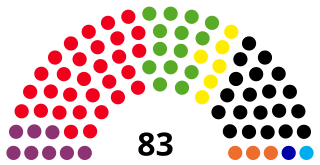
Social Democratic Party (SPD) 36.8% –5,5 33 –7 39.8%
Christian Democratic Union (CDU) 25.7% –4,1 23 –6 27.7%
Alliance '90/The Greens 16.4% +3,6 14 +2 16.9%
The Left Party.PDS 8.4% +6,7 7 +7 8.4%
Free Democratic Party (FDP) 6.0% +1,8 5 +4 6.0%
German People's Union (DVU) 2.7% +0,4 1 ±0 1.2%
Others 4.0% +1,4 0 ±0 0.0%
Totals 100.0% 83 100.0%

Related Research Articles

Free Democratic Party (Germany) political party in Germany

The Free Democratic Party is a liberal and classical liberal political party in Germany. The FDP is led by Christian Lindner.

Politics of Germany political system

Germany is a democratic, federal parliamentary republic, where federal legislative power is vested in the Bundestag and the Bundesrat.

Christian Democratic Union of Germany political party in Germany

The Christian Democratic Union of Germany is a Christian democratic and liberal-conservative political party in Germany. It is the major catch-all party of the centre-right in German politics. The CDU forms the CDU/CSU grouping, also known as the Union, in the Bundestag with its Bavarian counterpart the Christian Social Union in Bavaria (CSU). The party is widely considered an effective successor of the Centre Party, although it has a broader base.

1998 German federal election

Federal elections were held in Germany on 27 September 1998 to elect the members of the 14th Bundestag. The Social Democratic Party emerged as the largest faction in parliament, with its leader Gerhard Schröder becoming Chancellor.

Berlin state election, 2001 election

The Berlin state election, 2001, was conducted on 21 October 2001, to elect members to the Abgeordnetenhaus of Berlin.

2005 German federal election

Federal elections were held in Germany on 18 September 2005 to elect the members of the 16th Bundestag. This became necessary after a motion of confidence in Chancellor Gerhard Schröder failed on 1 July. Following the defeat of Schröder's Social Democratic Party (SPD) in a state election, Schröder asked his supporters to abstain from the Bundestag motion, knowing the motion would fail and thus triggering an early federal election.

Jamaica coalition (politics) German political term

Jamaica coalition is a term in German politics describing a coalition among the parties of the Christian Democratic Union/Christian Social Union (CDU/CSU), Free Democratic Party (FDP), and the Green Party.

Traffic light coalition

Traffic light coalition is a term originating in German politics where it describes a coalition government of the Social Democratic Party of Germany (SPD), the Free Democratic Party (FDP), and the Greens. It arises from the fact that the parties' traditional colours, respectively red, yellow, and green, resemble the normal colour sequence of a traffic light (Ampel). It has subsequently been used to describe similar coalitions between social democrats, liberals, and greens in other countries.

The state election to elect members of the Landtag of Hesse was held in the German state of Hesse on 27 January 2008.

The Politics of Schleswig-Holstein takes place within a framework of a federal parliamentary representative democratic republic, where the Federal Government of Germany exercises sovereign rights with certain powers reserved to the states of Germany including Schleswig-Holstein. The state has a multi-party system where the two main parties are the rightist Christian Democratic Union (CDU) and the leftist Social Democratic Party of Germany (SPD). The South Schleswig Voter Federation is a small political party present only in this state that represents the Danish and Frisian minorities.

Landtag of Hesse legislature of the state of Hesse, Germany

The Landtag of Hesse is the Parliament of the State of Hesse in the Federal Republic of Germany. It convenes in the Stadtschloss, Wiesbaden. As a Legislature it is responsible for passing laws at the state level and enacting the budget. Its most important function is to elect and control the state government. The constitution of the State of Hesse describes the role of the Landtag in §§ 75 to 99.

Early state elections for the Landtag of Hesse were held in Hesse on 18 January 2009. The reason for the early elections was the inability of the parties to form a government after the inconclusive 2008 Hessian election.

In modern Germany with its parliamentary system of government on federal and on state level, grand coalition describes a governing coalition of the two biggest parties in one parliament. In most cases this means a coalition of the Union and the Social Democrats (SPD).

2010 North Rhine-Westphalia state election election

The North Rhine-Westphalia state election, 2010, was an election held on 9 May 2010, to elect members to the Landtag of the German state of North Rhine-Westphalia. The incumbent government at the election was the Christian Democrat (CDU)–FDP administration of Minister-President Jürgen Rüttgers. The biggest opposition party was the Social Democratic Party, led by Hannelore Kraft since 2005.

The last Berlin state election was held on 18 September 2011, to elect members to the Abgeordnetenhaus of Berlin. All 141 seats were up for election. Berlin was governed by a coalition between the Social Democratic Party and The Left at the time. Current mayor Klaus Wowereit was the favourite heading into Sunday's election.

An election to the Landtag of Thuringia was held on 14 September 2014. The incumbent government was a CDU-SPD grand coalition led by Minister-President Christine Lieberknecht. After the election, the CDU-SPD coalition continued to have a majority in the Landtag, however only barely with just 46 seats or a majority of 1. The SPD, who were disappointed with their performance, considered becoming the junior partners in a Left-SPD-Green coalition; this again would only hold 46 seats and a majority of 1 in the Landtag.

2015 Bremen state election

A Bremen state election were held on 10 May 2015, to elect the Bürgerschaft as well as the Bremische Stadtbürgerschaft and the Stadtverordnetenversammlung Bremerhaven.