CL Bay 06b

Last updated
CL Bay 06b
CL Bay 06b.tif
Lightweight open coach (Sheet 570)
Stock type Open coach with open end-platforms
Manufacturer Waggonfabrik Josef Rathgeber
Constructed1906–1909
Retiredto 1961
Number built74
Design codeCL
Fleet numbers20 048 to 20 071
Specifications
Car length
  • 5,850 mm (19 ft 2+38 in) over body
  • 7,610 mm (24 ft 11+58 in) over headstocks
  • 8,834 mm (28 ft 11+34 in) over buffers
Width3,100 mm (10 ft 2 in)
Height3,557 mm (11 ft 8 in)
Wheelbase 5,000 mm (16 ft 4+78 in)
Weight8.1–8.4 t (8.0–8.3 long tons; 8.9–9.3 short tons) tare
Braking system(s) Screw brake / Westinghouse
Coupling system VDEV screw couplings
Seating31 Third class
Track gauge 1,435 mm (4 ft 8+12 in)

The Bavarian CL Bay 06b was a short open coach for branch line services with the Royal Bavarian State Railways (k.Bay.Sts.B.). It was listed in their 1913 fleet register under Design Sheet No. 570.

Contents

Development

With the growth of the branch line network in the Kingdom of Bavaria, there was a need for suitable coaches on the so-called Lokalbahnen or local railway lines. Since the only available locomotives were tank engines with low tractive power, such as the Class PtL 2/2, passenger coaches of a particularly light design were required. These coaches were not suitable for military transport.

Procurement

Between 1905 and 1911 a total of 281 [1] [2] wagons of classes BL, BCL, CL and PPostL were procured, all of which - except for the wagons of Class PPostL - had a uniform floor plan, open platforms at each end with Dixi gates on the steps and gangways only protected by a single iron railing. Large window panes were fitted instead of the composite windows that had been usual up to that point. They are sometimes referred to as 'the shorts' or 'the short ones' (Die Kurze).

Between 1906 and 1909, 74 of these wagons, built to the specifications of Design Sheet 570, were procured in a total of five batches from the company of Waggonfabrik Josef Rathgeber in Munich. In contrast to the CL based on Sheet 569, these had a service compartment for the guard.

Career

Four coaches were retired by 1939. After the end of the Second World War in 1945, the location of other new coaches could no longer be ascertained. Of the vehicles delivered, 51 entered DB service, where they were decommissioned by 1960.

Design features

Underframe

The underframe of the coach was made entirely of rivetted structural steel. The outer longitudinal beams were U-shaped with outward facing flanges. The crossbeams were also made of U-profiles and not cranked. The wagons had screw couplings of VDEV design. The drawbar ran the length of the vehicle and was spring-loaded in the middle. As buffing equipment, the wagons had slotted cylindrical buffers with an installation length of 612 millimetres, the buffer plates had a diameter of 370 millimetres.

Running gear

The coaches had riveted half-timbered axle boxes of the short type, made of sheet steel. The axles were housed in sliding axle bearings. The wheels were spoked. Due to the long wheelbase of 5,000 millimetres, standard VDEV radial axles were used. In addition to a screw brake, which was located on one of the platforms at the end of the coach, the coaches also had air brakes of the Westinghouse system.

Body

The frame of the coach body consisted of wooden posts. This was covered with sheet metal on the outside and wood on the inside. The joints of the sheets were covered by cover strips. The roof was gently rounded and extended beyond the open end-platforms. The coaches had folding branch line steps, which were later replaced by normal ones.

Facilities

The coach was 3rd class only and had a total of 31 seats and a toilet. A total of 20 standing places were designated for the two end-platforms. The coaches were lit by paraffin lamps and had steam heating. They were ventilated by static ceiling ventilators.

Coach numbering

Manufacturing dataCoach numbers [3] by epoch;
coach class
Running gearFacilitiesAdditional information
Year
built
Manu-
facturer
Qty.from 1875from 1909
(1907)
Rep.
(1919)
DR
(from 1923)
DRG
(from 1930)
DRG
post-rebuild
RetiredBrakesNo. of
axles
Radial
axle
Ltg.Htg.No. of
toilets
No. of seats by classSign
holders
Remarks
Design Sheet No. 570CLCL Bay 06bCL Bay 06b(see
legend)
(see
legend)
1st2nd3rd4th(see
legend)
1906 Rathg. 820 6559 301 Reg9 573 Reg03/1954Pl, Wsbr2VPD131
20 6569 302 Reg9 574 Reg07/1957
20 6579 303 Reg9 575 Reg06/1950Unserviceable (Altschadwagen)
20 6589 304 Reg9 576 Reg10/1954
20 6599 305 Reg9 577 Reg08/1951Unserviceable (Altschadwagen)
20 6609 306 Reg9 578 Reg10/1958
20 6619 307 Reg9 579 Regxx/193x
20 6629 308 Reg9 580 Reg09/1954
1907 Rathg. 1820 6639 327 Nür9 653 Nür03/1947Pl, Wsbr2VPD131Unserviceable (Altschadwagen)
20 6649 328 Nür9 654 Nür02/1957
20 6659 329 Nür9 655 Nür12/1957
20 6669 330 Nür9 656 Nür10/1951Unserviceable (Altschadwagen)
20 6679 331 Nür9 657 Nür10/1954
20 6689 332 Nür9 658 Nür09/1958
20 6699 248 Mü9 631 Mü01/1960
20 6709 249 Mü9 632 Mü03/1960
20 6719 327 Nür9 653 Nür09/1951Unserviceable (Altschadwagen)
20 6729 251 Mü9 634 Mü05/1959
20 6739 252 Mü9 635 Mü03/1956
20 6749 234 Au9 629 Au07/1955
20 6759 235 Au9 630 Au02/1959
20 6769 333 Nür9 659 Nür07/1960
20 6779 334 Nür9 660 Nür ? 1945
20 6789 335 Nür9 661 Nür06/1950Unserviceable (Altschadwagen)
20 6799 336 Nür9 662 Nür07/1950Unserviceable (Altschadwagen)
20 6809 337 Nür9 663 Nür11/1957
1909 Rathg. 1220 7399 352 Nür9 800 Nür09/1962Pl, Wsbr2VPD131
20 7409 353 Nür9 812 Reg03/1954
20 7419 354 Nür9 813 Reg11/1950
20 7429 236 Wür9 801 Nür10/1955
20 7439 237 Wür9 802 Nür05/1942
20 7449 277 Mü9 789 Mü06/1951Unserviceable (Altschadwagen)
20 7459 278 Mü9 790 Mü02/1953
20 7469 238 Au9 699 Au04/1956
20 7479 239 Au9 700 Au08/1962
20 7489 279 Mü9 727 Mü03/1959
20 7499 280 Mü9 728 Mü ? 1945
20 7509 281 Mü9 729 Mü ? 1945
1909 Rathg. 320 7809 366 Nür9 809 Nür ? 1945Pl, Wsbr2VPD131
20 7819 367 Nür9 810 Nür12/1956
20 7829 368 Nür9 811 Nür01/1957
Legend: brakes (Br.)Manual brake typesBrH = brakeman's cabin, Pl = manual brake on the platform, Fsbr = Freisitzbremse
Air brakesHnbr = Henri brake, Hsbr = Henri rapid-acting brake, Kp. = Knorr brake, Sbr. = Schleifer brake, Ssbr = Schleifer rapid-acting brake, Wbr = Westinghouse brake, Wsbr = Westinghouse rapid-acting brake
Vacuum brakesHbr = Hardy brake, Ahbr = Automatic Hardy vacuum brake
Legend: lighting (Ltg.)Types of lightingP = paraffin lamps, G = gas lamps, Gg = gas mantle lamps, El = electric lights
Legend: heatingTypes of heatingO = stove heating, D = steam heating, Pr. = briquette heating, L = only steam heating
Legend: sign holdersfor crossing intoAT = Austria, IT = Italy, CH = Switzerland, FR = France, BE = Belgium

See also

The following coaches were also built for the Lokalbahn branch line network:

Related Research Articles

<span class="mw-page-title-main">Penistone rail accidents</span> List of rail accidents in Penistone South Yorkshire, England

Over the latter years of the 19th and early years of the 20th centuries, Penistone in Yorkshire gained a name as an accident black-spot on Britain's railway network; indeed, it could be said to hold the title of the worst accident black-spot in the country. The main line through the town was the Woodhead route of the Manchester, Sheffield and Lincolnshire Railway between Sheffield Victoria and Manchester, London Road. The line was heavily graded with a summit some 400 yards inside the eastern portal of the Woodhead tunnel.
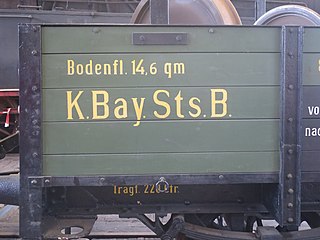
<span class="mw-page-title-main">Royal Bavarian State Railways</span>

The Royal Bavarian State Railways was the state railway company for the Kingdom of Bavaria. It was founded in 1844. The organisation grew into the second largest of the German state railways with a railway network of 8,526 kilometres by the end of the First World War.

<i>Adler</i> (locomotive)

The Adler was the first locomotive that was successfully used commercially for the rail transport of passengers and goods in Germany. The railway vehicle was designed and built in 1835 by the British railway pioneers George and Robert Stephenson in the English city of Newcastle. It was delivered to the Bavarian Ludwig Railway for service between Nuremberg and Fürth. It ran officially for the first time there on 7 December 1835. The Adler was a steam locomotive of the Patentee type with a wheel arrangement of 2-2-2 or 1A1. The Adler was equipped with a tender of type 2 T 2. It had a sister locomotive, the Pfeil.

<span class="mw-page-title-main">Bavarian branch lines</span> Railway lines in Bavaria

Bavarian branch lines comprised nearly half the total railway network in Bavaria, a state in the southeastern Germany that was a kingdom in the days of the German Empire. The construction era for branch lines lasted from 1872, when the first route, from Siegelsdorf to Langenzenn, was opened, to 1930, when the last section of the branch from Gößweinstein to Behringersmühle went operational.

<span class="mw-page-title-main">Einheitsdampflokomotive</span>

The Einheitsdampflokomotiven, sometimes shortened to Einheitslokomotiven or Einheitsloks, were the standardized steam locomotives built in Germany after 1925 under the direction of the Deutsche Reichsbahn-Gesellschaft. Their manufacture made extensive use of standard design features and components.

<i>Verbandsbauart</i> Goods wagon

The German term Verbandsbauart describes both a type of goods wagon as well as a type of tram.

The so-called Austauschbauart wagons were German railway vehicles produced from the late 1920s onwards which had common components built to agreed standards.

<span class="mw-page-title-main">Bavarian Forest Railway</span>

The Bavarian Forest Railway links the heart of the Bavarian Forest around Regen and Zwiesel to Plattling and the Danube valley on one side, and the Czech Republic through Bayerisch Eisenstein on the other. In the Danube valley it forms a junction with the Nuremberg–Regensburg–Passau long-distance railway and, to the south, regional lines to Landshut and Munich.
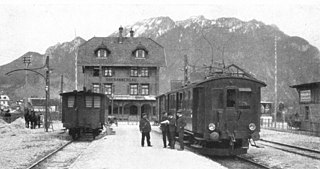
<i>Lokalbahn</i>

A Lokalbahn or Localbahn is a secondary railway line worked by local trains serving rural areas, typically in Austria and the south German states of Bavaria and Baden-Württemberg. Lokalbahnen appeared at the end of the 19th century before the use of cars became widespread.

<span class="mw-page-title-main">Umbau-Wagen</span> Railway coach

The Umbau-Wagen or Umbauwagen was a type of German railway passenger coach operated by the Deutsche Bundesbahn (DB) which appeared in the mid-1950s. The name means "rebuild coach" and they were made by rebuilding or converting former state railway (Länderbahn) compartment coaches, many of which were over 30 years old.

<span class="mw-page-title-main">Compartment coach</span> Railway carriage type

A compartment coach is a railway passenger coach divided into separate areas or compartments, with no means of moving between compartments.

A corridor coach is a type of railway passenger coach divided into compartments and having a corridor down one side of the coach to allow free movement along the train and between compartments.
<span class="mw-page-title-main">South African Clayton Railmotor</span>

The South African Railways Clayton Railmotor of 1929 was a steam railmotor.

<span class="mw-page-title-main">PwPost Bay 06</span> Class of German railway coach

The PwPost Bay 06 was a combined mail and luggage van designed for Lokalbahn branch line train services with the Royal Bavarian State Railways in the early 20th century. It was built to their Design Sheet Number 606.

The GwL class vans of the Royal Bavarian State Railways were goods vans built for branch lines in the Kingdom of Bavaria in the late 19th and early 20th centuries.

<span class="mw-page-title-main">CL Bay 11a</span>

The CL Bay 11a and CL Bay 14a were a class of open coach built for the Bavarian branch lines (Lokalbahn in the early 20th century. They were listed under Design Sheet 554 in the 1913 Fleet Register of the Royal Bavarian State Railways. In the engineering register of the Deutsche Reichsbahn they were listed as the Class CL Bay 14II under Sheet No. 6056.3.

<span class="mw-page-title-main">BCL Bay 09</span>

The Class BCL Bay 09 were open coaches for branch line services with the Royal Bavarian State Railways (K.Bay.Sts.B.) that were built in the early 20th century. They included those coaches listed in the 1913 fleet register under design sheet nos. 521, 6055.2 and 6055.3. As a result of remodelling they were reclassified according to the DRG’s 1930 engineering drawing register as classes CL Bay 09/21, BCL Bay 13a, CL Bay 13a/21, BCL Bay 14 and CL Bay 14/21.

References

  1. Konrad, Reisezugwagen der deutschen Länderbahnen, page 23.
  2. See also Sheet no. 499, 523, 568, 569, 570, 605 and 606 of the 1913 Bavarian railway fleet register
  3. The data is taken from the coach fleet registers of the Royal Bavarian State Railways as at the 31 March 1897 and 1913 respectively

Literature