
Brake van and guard's van are terms used mainly in the UK, Ireland, Australia and India for a railway vehicle equipped with a hand brake which can be applied by the guard. The equivalent North American term is caboose, but a British brake van and a caboose are very different in appearance, because the former usually has only four wheels, while the latter usually has bogies. German railways employed brakeman's cabins combined into other cars.
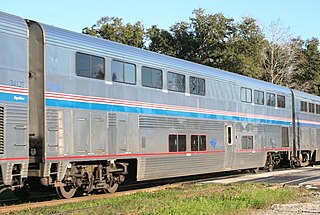
A passenger railroad car or passenger car, also called a passenger carriage, passenger coach, or passenger bogie is a railroad car that is designed to carry passengers. The term passenger car can also be associated with a sleeping car, a baggage car, a dining car, railway post office and prisoner transport cars.

The GM "Buffalo" bus is a colloquial term referring to several models of intercity motorcoaches built by the GM Truck and Coach Division at Pontiac, Michigan, between 1966 and 1980. "Buffalo" coaches have a stepped roof in front, and the first three rows of seats are at different levels, mounted on stepped floors resembling some types of theater seating.

Bavarian branch lines comprised nearly half the total railway network in Bavaria, a state in the southeastern Germany that was a kingdom in the days of the German Empire. The construction era for branch lines lasted from 1872, when the first route, from Siegelsdorf to Langenzenn, was opened, to 1930, when the last section of the branch from Gößweinstein to Behringersmühle went operational.

The Einheitsdampflokomotiven, sometimes shortened to Einheitslokomotiven or Einheitsloks, were the standardized steam locomotives built in Germany after 1925 under the direction of the Deutsche Reichsbahn-Gesellschaft. Their manufacture made extensive use of standard design features and components.

The German term Verbandsbauart describes both a type of goods wagon as well as a type of tram.
The so-called Austauschbauart wagons were German railway vehicles produced from the late 1920s onwards which had common components built to agreed standards.
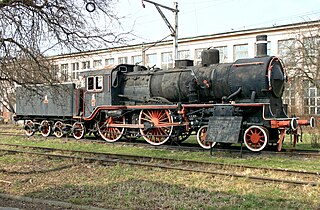
The Prussian S 6 was a class of German steam locomotive with a 4-4-0 wheel arrangement operated by the Prussian state railways for express train services.
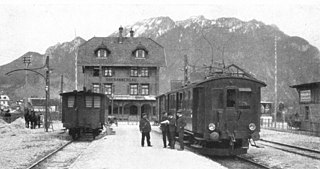
A Lokalbahn or Localbahn is a secondary railway line worked by local trains serving rural areas, typically in Austria and the south German states of Bavaria and Baden-Württemberg. Lokalbahnen appeared at the end of the 19th century before the use of cars became widespread.

The Umbau-Wagen or Umbauwagen was a type of German railway passenger coach operated by the Deutsche Bundesbahn (DB) which appeared in the mid-1950s. The name means "rebuild coach" and they were made by rebuilding or converting former state railway (Länderbahn) compartment coaches, many of which were over 30 years old.

A compartment coach is a railway passenger coach divided into separate areas or compartments, with no means of moving between compartments.

The Natal Government Railways Class K 2-6-0T of 1877 was a South African steam locomotive from the pre-Union era in the Natal Colony.
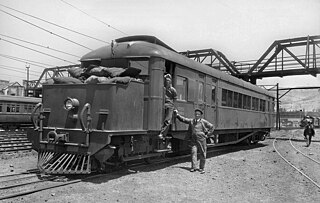
The South African Railways Clayton Railmotor of 1929 was a steam railmotor.

The Elmshorn–Bad Oldesloe railway is a regional railway line that has existed since 1896 in the south of the German state of Schleswig-Holstein. It has been operated since 1981 by the AKN Eisenbahn.

The Passenger Rail Agency of South Africa Class Afro 4000 of 2014 is a South African diesel-electric locomotive.

The PL type carriages were a series of 141 wooden passenger carriages used on the railways of Victoria, Australia. They consisted of the first class APL, second class BPL and combination second and guard's van, BCPL's.
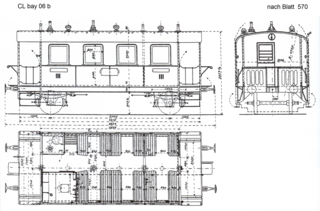
The Bavarian CL Bay 06b was a short open coach for branch line services with the Royal Bavarian State Railways (k.Bay.Sts.B.). It was listed in their 1913 fleet register under Design Sheet No. 570.

The PwPost Bay 06 was a combined mail and luggage van designed for Lokalbahn branch line train services with the Royal Bavarian State Railways in the early 20th century. It was built to their Design Sheet Number 606.
The GwL class vans of the Royal Bavarian State Railways were goods vans built for branch lines in the Kingdom of Bavaria in the late 19th and early 20th centuries.

The Class BCL Bay 09 were open coaches for branch line services with the Royal Bavarian State Railways (K.Bay.Sts.B.) that were built in the early 20th century. They included those coaches listed in the 1913 fleet register under design sheet nos. 521, 6055.2 and 6055.3. As a result of remodelling they were reclassified according to the DRG’s 1930 engineering drawing register as classes CL Bay 09/21, BCL Bay 13a, CL Bay 13a/21, BCL Bay 14 and CL Bay 14/21.


