Related Research Articles
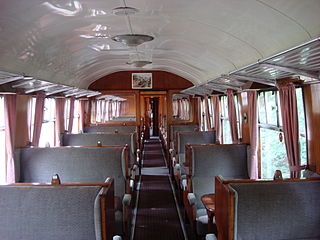
British Rail Mark 1 is the family designation for the first standardised designs of railway carriages built by British Railways (BR) from 1951 until 1974, now used only for charter services on the main lines or on preserved railways.
The Lancashire and Yorkshire Railway (LYR) built suburban electric stock for lines in Liverpool and Manchester. The line between Liverpool to Southport began using electric multiple units (EMUs) on 22 March 1904, using a third rail 625 V DC. Additional trains were later built for this route, and in 1913 incompatible stock for the route to Ormskirk. Lightweight units were built to run on the Liverpool Overhead Railway.
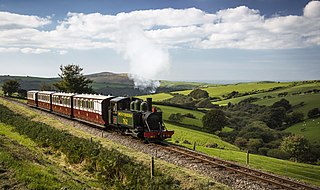
The Lynton and Barnstaple Railway (L&B) opened as an independent railway in May 1898. It was a single track, 1 ft 11+1⁄2 in narrow gauge railway and was slightly over 19 miles (31 km) long running through the rugged and picturesque area bordering Exmoor in North Devon, England. Although opened after the Light Railways Act 1896 came into force, it was authorised and constructed prior to that act. Therefore, as with all other railways, it was authorised under its own Act of Parliament and built to higher standards than similar railways of the time. In the United Kingdom it was notable as being the only narrow gauge line required to use main-line standard signalling. For a short period the line earned a modest return for shareholders, but for most of its life the L&B made a loss. In 1923, the L&B was taken over by the Southern Railway, and eventually closed in September 1935.
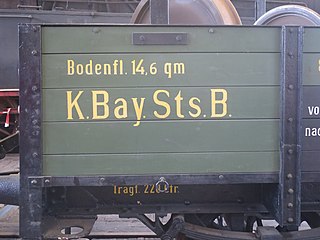
The Royal Bavarian State Railways was the state railway company for the Kingdom of Bavaria. It was founded in 1844. The organisation grew into the second largest of the German state railways with a railway network of 8,526 kilometres by the end of the First World War.
The Lokalbahn AG company, or 'LAG' for short, was a private company based in Munich, Bavaria, whose lines of business was the construction and operation of branch lines in Germany and Austria-Hungary. It existed from 1887 to 1938.
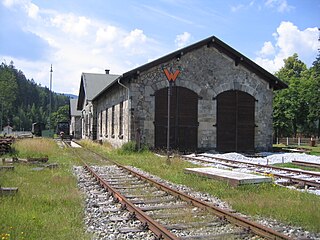
The Bavarian Localbahn Society, with its headquarters in Tegernsee, is a society that is concerned with the history of the railways in Bavaria. Localbahn means 'branch line' and is mainly used in southern Germany and Austria in lieu of the usual term Nebenbahn. The BLV's objectives are the operation of historic trains and the collection of historically valuable railway items from Bavaria.

Bavarian branch lines comprised nearly half the total railway network in Bavaria, a state in the southeastern Germany that was a kingdom in the days of the German Empire. The construction era for branch lines lasted from 1872, when the first route, from Siegelsdorf to Langenzenn, was opened, to 1930, when the last section of the branch from Gößweinstein to Behringersmühle went operational.
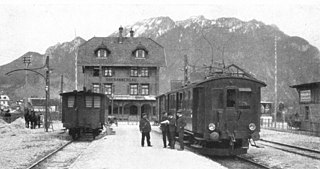
A Lokalbahn or Localbahn is a secondary railway line worked by local trains serving rural areas, typically in Austria and the south German states of Bavaria and Baden-Württemberg. Lokalbahnen appeared at the end of the 19th century before the use of cars became widespread.

The Passau–Neumarkt-Sankt Veit railway or Rott Valley Railway (Rottalbahn) is a single-tracked, unelectrified branch line in southeastern Bavaria in Germany. At 98 kilometres it is the longest branch line in Bavaria.

The Landshut–Rottenburg railway was a German branch line in the southern state of Bavaria. It was a stub line, about 27.5 kilometres long, from Landshut to Rottenburg an der Laaber, and was known by the locals as the Rottenburger Bockerl. Although the line is now closed, there is a plan to establish a museum railway on the remaining section from Landshut to Unterneuhausen.

The Ammergau Railway or Ammergaubahn is a single-tracked, electrified railway line in Bavaria in southern Germany. It runs from Murnau to Oberammergau, its latter stages following the valley of the river Ammer from which it derives its name. This stub line to Oberammergau branches off at Murnau from the Munich–Garmisch-Partenkirchen main line.
The Ranna–Auerbach railway was an 8-kilometre long branch line or Lokalbahn in Bavaria in southern Germany, which linked Auerbach in der Oberpfalz via Ranna to the Nuremberg–Cheb railway. It replaced the cable railway built in 1882 from the Maxhütte to Sulzbach-Rosenberg, which until then had transported mineral resources in the region around Auerbach to the railway.

The Vilshofen –Ortenburg railway, also known as the Wolfach Valley Railway, is a branch line or Lokalbahn in the province of Lower Bavaria in southern Germany. It was opened on 16 January 1908 and closed to passenger services on 30 September 1962.
The Falls–Gefrees railway was a German branch line spur in the Fichtel Mountains region of Upper Franconia in northern Bavaria. It ran through an area that is now within the jurisdiction of the town of Gefrees.

The Aufhausen–Kröhstorf railway was a branch line in the province of Lower Bavaria in southern Germany. The entire course of this former railway ran on what is today the municipality of Markt Eichendorf.
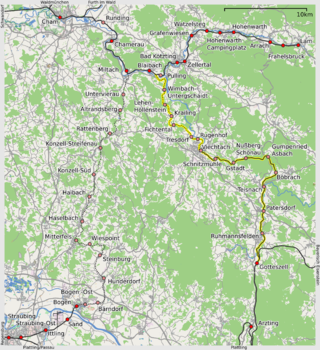
The Gotteszell–Blaibach railway is a railway line in the state of Bavaria in southern Germany that runs from Gotteszell in Lower Bavaria to Blaibach in the Upper Palatinate.
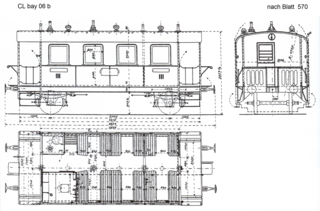
The Bavarian CL Bay 06b was a short open coach for branch line services with the Royal Bavarian State Railways (k.Bay.Sts.B.). It was listed in their 1913 fleet register under Design Sheet No. 570.

The PwPost Bay 06 was a combined mail and luggage van designed for Lokalbahn branch line train services with the Royal Bavarian State Railways in the early 20th century. It was built to their Design Sheet Number 606.

The CL Bay 11a and CL Bay 14a were a class of open coach built for the Bavarian branch lines (Lokalbahn in the early 20th century. They were listed under Design Sheet 554 in the 1913 Fleet Register of the Royal Bavarian State Railways. In the engineering register of the Deutsche Reichsbahn they were listed as the Class CL Bay 14II under Sheet No. 6056.3.

The Class BCL Bay 09 were open coaches for branch line services with the Royal Bavarian State Railways (K.Bay.Sts.B.) that were built in the early 20th century. They included those coaches listed in the 1913 fleet register under design sheet nos. 521, 6055.2 and 6055.3. As a result of remodelling they were reclassified according to the DRG’s 1930 engineering drawing register as classes CL Bay 09/21, BCL Bay 13a, CL Bay 13a/21, BCL Bay 14 and CL Bay 14/21.

