
The brake gangwayed or BG coach is a type of British Railways Mark 1 passenger brake van. It has a guard's compartment in the centre and two large areas either side for storing luggage. They were a very versatile type of coach and could be found all over the British Railways network and some are still in use today - although not in conventional use.
The rolling stock used on the Isle of Man Railway today is entirely original although, from an original total of 75 carriages, the number serviceable dropped as low as 14, but this total is once again increasing as a result of recent rebuilds The 3 ft gauge railway was provided with a variety of stock from different manufacturers over its time, and types of coach were categorised according to a lettering system, with the original four-wheeled coaches being of A, B, C and D types, and so on. The F prefix encompassed all bogie vehicles including conversions from the A-D series. Letters G-M denoted goods stock. N referred to ex-Manx Northern Railway 6 wheel carriages. The types of stock can be summarised as follows:-
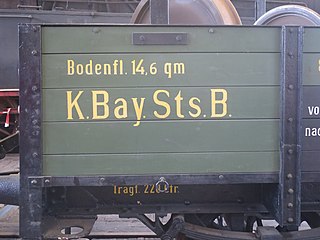
The Royal Bavarian State Railways was the state railway company for the Kingdom of Bavaria. It was founded in 1844. The organisation grew into the second largest of the German state railways with a railway network of 8,526 kilometres by the end of the First World War.

The Class PtL 2/2 locomotives of the Royal Bavarian State Railways were light and very compact superheated steam locomotives for operation on Bavarian branch lines. There were three types in total, of which two were transferred to the Deutsche Reichsbahn-Gesellschaft as Class 98.3 tank locomotives and even survived to join the Deutsche Bundesbahn fleet after the Second World War.

The Bavarian Class GtL 4/4 engines were superheated steam locomotives in service with the Royal Bavarian State Railways for duties on branch lines (Lokalbahnen).

Bavarian branch lines comprised nearly half the total railway network in Bavaria, a state in the southeastern Germany that was a kingdom in the days of the German Empire. The construction era for branch lines lasted from 1872, when the first route, from Siegelsdorf to Langenzenn, was opened, to 1930, when the last section of the branch from Gößweinstein to Behringersmühle went operational.

The German term Verbandsbauart describes both a type of goods wagon as well as a type of tram.
The steam railbuses of Bavarian Class MCCi were built between 1906–1908 for the Royal Bavarian State Railways for suburban services in the Munich area. Seven units were produced, the coach bodies being manufactured by MAN and the engines by Maffei.

The DRG Class ET 85 was a German electric motor coach with the Deutsche Reichsbahn and, later, the Deutsche Bundesbahn.
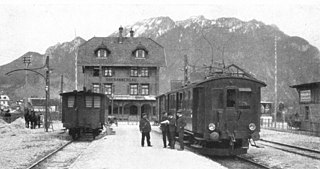
A Lokalbahn or Localbahn is a secondary railway line worked by local trains serving rural areas, typically in Austria and the south German states of Bavaria and Baden-Württemberg. Lokalbahnen appeared at the end of the 19th century before the use of cars became widespread.

The Umbau-Wagen or Umbauwagen was a type of German railway passenger coach operated by the Deutsche Bundesbahn (DB) which appeared in the mid-1950s. The name means "rebuild coach" and they were made by rebuilding or converting former state railway (Länderbahn) compartment coaches, many of which were over 30 years old.

A compartment coach is a railway passenger coach divided into separate areas or compartments, with no means of moving between compartments.
Railway coaches are classified under an international system developed by the UIC. This UIC classification of railway coaches replaced earlier national classification schemes in many countries, such as Germany. The coach class is expressed as a combination of letters. It is sometimes followed, for example in the Deutsche Bahn AG, by a three-figure class number. In a broader sense the vehicle number displayed on the coach is also part of its classification, because it encodes other technical details such as the top speed or the type of heating system used.
The UIC type X, Y and Z coaches are passenger coaches for international railway services that have been standardised in certain respects by the International Union of Railways.

The electric passenger train locomotives of Bavarian Class EP 3/5 were the first electric locomotives designed for single-phase AC, 15 kV, 16+2⁄3 Hz working for the Royal Bavarian State Railways. The first electrical services in Bavaria were on the Murnau–Oberammergau line using 5 kV and 16 Hz on 1 January 1905. After 1918 they were reclassified as EP1 20 001 – 005 and taken over by the DR as E 62 01 – 05.

The Southern Railway Maunsell carriage was the first design family of railway carriages built by Richard Maunsell for the Southern Railway (SR) in the United Kingdom. Following grouping in 1923, SR had continued to build carriages to the designs of the previous three main companies, and the Maunsell carriage was intended to be the standard carriage design for use across the Southern Railway lines, incorporating the best features of each of the former companies' designs.
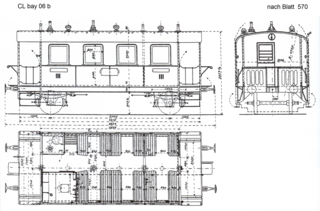
The Bavarian CL Bay 06b was a short open coach for branch line services with the Royal Bavarian State Railways (k.Bay.Sts.B.). It was listed in their 1913 fleet register under Design Sheet No. 570.
The GwL class vans of the Royal Bavarian State Railways were goods vans built for branch lines in the Kingdom of Bavaria in the late 19th and early 20th centuries.

The CL Bay 11a and CL Bay 14a were a class of open coach built for the Bavarian branch lines (Lokalbahn in the early 20th century. They were listed under Design Sheet 554 in the 1913 Fleet Register of the Royal Bavarian State Railways. In the engineering register of the Deutsche Reichsbahn they were listed as the Class CL Bay 14II under Sheet No. 6056.3.

The Class BCL Bay 09 were open coaches for branch line services with the Royal Bavarian State Railways (K.Bay.Sts.B.) that were built in the early 20th century. They included those coaches listed in the 1913 fleet register under design sheet nos. 521, 6055.2 and 6055.3. As a result of remodelling they were reclassified according to the DRG’s 1930 engineering drawing register as classes CL Bay 09/21, BCL Bay 13a, CL Bay 13a/21, BCL Bay 14 and CL Bay 14/21.

