
Goosefishes, sometimes called anglers or monkfishes, are a family, the Lophiidae, of marine ray-finned fishes belonging to the order Lophiiformes, the anglerfishes. These fishes are found in all the world's oceans except for the Antarctic Ocean.

Frogfishes are any member of the anglerfish family Antennariidae, of the order Lophiiformes. Antennariids are known as anglerfish in Australia, where the term "frogfish" refers to members of the unrelated family Batrachoididae. Frogfishes are found in almost all tropical and subtropical oceans and seas around the world, the primary exception being the Mediterranean Sea.

Handfish are any anglerfish within the family Brachionichthyidae, a group which comprises five genera and 14 extant species. These benthic marine fish are unusual in the way they propel themselves by walking on the sea floor rather than swimming.

The triplewart seadevil is a sea devil of the family Ceratiidae and the order Lophoiiformes. This species is the only member of its genus. Noted for its extreme sexual dimorphism, the triplewart seadevil's length ranges from 20 to 30 cm for females and 1 to 3 cm for males.

The horned lantern fish or prickly seadevil is a deep-sea anglerfish found worldwide. It is the sole species in the family Centrophrynidae, distinguished from other deep-sea anglerfishes by various characters including four pectoral radials, an anterior spine on the subopercular bone, and a short hyoid (chin) barbel in both sexes.
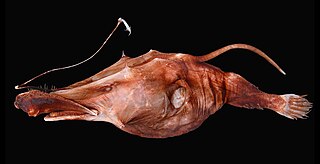
The complete anglerfish (Lasiognathus) is a genus of deep-sea anglerfish in the family Thaumatichthyidae, with six species known from the Atlantic and Pacific Oceans. Its lure apparatus appears to consist of a fishing rod, a fishing line, bait, and hooks. It is also distinctive for an enormous upper jaw with premaxillaries that can be folded down to enclose the much shorter lower jaw.

The anglerfish are fish of the teleost order Lophiiformes. They are bony fish named for their characteristic mode of predation, in which a modified luminescent fin ray acts as a lure for other fish. The luminescence comes from symbiotic bacteria, which are thought to be acquired from seawater, that dwell in and around the sea.

Histiophryne is a genus of frogfishes found in waters ranging from Taiwan to South Australia. There are currently five known species. These fishes are easily distinguished from other anglerfishes as having a reduced luring appendage, a highly evolved form of the first dorsal fin spine.

Theodore Wells Pietsch III is an American systematist and evolutionary biologist especially known for his studies of anglerfishes. Pietsch has described 72 species and 14 genera of fishes and published numerous scientific papers focusing on the relationships, evolutionary history, and functional morphology of teleosts, particularly deep-sea taxa. For this body of work, Pietsch was awarded the Robert H. Gibbs Jr. Memorial Award in Systematic Ichthyology by the American Society of Ichthyologists and Herpetologists in 2005. Pietsch has spent most of his career at the University of Washington in Seattle as a professor mentoring graduate students, teaching ichthyology to undergraduates, and curating the ichthyology collections of the UW Burke Museum of Natural History and Culture.
Sharfia mirabilis is an extinct species of anglerfish in the family Lophiidae. It was discovered in 2011 during a review of fossil material at the Muséum national d'histoire naturelle in Paris. The fossil material was collected from the Monte Bolca Lagerstätte, one of the earliest known Eocene fossil sites. The undescribed genus was originally identified as Lophius brachysomus.
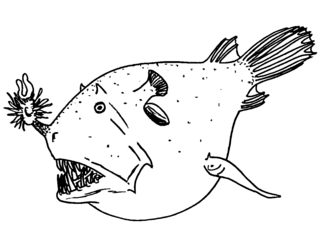
Borophryne apogon, the netdevil, or greedy seadevil, is a species of leftvent anglerfish known today from the waters of the eastern Pacific Ocean off the Central American coast. It is found at depths down to around 1,750 m (5,700 ft). This species grows to a length of 8.3 centimetres (3.3 in) TL. A fossil specimen of this species has been found in the Los Angeles Basin dating back to the Late Miocene, some eight million years ago.

Linophryne is a genus of leftvents, commonly called the "bearded seadevils."

Lophiodes is a genus of marine ray-finned fishes belonging to the family Lophiidae, the goosefishes, monkfishes and anglers. It is one of four extant genera in the family Lophiidae. The fish in this genus are found in the Atlantic, Indian and Pacific Oceans.
Lophiomus is a monospecific genus of marine ray-finned fish belonging to the family, Lophiidae, the goose fishes, monkfishes or anglers. The only species in the genus is Lophiomus setigerus, the blackmouth angler, blackmouth goosefish, broadheaded angler or broadhead goosefish. This fish is found in the Indo-Pacific.

Pristigenys is a genus of marine ray-finned fish in the family Priacanthidae. It contains five extant species and one extinct species, P. substriata, which is known from fossils found in the Eocene of Monte Bolca, Italy.
Porophryne erythrodactylus, also known as the red-fingered anglerfish or the Bare Island anglerfish is a species of frogfish endemic to Australia. This species occurs Kurnell and Bare Island in Botany Bay, New South Wales, Australia. This species is the only known member of the genus Porophryne. This genus is a sister genus of Kuiterichthys.
Lasiognathus dinema is a species of wolftrap angler found in the deep waters of the northern Gulf of Mexico. It is found at depths of around 3,280 to 4,900 feet.

Linophryne indica, or headlight angler, is a leftvent anglerfish in the family Linophrynidae, found in the bathyal zone of the Pacific Ocean at depths below 1,000 m (3,300 ft). The female is significantly larger than the mature male. A fossil specimen of this species has been found in the Los Angeles Basin dating back to the Late Miocene, some eight million years ago.
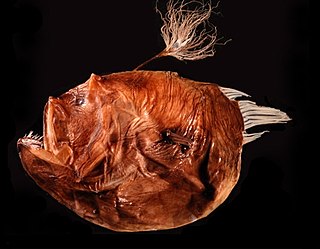
Bufoceratias shaoi is a species of double angler, a type of anglerfish. The fish is bathypelagic and has been found at depths ranging from 0 to 1,200 metres. It has been found in the western Indian Ocean and western Pacific Ocean. It was first described in 2004 by Theodore Pietsch, Ho Hsuan-Ching & Chen Hong-Ming.


