Related Research Articles

In biology, histones are highly basic proteins abundant in lysine and arginine residues that are found in eukaryotic cell nuclei and in most Archaeal phyla. They act as spools around which DNA winds to create structural units called nucleosomes. Nucleosomes in turn are wrapped into 30-nanometer fibers that form tightly packed chromatin. Histones prevent DNA from becoming tangled and protect it from DNA damage. In addition, histones play important roles in gene regulation and DNA replication. Without histones, unwound DNA in chromosomes would be very long. For example, each human cell has about 1.8 meters of DNA if completely stretched out; however, when wound about histones, this length is reduced to about 90 micrometers (0.09 mm) of 30 nm diameter chromatin fibers.
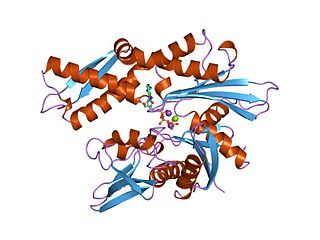
The 70 kilodalton heat shock proteins are a family of conserved ubiquitously expressed heat shock proteins. Proteins with similar structure exist in virtually all living organisms. Intracellularly localized Hsp70s are an important part of the cell's machinery for protein folding, performing chaperoning functions, and helping to protect cells from the adverse effects of physiological stresses. Additionally, membrane-bound Hsp70s have been identified as a potential target for cancer therapies and their extracellularly localized counterparts have been identified as having both membrane-bound and membrane-free structures.

Heat shock protein HSP 90-alpha is a protein that in humans is encoded by the HSP90AA1 gene.

Human gene HSPA1B is an intron-less gene which encodes for the heat shock protein HSP70-2, a member of the Hsp70 family of proteins. The gene is located in the major histocompatibility complex, on the short arm of chromosome 6, in a cluster with two paralogous genes, HSPA1A and HSPA1L. HSPA1A and HSPA1B produce nearly identical proteins because the few differences in their DNA sequences are almost exclusively synonymous substitutions or in the three prime untranslated region, heat shock 70kDa protein 1A, from HSPA1A, and heat shock 70kDa protein 1B, from HSPA1B. A third, more modified paralog to these genes exists in the same region, HSPA1L, which shares a 90% homology with the other two.

Heat shock factor 1 (HSF1) is a protein that in humans is encoded by the HSF1 gene. HSF1 is highly conserved in eukaryotes and is the primary mediator of transcriptional responses to proteotoxic stress with important roles in non-stress regulation such as development and metabolism.
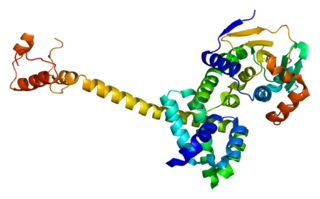
Hsp90 co-chaperone Cdc37 is a protein that in humans is encoded by the CDC37 gene. This protein is highly similar to Cdc 37, a cell division cycle control protein of Saccharomyces cerevisiae. This protein is a HSP90 Co-chaperone with specific function in cell signal transduction. It has been shown to form complex with Hsp90 and a variety of protein kinases including CDK4, CDK6, SRC, RAF1, MOK, as well as eIF-2 alpha kinases. It is thought to play a critical role in directing Hsp90 to its target kinases.

Heat shock protein HSP 90-beta also called HSP90beta is a protein that in humans is encoded by the HSP90AB1 gene.

Folliculin-interacting protein 1 (FNIP1) functions as a co-chaperone which inhibits the ATPase activity of the chaperone Hsp90 and decelerates its chaperone cycle. FNIP1 acts as a scaffold to load FLCN onto Hsp90. FNIP1 is also involved in chaperoning of both kinase and non-kinase clients.
H3K27ac is an epigenetic modification to the DNA packaging protein histone H3. It is a mark that indicates acetylation of the lysine residue at N-terminal position 27 of the histone H3 protein.
H2BK5ac is an epigenetic modification to the DNA packaging protein Histone H2B. It is a mark that indicates the acetylation at the 5th lysine residue of the histone H2B protein. H2BK5ac is involved in maintaining stem cells and colon cancer.
H4K16ac is an epigenetic modification to the DNA packaging protein Histone H4. It is a mark that indicates the acetylation at the 16th lysine residue of the histone H4 protein.
H4K5ac is an epigenetic modification to the DNA packaging protein histone H4. It is a mark that indicates the acetylation at the 5th lysine residue of the histone H4 protein. H4K5 is the closest lysine residue to the N-terminal tail of histone H4. It is enriched at the transcription start site (TSS) and along gene bodies. Acetylation of histone H4K5 and H4K12ac is enriched at centromeres.
H4K8ac, representing an epigenetic modification to the DNA packaging protein histone H4, is a mark indicating the acetylation at the 8th lysine residue of the histone H4 protein. It has been implicated in the prevalence of malaria.
H4K12ac is an epigenetic modification to the DNA packaging protein histone H4. It is a mark that indicates the acetylation at the 12th lysine residue of the histone H4 protein. H4K12ac is involved in learning and memory. It is possible that restoring this modification could reduce age-related decline in memory.
H4K91ac is an epigenetic modification to the DNA packaging protein histone H4. It is a mark that indicates the acetylation at the 91st lysine residue of the histone H4 protein. No known diseases are attributed to this mark but it might be implicated in melanoma.
H3K23ac is an epigenetic modification to the DNA packaging protein Histone H3. It is a mark that indicates the acetylation at the 23rd lysine residue of the histone H3 protein.
H3K14ac is an epigenetic modification to the DNA packaging protein Histone H3. It is a mark that indicates the acetylation at the 14th lysine residue of the histone H3 protein.
H3K36ac is an epigenetic modification to the DNA packaging protein Histone H3. It is a mark that indicates the acetylation at the 36th lysine residue of the histone H3 protein.
H3K56ac is an epigenetic modification to the DNA packaging protein Histone H3. It is a mark that indicates the acetylation at the 56th lysine residue of the histone H3 protein.

Mehdi Mollapour is a British-American Biochemist and Cancer Biologist. He is a Professor, Vice Chair for Translational Research and Director of Renal Cancer Biology Program for the Department of Urology, and Adjunct Professor at the Department of Biochemistry and Molecular Biology at SUNY Upstate Medical University.
References
- 1 2 Nitika; Porter, Corey M.; Truman, Andrew W.; Truttmann, Matthias C. (2020-07-31). "Post-translational modifications of Hsp70 family proteins: Expanding the chaperone code". The Journal of Biological Chemistry. 295 (31): 10689–10708. doi: 10.1074/jbc.REV120.011666 . ISSN 0021-9258. PMC 7397107 . PMID 32518165.
- 1 2 3 4 Backe, Sarah J.; Sager, Rebecca A.; Woodford, Mark R.; Makedon, Alan M.; Mollapour, Mehdi (2020-08-07). "Post-translational modifications of Hsp90 and translating the chaperone code". The Journal of Biological Chemistry. 295 (32): 11099–11117. doi: 10.1074/jbc.REV120.011833 . ISSN 0021-9258. PMC 7415980 . PMID 32527727.
- ↑ Jakobsson, Magnus E.; Moen, Anders; Bousset, Luc; Egge-Jacobsen, Wolfgang; Kernstock, Stefan; Melki, Ronald; Falnes, Pål Ø. (2013-09-27). "Identification and Characterization of a Novel Human Methyltransferase Modulating Hsp70 Protein Function through Lysine Methylation". The Journal of Biological Chemistry. 288 (39): 27752–27763. doi: 10.1074/jbc.M113.483248 . ISSN 0021-9258. PMC 3784692 . PMID 23921388.
- ↑ Kampinga, Harm H.; Craig, Elizabeth A. (August 2010). "The Hsp70 chaperone machinery: J-proteins as drivers of functional specificity". Nature Reviews. Molecular Cell Biology. 11 (8): 579–592. doi:10.1038/nrm2941. ISSN 1471-0072. PMC 3003299 . PMID 20651708.
- ↑ Cloutier, Philippe; Coulombe, Benoit (2013). "Regulation of molecular chaperones through post-translational modifications: Decrypting the chaperone code". Biochimica et Biophysica Acta (BBA) - Gene Regulatory Mechanisms. 1829 (5): 443–54. doi:10.1016/j.bbagrm.2013.02.010. PMC 4492711 . PMID 23459247.
- ↑ Cloutier, Philippe; Lavallée-Adam, Mathieu; Faubert, Denis; Blanchette, Mathieu; Coulombe, Benoit (2013). "A Newly Uncovered Group of Distantly Related Lysine Methyltransferases Preferentially Interact with Molecular Chaperones to Regulate Their Activity". PLOS Genetics. 9 (1): e1003210. doi: 10.1371/journal.pgen.1003210 . PMC 3547847 . PMID 23349634.
- ↑ Woodford, Mark R.; Truman, Andrew W.; Dunn, Diana M.; Jensen, Sandra M.; Cotran, Richard; Bullard, Renee; Abouelleil, Mourad; Beebe, Kristin; Wolfgeher, Donald; Wierzbicki, Sara; Post, Dawn E. (2016-02-02). "Mps1 Mediated Phosphorylation of Hsp90 Confers Renal Cell Carcinoma Sensitivity and Selectivity to Hsp90 Inhibitors". Cell Reports. 14 (4): 872–884. doi:10.1016/j.celrep.2015.12.084. ISSN 2211-1247. PMC 4887101 . PMID 26804907.
- ↑ Beltrao, Pedro; Albanèse, Véronique; Kenner, Lillian R.; Swaney, Danielle L.; Burlingame, Alma; Villén, Judit; Lim, Wendell A.; Fraser, James S.; Frydman, Judith; Krogan, Nevan J. (2012-07-20). "Systematic Functional Prioritization of Protein Posttranslational Modifications". Cell. 150 (2): 413–425. doi:10.1016/j.cell.2012.05.036. ISSN 0092-8674. PMC 3404735 . PMID 22817900.
- ↑ Truman, Andrew; Kristjansdottir, Kolbrun; Wolfgeher, Donald; Hasin, Naushaba; Polier, Sigrun; Zhang, Hong; Perrett, Sarah; Prodromou, Chrisostomos; Jones, Gary; Kron, Stephen (2012-12-07). "CDK-Dependent Hsp70 Phosphorylation Controls G1 Cyclin Abundance and Cell-Cycle Progression". Cell. 151 (6): 1308–1318. doi:10.1016/j.cell.2012.10.051. ISSN 0092-8674. PMC 3778871 . PMID 23217712.
- ↑ Mollapour, Mehdi; Tsutsumi, Shinji; Truman, Andrew W.; Xu, Wanping; Vaughan, Cara K.; Beebe, Kristin; Konstantinova, Anna; Vourganti, Srinivas; Panaretou, Barry; Piper, Peter W.; Trepel, Jane B. (2011-03-18). "Threonine 22 phosphorylation attenuates Hsp90 interaction with co-chaperones and affects its chaperone activity". Molecular Cell. 41 (6): 672–681. doi:10.1016/j.molcel.2011.02.011. ISSN 1097-2765. PMC 3062913 . PMID 21419342.
- ↑ Lopez, Victor A.; Park, Brenden C.; Nowak, Dominika; Sreelatha, Anju; Zembek, Patrycja; Fernandez, Jessie; Servage, Kelly A.; Gradowski, Marcin; Hennig, Jacek; Tomchick, Diana R.; Pawłowski, Krzysztof (2019-09-19). "A Bacterial Effector Mimics a Host HSP90 Client to Undermine Immunity". Cell. 179 (1): 205–218.e21. doi:10.1016/j.cell.2019.08.020. ISSN 0092-8674. PMC 6754304 . PMID 31522888.
- ↑ Donlin, Laura T.; Andresen, Christian; Just, Steffen; Rudensky, Eugene; Pappas, Christopher T.; Kruger, Martina; Jacobs, Erica Y.; Unger, Andreas; Zieseniss, Anke; Dobenecker, Marc-Werner; Voelkel, Tobias (2012-01-15). "Smyd2 controls cytoplasmic lysine methylation of Hsp90 and myofilament organization". Genes & Development. 26 (2): 114–119. doi:10.1101/gad.177758.111. ISSN 0890-9369. PMC 3273835 . PMID 22241783.
- ↑ Abu-Farha, Mohamed; Lanouette, Sylvain; Elisma, Fred; Tremblay, Véronique; Butson, Jeffery; Figeys, Daniel; Couture, Jean-François (October 2011). "Proteomic analyses of the SMYD family interactomes identify HSP90 as a novel target for SMYD2". Journal of Molecular Cell Biology. 3 (5): 301–308. doi: 10.1093/jmcb/mjr025 . ISSN 1759-4685. PMID 22028380.
- ↑ Rehn, Alexandra; Lawatscheck, Jannis; Jokisch, Marie-Lena; Mader, Sophie L.; Luo, Qi; Tippel, Franziska; Blank, Birgit; Richter, Klaus; Lang, Kathrin; Kaila, Ville R. I.; Buchner, Johannes (May 2020). "A methylated lysine is a switch point for conformational communication in the chaperone Hsp90". Nature Communications. 11 (1): 1219. Bibcode:2020NatCo..11.1219R. doi:10.1038/s41467-020-15048-8. ISSN 2041-1723. PMC 7057950 . PMID 32139682.