
Extinction is the termination of a kind of organism or of a group of kinds (taxon), usually a species. The moment of extinction is generally considered to be the death of the last individual of the species, although the capacity to breed and recover may have been lost before this point. Because a species' potential range may be very large, determining this moment is difficult, and is usually done retrospectively. This difficulty leads to phenomena such as Lazarus taxa, where a species presumed extinct abruptly "reappears" after a period of apparent absence.

The Exocoetidae are a family of marine ray-finned fish in the order Beloniformes, known colloquially as flying fish or flying cod. About 64 species are grouped in seven genera. While they cannot fly in the same way a bird does, flying fish can make powerful, self-propelled leaps out of the water where their long wing-like fins enable gliding for considerable distances above the water's surface. The main reason for this behavior is thought to be to escape from underwater predators, which include swordfish, mackerel, tuna, and marlin, among others, though their periods of flight expose them to attack by avian predators such as frigate birds.

The masked booby, also called the masked gannet or the blue-faced booby, is a large seabird of the booby and gannet family, Sulidae. First described by the French naturalist René-Primevère Lesson in 1831, the masked booby is one of six species of booby in the genus Sula. It has a typical sulid body shape, with a long pointed yellowish bill, long neck, aerodynamic body, long slender wings and pointed tail. The adult is bright white with black wings, a black tail and a dark face mask; at 75–85 cm (30–33 in) long, it is the largest species of booby. The sexes have similar plumage. This species ranges across tropical oceans, except in the eastern Atlantic and eastern Pacific. In the latter, it is replaced by the Nazca booby, which was formerly regarded as a subspecies of masked booby.

Coris is a genus of wrasses, collectively known as the rainbow wrasses, found in the Atlantic, Indian, and Pacific Oceans.

Cheilopogon is a genus of flyingfishes.
The Australasian flying fish, Cheilopogon pinnatibarbatus melanocercus, is a subspecies of flyingfish of the family Exocoetidae, found off New South Wales of Australia, and around New Zealand, in surface waters. The Australasian flying fish feeds mainly on plankton and small crustaceans.
Cheilopogon pinnatibarbatus japonicus is a subspecies of flyingfish of the family Exocoetidae, found in the seas around Japan. Its length is up to 50 cm.

The California flying fish, Cheilopogon pinnatibarbatus californicus, is a subspecies of Bennett's flying fish. Prior to the 1970s, the California flying fish was known as a distinct species, with the scientific classification Cypselurus californicus. In fact there are 40 distinct classifications of flying fish. It may grow up to 19 inches (48 cm) in length and is the largest member of the flying fish family. It is found in the Eastern Pacific Ocean, from Oregon to Baja California. As with all other flying fish, the California can not actually fly, but it can launch itself into the air, using its specially adapted fins to glide along the surface.
In biology, a species is often defined as the largest group of organisms in which any two individuals of the appropriate sexes or mating types can produce fertile offspring, typically by sexual reproduction. It is the basic unit of classification and a taxonomic rank of an organism, as well as a unit of biodiversity. Other ways of defining species include their karyotype, DNA sequence, morphology, behaviour, or ecological niche. In addition, paleontologists use the concept of the chronospecies since fossil reproduction cannot be examined.

The Atlantic flyingfish is a flying fish in the family Exocoetidae. It was first described by the French zoologist, Achille Valenciennes in a 22-volume work entitled Histoire naturelle des poissons, which was a collaboration with fellow zoologist Georges Cuvier.

Cirrhimuraena is a genus of eels in the snake eel family Ophichthidae.
Cirrhimuraena cheilopogon is an eel in the family Ophichthidae. It was described by Pieter Bleeker in 1860. It is a tropical, marine eel which is known from Papua New Guinea, in the western central Pacific Ocean.
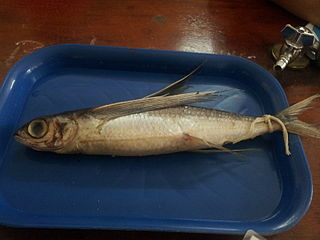
Cheilopogon nigricans, the blacksail flyingfish, also known as African flyingfish, or leaping flyingfish, is a flying fish in the family Exocoetidae. It is an oceanodromous, plankton-eating marine fish which has commercial value.
The Flying Fish Festival is one of the traditional ceremonies of the Taiwanese indigenous Yami people, which live on a tiny island off the southeastern coast of Taiwan called Orchid Island. The Flying Fish Festival comes from the legends of the Yami people and constitutes the social norms of their society. During the festival period, the Yami people need to be very careful of their actions and words in order not to violate the norms. In addition to the Yami's cultural heritage, the Flying Fish Festival also implies the respect for the natural environment and sustainable ecological perceptions.
The spotfin flyingfish, Cheilopogon furcatus, is a fish in the flying fish family, Exocoetidae.
Frederick Debell Bennett was an English ship surgeon and biologist.

Cypsellurinae is a subfamily of flying fishes, one of four in the family Exocoetidae and the only one which is not monogeneric.
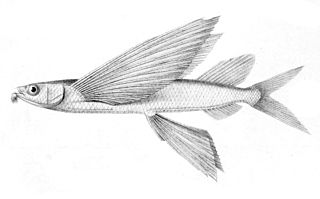
Cheilopogon pinnatibarbatus, Bennett's flying fish, is a species of flying fish which has a circumglobal distribution in tropical and subtropical seas. It is an epiplegaic species which feeds on zooplankton and small fishes and is capable of leaping out of the water and gliding over the surface.

