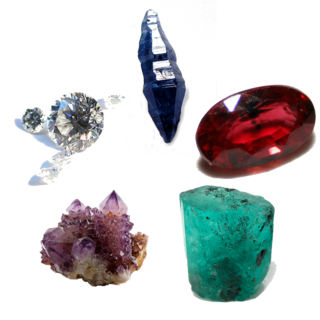
A gemstone is a piece of mineral crystal which, when cut or polished, is used to make jewelry or other adornments. Certain rocks and occasionally organic materials that are not minerals may also be used for jewelry and are therefore often considered to be gemstones as well. Most gemstones are hard, but some softer minerals such as brazilianite may be used in jewelry because of their color or luster or other physical properties that have aesthetic value. However, generally speaking, soft minerals are not typically used as gemstones by virtue of their brittleness and lack of durability.

Hematite, also spelled as haematite, is a common iron oxide compound with the formula, Fe2O3 and is widely found in rocks and soils. Hematite crystals belong to the rhombohedral lattice system which is designated the alpha polymorph of Fe
2O
3. It has the same crystal structure as corundum (Al
2O
3) and ilmenite (FeTiO
3). With this it forms a complete solid solution at temperatures above 950 °C (1,740 °F).
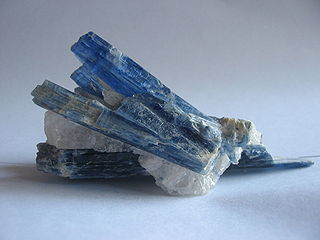
Kyanite is a typically blue aluminosilicate mineral, found in aluminium-rich metamorphic pegmatites and sedimentary rock. It is the high pressure polymorph of andalusite and sillimanite, and the presence of kyanite in metamorphic rocks generally indicates metamorphism deep in the Earth's crust. Kyanite is also known as disthene or cyanite.
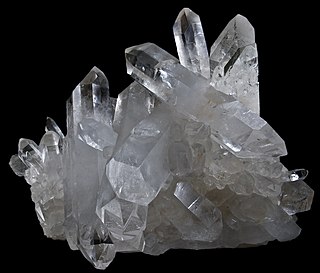
Quartz is a hard, crystalline mineral composed of silica (silicon dioxide). The atoms are linked in a continuous framework of SiO4 silicon–oxygen tetrahedra, with each oxygen being shared between two tetrahedra, giving an overall chemical formula of SiO2. Quartz is, therefore, classified structurally as a framework silicate mineral and compositionally as an oxide mineral. Quartz is the second most abundant mineral in Earth's continental crust, behind feldspar.

Titanite, or sphene (from Ancient Greek σφηνώ (sphēnṓ) 'wedge'), is a calcium titanium nesosilicate mineral, CaTiSiO5. Trace impurities of iron and aluminium are typically present. Also commonly present are rare earth metals including cerium and yttrium; calcium may be partly replaced by thorium.

Fluorite (also called fluorspar) is the mineral form of calcium fluoride, CaF2. It belongs to the halide minerals. It crystallizes in isometric cubic habit, although octahedral and more complex isometric forms are not uncommon.

The mineral or gemstone chrysoberyl is an aluminate of beryllium with the formula BeAl2O4. The name chrysoberyl is derived from the Greek words χρυσός chrysos and βήρυλλος beryllos, meaning "a gold-white spar". Despite the similarity of their names, chrysoberyl and beryl are two completely different gemstones, although they both contain beryllium. Chrysoberyl is the third-hardest frequently encountered natural gemstone and lies at 8.5 on the Mohs scale of mineral hardness, between corundum (9) and topaz (8).

Pleochroism is an optical phenomenon in which a substance has different colors when observed at different angles, especially with polarized light.

Liuyang is a county-level city, the most populous and the easternmost county-level division of Hunan Province, China; it is under the administration of the prefecture-level city of Changsha, the provincial capital. Located on the northeastern margin of Hunan, the city is bordered to the north by Pingjiang County, to the west by Changsha County and Yuhua District, to the south by Shifeng, Hetang Districts of Zhuzhou and Liling City, to the southeast and the east by Yuanzhou District of Yichun, Shangli, Wanzai and Tonggu Counties of Jiangxi. Liuyang City covers 4,997.35 km2 (1,929.49 sq mi) with registered population of 1,453,246 and resident population of 1,297,700. The city has four subdistricts, 26 towns and two townships under its jurisdiction, its jurisdiction, its administrative centre is at Guankou Subdistrict (关口街道).

The peony or paeony is any flowering plant in the genus Paeonia, the only genus in the family Paeoniaceae. Peonies are native to Asia, Europe, and Western North America. Scientists differ on the number of species that can be distinguished, ranging from 25 to 40, although the current consensus describes 33 known species. The relationships between the species need to be further clarified.

Selenite, satin spar, desert rose, and gypsum flower are crystal habit varieties of the mineral gypsum.
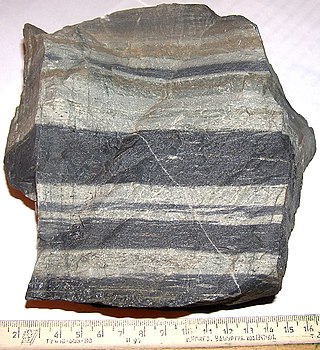
Hornfels is the group name for a set of contact metamorphic rocks that have been baked and hardened by the heat of intrusive igneous masses and have been rendered massive, hard, splintery, and in some cases exceedingly tough and durable. These properties are caused by fine grained non-aligned crystals with platy or prismatic habits, characteristic of metamorphism at high temperature but without accompanying deformation. The term is derived from the German word Hornfels, meaning "hornstone", because of its exceptional toughness and texture both reminiscent of animal horns. These rocks were referred to by miners in northern England as whetstones.

Xenotime is a rare-earth phosphate mineral, the major component of which is yttrium orthophosphate (YPO4). It forms a solid solution series with chernovite-(Y) (YAsO4) and therefore may contain trace impurities of arsenic, as well as silicon dioxide and calcium. The rare-earth elements dysprosium, erbium, terbium and ytterbium, as well as metal elements such as thorium and uranium (all replacing yttrium) are the expressive secondary components of xenotime. Due to uranium and thorium impurities, some xenotime specimens may be weakly to strongly radioactive. Lithiophyllite, monazite and purpurite are sometimes grouped with xenotime in the informal "anhydrous phosphates" group. Xenotime is used chiefly as a source of yttrium and heavy lanthanide metals (dysprosium, ytterbium, erbium and gadolinium). Occasionally, gemstones are also cut from the finest xenotime crystals.

Diamond is the allotrope of carbon in which the carbon atoms are arranged in the specific type of cubic lattice called diamond cubic. It is a crystal that is transparent to opaque and which is generally isotropic. Diamond is the hardest naturally occurring material known. Yet, due to important structural brittleness, bulk diamond's toughness is only fair to good. The precise tensile strength of bulk diamond is little known; however, compressive strength up to 60 GPa has been observed, and it could be as high as 90–100 GPa in the form of micro/nanometer-sized wires or needles, with a corresponding maximum tensile elastic strain in excess of 9%. The anisotropy of diamond hardness is carefully considered during diamond cutting. Diamond has a high refractive index (2.417) and moderate dispersion (0.044) properties that give cut diamonds their brilliance. Scientists classify diamonds into four main types according to the nature of crystallographic defects present. Trace impurities substitutionally replacing carbon atoms in a diamond's crystal structure, and in some cases structural defects, are responsible for the wide range of colors seen in diamond. Most diamonds are electrical insulators and extremely efficient thermal conductors. Unlike many other minerals, the specific gravity of diamond crystals (3.52) has rather small variation from diamond to diamond.
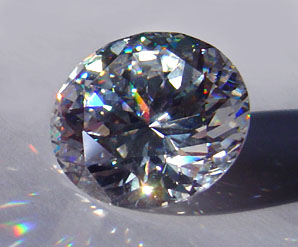
A diamond simulant, diamond imitation or imitation diamond is an object or material with gemological characteristics similar to those of a diamond. Simulants are distinct from synthetic diamonds, which are actual diamonds exhibiting the same material properties as natural diamonds. Enhanced diamonds are also excluded from this definition. A diamond simulant may be artificial, natural, or in some cases a combination thereof. While their material properties depart markedly from those of diamond, simulants have certain desired characteristics—such as dispersion and hardness—which lend themselves to imitation. Trained gemologists with appropriate equipment are able to distinguish natural and synthetic diamonds from all diamond simulants, primarily by visual inspection.
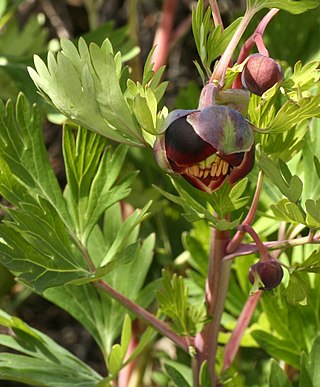
Paeonia californica is a perennial herbaceous plant of 35–70 cm high, that retreats underground in summer, and reoccurs with the arrival of the winter rains. It has lobed leaves, elliptic (cup-shaped) drooping flowers with dark maroon-colored petals, and many yellow anthers. It flowers mostly from January to March, and later develops two to five fruits per flower. Its common name is California peony and it is sometimes also referred to as wild peony. This peony is an endemic of southwestern California (USA), where it is not rare, and northernmost Baja California (Mexico). It grows on dry hillsides in the coastal sage scrub and chaparral communities of the coastal mountains of Southern and Central California, often as an understory plant.

Perovskite (pronunciation: ) is a calcium titanium oxide mineral composed of calcium titanate (chemical formula CaTiO3). Its name is also applied to the class of compounds which have the same type of crystal structure as CaTiO3, known as the perovskite structure, which has a general chemical formula A2+B4+(X2−)3. Many different cations can be embedded in this structure, allowing the development of diverse engineered materials.

Paeonia delavayi is a low woody shrub belonging to the peony family, and is endemic to China. The vernacular name in China is 滇牡丹. In English it is called Delavay's tree peony, Delavay peony, Dian peony, and dian mu dan. It mostly has reddish-brown to yellow, nodding flowers from mid May to mid June. The light green, delicate looking deciduous leaves consist of many segments, and are alternately arranged on new growth.

Flower preservation has existed since early history, although deliberate flower preservation is a more recent phenomenon. In the Middle East, the bones of pre-historic man were discovered with delicate wild flowers probably as a tribute to a passing loved one. Evidence of deliberate use of specific flowers is indicated by the pollen grains that were present. Brightly colored and vivid flowers were also found in Egyptian tombs. These flowers were approximated to be 4,000 years old. In the sixteenth century medicinal nosegays began to give way to ornamental ones. Flowers essentially started to be used for decorative purposes such as jewels, fans and gloves. During the Elizabethan Age the once familiar ruff was replaced by soft lacy collars, and bosom flowers also became popular.
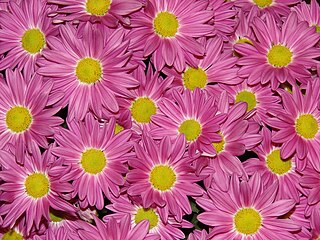
The Chrysanthemum Festival, is a festival held in the town of Xiaolan in November. Zhongshan is sometimes called "Chrysanthemum city" because of its chrysanthemum culture. During the Ming dynasty, people planted chrysanthemums and gathered together to appreciate them. While doing that, they also wrote poems, drew pictures and drank liquor. Later, these gatherings grew into chrysanthemum festivals, which were held every 10 years. In Qing dynasty, people started holding the Grand Chrysanthemum Festival, which is held every 60 years. Now, chrysanthemum festivals are held every year, and draw visitors from around the world.


