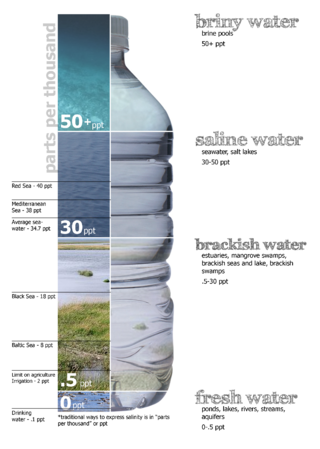
Brackish water, sometimes termed brack water, is water occurring in a natural environment that has more salinity than freshwater, but not as much as seawater. It may result from mixing seawater and fresh water together, as in estuaries, or it may occur in brackish fossil aquifers. The word comes from the Middle Dutch root brak. Certain human activities can produce brackish water, in particular civil engineering projects such as dikes and the flooding of coastal marshland to produce brackish water pools for freshwater prawn farming. Brackish water is also the primary waste product of the salinity gradient power process. Because brackish water is hostile to the growth of most terrestrial plant species, without appropriate management it can be damaging to the environment.

The Great Lakes, also called the Great Lakes of North America, are a series of large interconnected freshwater lakes spanning the Canada–United States border. The five lakes are Superior, Michigan, Huron, Erie, and Ontario. The Great Lakes Waterway enables modern travel and shipping by water among the lakes. The lakes connect to the Atlantic Ocean via the Saint Lawrence River.

Perch is a common name for freshwater fish from the genus Perca, which belongs to the family Percidae of the large order Perciformes. The name comes from Greek: πέρκη, romanized: perke, meaning the type species of this genus, the European perch.

Trout is a generic common name for numerous species of carnivorous freshwater ray-finned fishes belonging to the genera Oncorhynchus, Salmo and Salvelinus, all of which are members of the subfamily Salmoninae in the family Salmonidae. The word trout is also used for some similar-shaped but non-salmonid fish, such as the spotted seatrout/speckled trout.
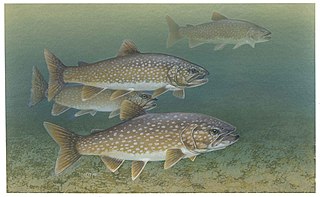
The lake trout is a freshwater char living mainly in lakes in northern North America. Other names for it include mackinaw, namaycush,lake char (or charr), touladi, togue, and grey trout. In Lake Superior, it can also be variously known as siscowet, paperbelly and lean. The lake trout is prized both as a game fish and as a food fish. Those caught with dark coloration may be called mud hens.
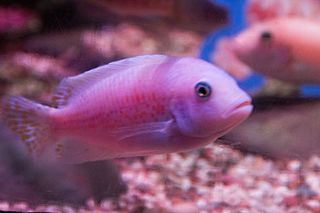
Cichlids are fish from the family Cichlidae in the order Cichliformes. Traditionally Cichlids were classed in a suborder, the Labroidei, along with the wrasses (Labridae), in the order Perciformes, but molecular studies have contradicted this grouping. On the basis of fossil evidence, it first appeared in Argentina during the Early Eocene epoch, about 48.6 million years ago; however, molecular clock estimates have placed the family's origin as far back as 67 million years ago, during the late Cretaceous period. The closest living relative of cichlids is probably the convict blenny, and both families are classified in the 5th edition of Fishes of the World as the two families in the Cichliformes, part of the subseries Ovalentaria. This family is large, diverse, and widely dispersed. At least 1,650 species have been scientifically described, making it one of the largest vertebrate families. New species are discovered annually, and many species remain undescribed. The actual number of species is therefore unknown, with estimates varying between 2,000 and 3,000.

Lake Malawi, also known as Lake Nyasa in Tanzania and Lago Niassa in Mozambique, is an African Great Lake and the southernmost lake in the East African Rift system, located between Malawi, Mozambique and Tanzania.

Lake Victoria is one of the African Great Lakes. With a surface area of approximately 59,947 km2 (23,146 sq mi), Lake Victoria is Africa's largest lake by area, the world's largest tropical lake, and the world's second-largest fresh water lake by surface area after Lake Superior in North America. In terms of volume, Lake Victoria is the world's ninth-largest continental lake, containing about 2,424 km3 (1.965×10⁹ acre⋅ft) of water. Lake Victoria occupies a shallow depression in Africa. The lake has an average depth of 40 m (130 ft) and a maximum depth of 80–81 m (262–266 ft). Its catchment area covers 169,858 km2 (65,583 sq mi). The lake has a shoreline of 7,142 km (4,438 mi) when digitized at the 1:25,000 level, with islands constituting 3.7% of this length.
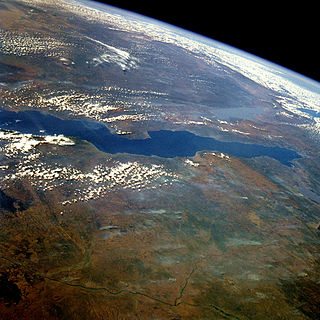
Lake Tanganyika is an African Great Lake. It is the second-largest freshwater lake by volume and the second deepest, in both cases after Lake Baikal in Siberia. It is the world's longest freshwater lake. The lake is shared among four countries—Tanzania, the Democratic Republic of the Congo, Burundi, and Zambia—with Tanzania (46%) and the DRC (40%) possessing the majority of the lake. It drains into the Congo River system and ultimately into the Atlantic Ocean.
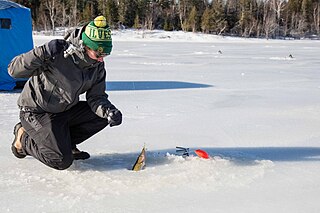
Ice fishing is the practice of catching fish with lines and fish hooks or spears through an opening in the ice on a frozen body of water. Ice fishers may fish in the open or in heated enclosures, some with bunks and amenities.
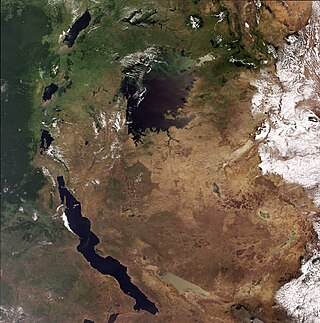
The African Great Lakes are a series of lakes constituting the part of the Rift Valley lakes in and around the East African Rift. The series includes Lake Victoria, the second-largest freshwater lake in the world by area; Lake Tanganyika, the world's second-largest freshwater lake by volume and depth; Lake Malawi, the world's eighth-largest freshwater lake by area; and Lake Turkana, the world's largest permanent desert lake and the world's largest alkaline lake. Collectively, they contain 31,000 km3 (7,400 cu mi) of water, which is more than either Lake Baikal or the North American Great Lakes. This total constitutes about 25% of the planet's unfrozen surface fresh water. The large rift lakes of Africa are the ancient home of great biodiversity, and 10% of the world's fish species live in this region.
The yellow perch, commonly referred to as perch, striped perch, American perch or preacher is a freshwater perciform fish native to much of North America. The yellow perch was described in 1814 by Samuel Latham Mitchill from New York. It is closely related, and morphologically similar to the European perch ; and is sometimes considered a subspecies of its European counterpart.

The Arctic char or Arctic charr is a cold-water fish in the family Salmonidae, native to alpine lakes, as well as Arctic and subarctic coastal waters in the Holarctic.

The Upper Mississippi River National Wildlife and Fish Refuge is a 240,000-acre (970 km2), 261-mile long (420 km) National Wildlife Refuge located in and along the Upper Mississippi River. It runs from Wabasha, Minnesota in the north to Rock Island, Illinois in the south.

Freshwater fish are fish species that spend some or all of their lives in bodies of fresh water such as rivers, lakes and inland wetlands, where the salinity is less than 1.05%. These environments differ from marine habitats in many ways, especially the difference in levels of osmolarity. To survive in fresh water, fish need a range of physiological adaptations.

Paedophagy in its general form is the feeding behaviour of fish or other animals whose diet is partially, or primarily the eggs or larvae of other animals. However, P. H. Greenwood, who was the first to describe paedophagia, defines it to be a feeding behaviour evolved among cichlid fishes.

Fish stocking is the practice of releasing fish that are artificially raised in a hatchery into a natural body of water, to supplement existing wild populations or to create a new population where previously none exists. Stocking may be done for the benefit of commercial, recreational or tribal heritage fishing, but may also be done for ecological conservation to restore or increase the population of threatened/endangered fish species that is pressured by prior overfishing, habitat destruction, and/or competition from invasive species.

The Loch Lomond Vernal Pool Ecological Reserve is a nature reserve of 8.22 acres (33,300 m2) in the community of Loch Lomond in Lake County, California. It is one of 119 ecological reserves managed by the California Department of Fish and Game (CDFG). The ecological reserve system was authorized by the state legislature in 1968 for the purpose of conservation and protection of rare plants, animals and habitats.
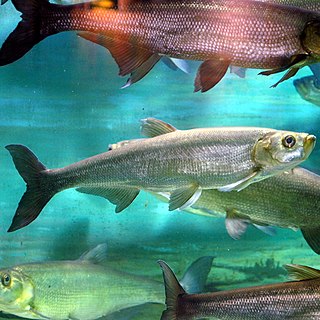
The Cultrinae are one of at least 13 subfamilies of cyprinid fish. It contains ten genera.

Saratoga Lake is in the eastern part of Saratoga County, New York. The lake is approximately 4.5 miles (7.2 km) long, about 1.5 miles (2.4 km) wide at its widest point, and about 95 feet (29 m) deep.

