
The Polyporales are an order of about 1800 species of fungi in the division Basidiomycota. The order includes some polypores as well as many corticioid fungi and a few agarics. Many species within the order are saprotrophic, most of them wood-rotters. Some genera, such as Ganoderma and Fomes, contain species that attack living tissues and then continue to degrade the wood of their dead hosts. Those of economic importance include several important pathogens of trees and a few species that cause damage by rotting structural timber. Some of the Polyporales are commercially cultivated and marketed for use as food items or in traditional Chinese medicine.

Latimeriidae is the only extant family of coelacanths, an ancient lineage of lobe-finned fish. It contains two extant species in the genus Latimeria, found in deep waters off the coasts of southern Africa and east-central Indonesia. In addition, several fossil genera are known from the Mesozoic of Europe, the Middle East, and the southeastern United States, dating back to the Triassic.

Epihippus is an extinct genus of the modern horse family Equidae that lived in the Eocene, from 46 to 38 million years ago.
Mollakənd is a village and municipality in the Kurdamir Rayon of Azerbaijan.

The Fomitopsidaceae are a family of fungi in the order Polyporales. Most species are parasitic on woody plants, and tend to cause brown rots. The name comes from Fomitopsis + -aceae.
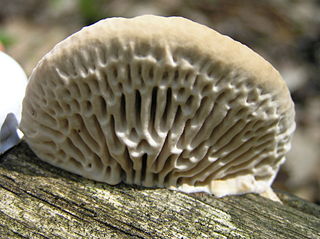
Daedalea is a genus of fungi in the family Fomitopsidaceae. The genus was circumscribed in 1801 by mycologist Christian Hendrik Persoon, based on the type D. quercina and four other species. The generic name is derived from the Ancient Greek δαιδαλεος.

Daedalea quercina is a species of mushroom in the order Polyporales, and the type species of the genus Daedalea. Commonly known as the oak mazegill or maze-gill fungus, the specific epithet refers to the oak genus Quercus, upon which it frequently grows, causing a brown rot. It is found in Europe, Asia, Northern Africa and Australasia. Though inedible, it can be used as a natural comb and has been the subject of chemical research.
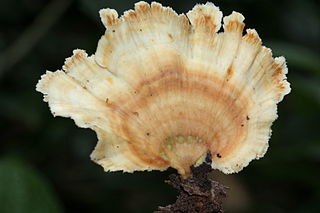
Flabellophora is a genus of poroid fungi in the family Steccherinaceae. The genus was circumscribed by New Zealand-based mycologist Gordon Herriot Cunningham 1965. Most species in the genus were described by E. J. H. Corner in 1987.

The hydnoid fungi are a group of fungi in the Basidiomycota with basidiocarps producing spores on pendant, tooth-like or spine-like projections. They are colloquially called tooth fungi. Originally such fungi were referred to the genus Hydnum, but it is now known that not all hydnoid species are closely related.
Rickiopora is a fungal genus of unknown familial placement in the order Polyporales. The genus is monotypic, containing the single neotropical species Rickiopora latemarginata.
Daedalea ryvardeniana is a neotropical species of poroid fungus in the family Fomitopsidaceae. Found in Brazil, it was described as new to science in 2012.
Ungulidaedalea is a fungal genus in the family Fomitopsidaceae. The genus was circumscribed by Chinese mycologists in 2016 to contain the single species Ungulidaedalea fragilis, a fungus that was described as new in 2014 with the name Fomitopsis fragilis. The holotype of this fungus was collected in Jianfengling Nature Reserve, in Ledong County (Hainan). The generic name Ungulidaedalea refers to the resemblance between this species and Daedalea, and also to the hoof-shaped (ungulate) form of the fruit body. Ungulidaedalea fragilis has rather fragile fruit bodies with a dark brown crust and large angular pores on the cap underside. Microscopic characteristics include its densely septated skeletal hyphae, and oblong-ellipsoid spores that measure 4–5.2 by 2.2–2.8 μm.
The sulfate chlorides are double salts containing both sulfate (SO42–) and chloride (Cl–) anions. They are distinct from the chlorosulfates, which have a chlorine atom attached to the sulfur as the ClSO3− anion.

The sulfate carbonates are a compound carbonates, or mixed anion compounds that contain sulfate and carbonate ions. Sulfate carbonate minerals are in the 7.DG and 5.BF Nickel-Strunz groupings.
Borate sulfates are mixed anion compounds containing separate borate and sulfate anions. They are distinct from the borosulfates where the borate is linked to a sulfate via a common oxygen atom.
Chlidonophoridae is a family of brachiopods belonging to the order Terebratulida.

The sandy ray or sandy skate is a species of ray in the family Rajidae.
Calcarichelys is an extinct genus of protostegid turtle from the Late Cretaceous of the Selma Formation in Alabama, and possibly from Angola. It contains only one species, C. gemma.
Chaetostoma niveum is a species of catfish in the family Loricariidae. It is native to South America, where it occurs in the Jurubidá River basin in the Chocó Department in Colombia. The species reaches 9.1 cm SL.

