| Davao Occidental creation plebiscite, 2013 | |||||||||||||
|---|---|---|---|---|---|---|---|---|---|---|---|---|---|
| "Do you approve of the creation of the province of Davao Occidental out of the province of Davao del Sur which shall be composed of the municipalities of Santa Maria, Malita, Don Marcelino, Jose Abad Santos and Sarangani pursuant to Republic Act No. 10360 dated July 23, 2012? [1] | |||||||||||||
| |||||||||||||
On October 28, 2013, residents of Davao del Sur voted in a plebiscite to approve or disapprove the creation of the then proposed province of Davao Occidental.
Davao Occidental is the 81st and newest province in the Philippines located in the Davao Region in Mindanao. Its capital is the municipality of Malita. To the east lies the Davao Gulf. It also shares a water border with the Indonesian province of North Sulawesi to the south.
The creation of Davao Occidental was first proposed by then Davao del Sur congressman, Marc Douglas Cagas IV in 2013, while his father, Douglas Cagas, was still the governor of Davao del Sur. The proposed province was to compose all municipalities of Davao del Sur under the 2nd legislative district at that time. Cagas withdrew his proposal as the 2013 Philippine elections drew near. [2]
Marc Douglas C. Cagas IV is a Filipino politician. A member of the Nacionalista Party, he was elected in 2007 as a Member of the House of Representatives of the Philippines, representing the First District of Davao del Sur. He forfeited a run for re-election in 2013 in order to run for Governor of Davao del Sur. Cagas lost the election to the Liberal Party candidate, former Congressman Claude Bautista.
The proposal was revived by Franklin Bautista 2nd district congressman of Davao del Sur. [2] Bautista passed a law proposing the creation of the province, was passed in Congress, and approved by President Benigno Aquino III. Bautista's version of the law has a more limited scope with the municipalities of Santa Maria, Malita, Don Marcelino, Jose Abad Santos and Sarangani proposed to form Davao del Sur. Cagas version included the municipalities of Kiblawan, Malalag and Sulop. The three municipalities opted out from being a part of the Davao Occidental proposed by Bautista. [2] [3]
Franklin P. Bautista is a Filipino politician currently serving as the first Vice Governor of the newly created Province of Davao Occidental. A member of the Liberal Party, he has been elected to two terms as a Member of the House of Representatives of the Philippines, representing the Second District of Davao del Sur. He first served from 1998 to 2001, and was again elected in 2007. He also served two non-consecutive terms as Mayor of Malita when the municipality was then part of Davao del Sur.
By virtue of Republic Act 10360 enacted on July 23, 2013, the province is the newest in the country, carved out from the southern part of Davao del Sur. RA 10360 was passed by the House of Representatives and Senate on November 28, 2012, and December 5, 2012, respectively, and signed by President Benigno Aquino III on January 14, 2013. [4] [5] A plebiscite was to be held to ratify the law.
Davao del Sur is a province in the Philippines located in the Davao Region in Mindanao. Its capital and largest city is Digos. The province is bordered by Davao City to the north, Davao Occidental to the south and Cotabato, Sultan Kudarat, South Cotabato and Sarangani to the west. To the east lies the Davao Gulf.
The House of Representatives of the Philippines, is the lower house of the Congress of the Philippines. It is often commonly referred to as Congress and informally referred to as Camara or Kamara. Members of the House are officially styled as representative (Kinatawan) and sometimes informally called Congressmen/Congresswomen and are elected to a three-year term. They can be re-elected, but cannot serve more than three consecutive terms. Around eighty percent of congressmen are district representatives, representing a particular geographical area. There are 234 legislative districts in the country, each composed of about 250,000 people. There are also party-list representatives elected through the party-list system who constitute not more than twenty percent of the total number of representatives.
The Senate of the Philippines is the upper house of the bicameral legislature of the Philippines, the Congress; the House of Representatives is the lower house. The Senate is composed of 24 senators who are elected at-large with the country as one district under plurality-at-large voting.
A majority vote of those who participated in the plebiscite was required to approve or disapprove the creation of Davao Occidental. [3] Registered voters of Davao del Sur except Davao City at the time of the plebiscite were eligible to vote. [6] The results of the plebiscite was announced by the COMELEC in October 30, 2013. 76 percent of those who voted favor the creation of the new province. [3]

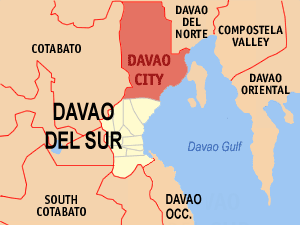
Davao City, officially the City of Davao, is a 1st class highly urbanized city in the island of Mindanao, Philippines. The city has a total land area of 2,443.61 km2 (943.48 sq mi), making it the largest city in the Philippines in terms of land area. It is the third-most populous city in the Philippines after Quezon City and Manila, the most populous city in the country outside Metro Manila, and the most populous in Mindanao. As of the 2015 census, the city had a population of 1,632,991.
Malita, was designated as capital of the new province and government officials of Davao del Sur with assistance from the Department of Interior and Local Government retains jurisdiction over the new province [3] until residents of the province vote for the province's own set of government officials in 2016. [2]
The Provinces of the Philippines are the primary political and administrative divisions of the Philippines. There are 81 provinces at present, further subdivided into component cities and municipalities. The National Capital Region, as well as independent cities, are independent of any provincial government. Each province is governed by an elected legislature called the Sangguniang Panlalawigan and by an elected governor.
A city is one of the units of local government in the Philippines. All Philippine cities are chartered cities, whose existence as corporate and administrative entities is governed by their own specific municipal charters in addition to the Local Government Code of 1991, which specifies their administrative structure and powers. As of December 12, 2015, there were 145 cities.
The Province of Davao was a province of the Philippines in the island of Mindanao. It was divided into three provinces of Davao del Norte, Davao Oriental, and Davao del Sur with the passage of Philippine Republic Act No. 4867 on May 20, 1967. It was one of the largest, most populous and prosperous provinces in the country during its time, being settled by immigrants from the Luzon and Visayas island groups.
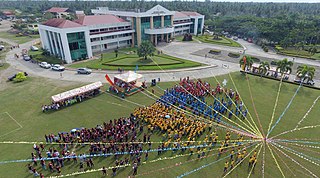
Compostela Valley, or ComVal, is a province in the Philippines located in the Davao Region in Mindanao. The province, called ComVal for short, used to be part of Davao del Norte until it was made independent in 1998.
The Autonomous Region in Muslim Mindanao was an autonomous region of the Philippines, located in the Mindanao island group of the Philippines, that consisted of five predominantly Muslim provinces: Basilan, Lanao del Sur, Maguindanao, Sulu, and Tawi-Tawi. It was the only region that had its own government. The region's de facto seat of government was Cotabato City, although this self-governing city was outside its jurisdiction.

Don Marcelino, officially the Municipality of Don Marcelino, is a 3rd class municipality in the province of Davao Occidental, Philippines. According to the 2015 census, it has a population of 44,554 people.

Jose Abad Santos, officially the Municipality of Jose Abad Santos, is a 1st class municipality in the province of Davao Occidental, Philippines. According to the 2015 census, it has a population of 76,332 people.
Malita, officially the Municipality of Malita, is a 1st class municipality and capital of the province of Davao Occidental, Philippines. According to the 2015 census, it has a population of 117,746 people.
The Legislative District of Davao del Sur is the representation of the province of Davao del Sur in the various national legislatures of the Philippines. The province is currently represented in the lower house of the Congress of the Philippines through its lone congressional district.
The Quezon del Sur creation plebiscite was a plebiscite on the creation of the Province of Quezon del Sur from Quezon; the original Quezon province would have been renamed to "Quezon del Norte" had the plebiscite been approved by the residents of Quezon. The plebiscite was held on December 13, 2008, and the result was a slight majority rejecting the creation of the province.
Barangay elections was held on Monday, October 28, 2013. The election shall elect the Punong Barangay, more commonly known as barangay captains, and members of the Sangguniang Barangay, or barangay council, in 42,028 barangays throughout the Philippines whose terms start on November 30, 2013. Barangays are the smallest local government unit in the Philippines.
An autonomous region of the Philippines is a first-level administrative division and it has the authority to control the region's culture and economy. It is a minority entity that has a higher population of a particular minority ethnic group. The Constitution of the Philippines allows for two autonomous regions: for Cordilleras and Muslim Mindanao.
Gubernatorial elections were held in the Philippines on May 9, 2016. All provinces elected their provincial governors for three-year terms, who will be inaugurated on June 30, 2016 after their proclamation. Governors that are currently serving their third consecutive terms are prohibited from running as governors.

The first Davao Occidental local elections were held on May 9, 2016 as part of the 2016 general election. Voters selected candidates for all local positions: a town mayor, vice mayor and town councilors, as well as members of the Sangguniang Panlalawigan, the governor, vice-governor, and representative for the Lone District of Davao Occidental.
The Legislative District of Davao Occidental is the representation of the province of Davao Occidental in the various national legislatures of the Philippines. The province is currently represented in the lower house of the Congress of the Philippines through its lone congressional district.