
Agathis, commonly known as kauri or dammara, is a genus of 22 species of evergreen tree. The genus is part of the ancient conifer family Araucariaceae, a group once widespread during the Jurassic and Cretaceous periods, but now largely restricted to the Southern Hemisphere except for a number of extant Malesian Agathis.

The weka is a flightless bird species of the rail family. It is endemic to New Zealand. Four subspecies are recognized but only two (northern/southern) are supported by genetic evidence. Weka are sturdy brown birds, about the size of a chicken. As omnivores, they feed mainly on invertebrates and fruit. Weka usually lay eggs between August and January; both sexes help to incubate.

Cephalorhynchus is a genus in the dolphin family Delphinidae.

Phragmites is a genus of four species of large perennial reed grasses found in wetlands throughout temperate and tropical regions of the world.
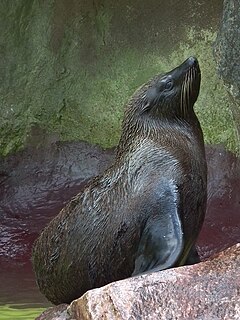
The South American fur seal breeds on the coasts of Peru, Chile, the Falkland Islands, Argentina, Uruguay and Brazil. The total population is around 250,000. However, population counts are sparse and outdated. Although Uruguay has long been considered to be the largest population of South American fur seals, recent census data indicates that the largest breeding population of A. a. australis are at the Falkland Islands followed by Uruguay. The population of South American fur seals in 1999 was estimated at 390,000, a drop from a 1987 estimate of 500,000 - however a paucity of population data, combined with inconsistent census methods, makes it difficult to interpret global population trends.
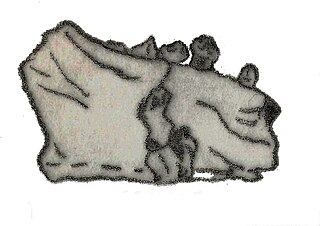
Fabrosaurus is a genus of ornithischian dinosaur that lived during the Early Jurassic. It was originally placed within the now obsolete family Fabrosauridae.

Neuquensaurus is a genus of saltasaurid sauropod dinosaur that lived in the Late Cretaceous, about 80 million years ago in Argentina and Uruguay in South America. Its fossils were recovered from outcrops of the Anacleto Formation around Cinco Saltos, near the Neuquén river from which its name is derived.

The common blossom bat also known as the southern blossom bat or Queensland blossom bat, is a megabat in the family Pteropodidae. The common blossom bat feeds mostly on nectar and pollen rather than fruit. It is one of eight Pteropodidae species on mainland Australia. It is one of the smallest of all nectarivorous megabats.

The little bent-wing bat or little long-fingered bat is a species of vesper bat in the family Miniopteridae. It is found in Australia, Indonesia, the Philippines, and Vanuatu.

Citrus australis, the Dooja, round lime, Australian lime or Australian round lime, is a large shrub or small tree producing an edible fruit. It grows in forest margins in the Beenleigh area and northwards, in Queensland, Australia.

Phragmites australis, known as common reed, is a broadly distributed wetland grass growing nearly 20 ft (6 m) tall.
Eromangasaurus is an extinct genus of elasmosaurid known from northern Queensland of Australia.

Grevillea australis, the Southern grevillea, is a species of flowering plant in the family Protaceae. The only Grevillea to occur naturally in Tasmania, it also grows in highland areas of south-eastern mainland Australia. It has several variations in the wild, and is therefore a very variable species.
Ulmus glabra 'Australis' is a Wych Elm cultivar described by Loudon in 1838, from a tree in the Royal Horticultural Society garden, as U. montana var. australisHort..

Hypogeomys australis is an extinct rodent from central and southeastern Madagascar. First described in 1903, it is larger than its close relative, the living Hypogeomys antimena, which occurs further west, but otherwise similar. Average length of the femur is 72.1 mm, compared to 63.8 mm in H. antimena. One of the few extinct rodents of Madagascar, it survived to at least around 1536 BP based on radiocarbon dating. Little is known of its ecology, but it may have lived in burrows like its living relative and eaten some arid-adapted plants.

Amanita australis is a species of fungus in the family Amanitaceae. It is found only in New Zealand, where it occurs in Leptospermum and Nothofagus forest. The species was first described by New Zealand mycologist Greta Stevenson in 1962; in the same publication Stevenson also described what she thought was a unique species, Limacella macrospora, but over 30 years later this was reduced to synonymy with A. australis.
Diplophos is a genus of bristlemouths.
Diplophos taenia is a species of Stomiiformes in the family Gonostomatidae.
Diplophos orientalis is a species of Stomiiformes in the family Gonostomatidae.
Diplophos pacificus is a species of Stomiiformes in the family Gonostomatidae.

