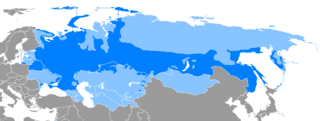
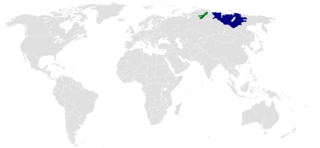
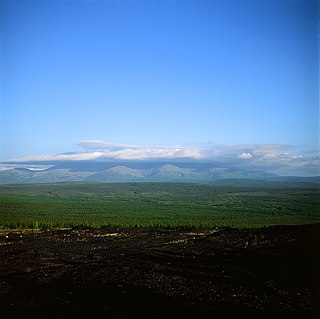
The Poles of Cold are the places in the southern and northern hemispheres where the lowest air temperatures have been recorded.

The Chersky Range is a chain of mountains in northeastern Siberia between the Yana River and the Indigirka River. It generally runs from northwest to southeast through the Sakha Republic and Magadan Oblast. The highest peak in the range is Peak Pobeda, which is 3,003 meters tall. The range lies on the boundary between the Eurasian and North American tectonic plates. The Chersky mountains, along with the neighboring Verkhoyansk Range, have a moderate effect on the climate of Siberia. The ridges obstruct west-moving air flows, decreasing the amount of snowfall in the plains to the west.

Huanta Province is the northernmost of the eleven provinces in the Ayacucho region in Peru. The capital of the Huanta province is the city of Huanta.

Bruntál District is a district (okres) within Moravian-Silesian Region of the Czech Republic. Its capital is Bruntál, but the biggest town is Krnov. Part of the district belongs to Moravia, while another part belongs to Czech Silesia.
Ilya Perfilyev (Perfiryev), was a Russian explorer, polar seafarer and a founder of Verkhoyansk. In the summer of 1633 he headed a group, consisted of merchant-and-industrial people and Yenisey and Tobolsk Cossacks. In 1634 he discovered the Yana River and the Yana-Indigirka lowland.

The Šmarna Gora District, or simply Šmarna Gora, is a district of the City Municipality of Ljubljana, the capital of Slovenia. It has been named after Mount Saint Mary, an inselberg in the north of the city of Ljubljana.

Bębnów is a village in the administrative district of Gmina Gowarczów, within Końskie County, Świętokrzyskie Voivodeship, in south-central Poland. It lies approximately 5 kilometres (3 mi) south-west of Gowarczów, 6 km (4 mi) north of Końskie, and 44 km (27 mi) north of the regional capital Kielce.
Trawniki is a village in the administrative district of Gmina Smyków, within Końskie County, Świętokrzyskie Voivodeship, in south-central Poland. It lies approximately 5 kilometres (3 mi) east of Smyków, 17 km (11 mi) south of Końskie, and 23 km (14 mi) north-west of the regional capital Kielce.
Rybno is a village in the administrative district of Gmina Wierzbinek, within Konin County, Greater Poland Voivodeship, in west-central Poland. It lies approximately 6 kilometres (4 mi) south-west of Wierzbinek, 25 km (16 mi) north-east of Konin, and 106 km (66 mi) east of the regional capital Poznań.
Pólko is a village in the administrative district of Gmina Kaźmierz, within Szamotuły County, Greater Poland Voivodeship, in west-central Poland. It lies approximately 12 kilometres (7 mi) south-west of Szamotuły and 34 km (21 mi) north-west of the regional capital Poznań.
Wilkowo is a village in the administrative district of Gmina Świebodzin, within Świebodzin County, Lubusz Voivodeship, in western Poland. It lies approximately 5 kilometres (3 mi) west of Świebodzin, 36 km (22 mi) north of Zielona Góra, and 56 km (35 mi) south of Gorzów Wielkopolski.
Zielonówek is a village in the administrative district of Gmina Olecko, within Olecko County, Warmian-Masurian Voivodeship, in northern Poland. It lies approximately 3 kilometres (2 mi) west of Olecko and 132 km (82 mi) east of the regional capital Olsztyn.
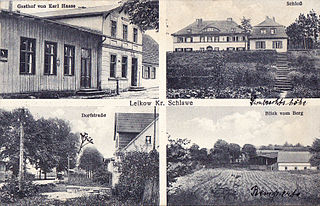
Lejkowo is a village in the administrative district of Gmina Malechowo, within Sławno County, West Pomeranian Voivodeship, in north-western Poland. It lies approximately 9 kilometres (6 mi) south-east of Malechowo, 15 km (9 mi) south-west of Sławno, and 161 km (100 mi) north-east of the regional capital Szczecin.

Buford is a hamlet in central Alberta, Canada within Leduc County. It is located 2 kilometres (1.2 mi) south of Highway 39, 23 kilometres (14 mi) west of Leduc.
Gababedji is a village and rural commune in Niger.
Oud-Charlois is a neighborhood of Rotterdam, Netherlands.

The Sartang River is a river in the Republic of Sakha in Russia. It is an easterly offshoot of the Yana, and is 620 kilometres (390 mi) long, with a drainage basin of 17,800 square kilometres (6,900 sq mi).