
Isopoda is an order of crustaceans. Members of this group are called Isopods and include both terrestrial and aquatic species such as woodlice. All have rigid, segmented exoskeletons, two pairs of antennae, seven pairs of jointed limbs on the thorax, and five pairs of branching appendages on the abdomen that are used in respiration. Females brood their young in a pouch under their thorax.
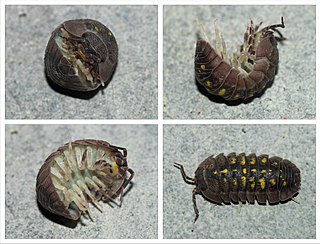
Armadillidiidae is a family of woodlice, a terrestrial crustacean group in the order Isopoda. Unlike members of some other woodlice families, members of this family can roll into a ball, an ability they share with the outwardly similar but unrelated pill millipedes and other animals. This ability gives woodlice in this family their common names of pill bugs or roly polies. Other common names include slaters, potato bugs, butchy boys, and doodle bugs. Most species are native to the Mediterranean Basin, while a few species have wider European distributions. The best-known species, Armadillidium vulgare, was introduced to New England in the early 19th century and has become widespread throughout North America.
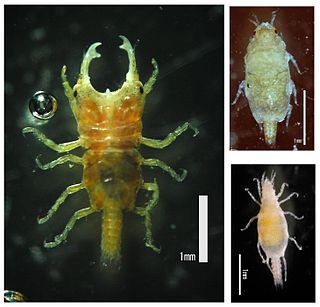
The Gnathiidae are a family of isopod crustaceans. They occur in a wide range of depths, from the littoral zone to the deep sea. The adults are associated with sponges and may not feed. The juvenile form is known as a 'praniza', and it is a temporary parasite of marine fish. These forms are not larvae; Gnathiidae instead become parasitic during the manca stage. Mancae of the Gnathiidae closely resemble the adult form, however they lack the final pair of pereiopods.
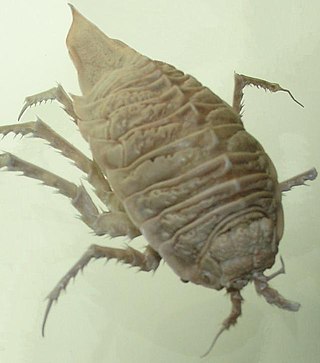
The Valvifera are marine isopod crustaceans. Valviferans are distinguished, however, by the flat, valve-like uropods which hinge laterally and fold inward beneath the rear part of their bodies, covering the pleopods. Some species are omnivorous, and serve as effective scavengers in the economy of the sea.

Metatrichoniscoides is a genus of isopod crustacean in family Trichoniscidae.
Moserius is a genus of crustacean in family Trichoniscidae, with two described species:

Woodlice are terrestrial isopods in the suborder Oniscidea. Their name is derived from being often found in old wood, and from louse, a parasitic insect, although woodlice are neither parasitic nor insects.
Iais is a genus of isopod crustaceans. Iais species are found in association with larger isopods of the family Sphaeromatidae, usually on the ventral surface of the larger animal, between the pereiopods and on the pleopods. They are native to Australasia and South America, although Iais californica and its host Sphaeroma quoyanum have invaded California, and I. californica was first described from Sausalito, California.
Dynoides is a genus of isopod crustaceans in the family Sphaeromatidae, containing the following species:

Dynoides elegans is a species of isopod crustacean in the genus Dynoides. It was originally described in 1923 by Pearl Lee Boone as "Cianella elegans" based on specimens from La Jolla and San Pedro, California. It was transferred to the genus Dynoides in 2000, when Boone's genus was sunk into synonymy with Dynoides.
Suarezia is a genus of woodlice, in the family Scleropactidae, containing the two species Suarezia differens and Suarezia heterodoxa, both of which are endemic to Madagascar.
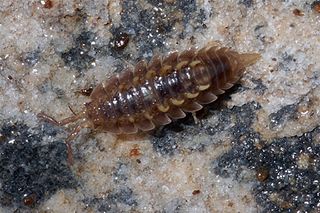
Deto is a genus of woodlice in the family Detonidae. Members of this genus can be found along the coasts in areas of New Zealand, Namibia, South Africa and Australia.
Dynoides viridis is a species of isopod in the family Sphaeromatidae. It was first found on Heron Island, Great Barrier Reef.

Euidotea is a genus of marine isopods belonging to the family Idoteidae. The species of this genus are found in Australia and New Zealand.

Paxodillidium is a genus of woodlice endemic to Greece. It is monotypic, being represented by the single species Paxodillidium schawalleri. Its true affinities within the family Armadillidiidae are not known.

Eluma is a genus of woodlice in the family Armadillidiidae. The members of this genus are native to the Iberian Peninsula, Morocco, the Atlantic islands of the Azores, Canaries and Madeira, and from the west of France to the British Isles.

Ctenorillo is a genus of woodlouse within the family Armadillidae.

Schizidium is a genus of woodlice, found from Greece to Iran.
Eluma caelata is a species of woodlouse found throughout Western Europe and Northwestern Africa. It has been introduced to other regions, such as French Guiana. It was first described as Armadillidium caelatum.
Eluma praticola is a species of woodlouse, found throughout northeastern Morocco in the Oued Laou basin. Its name derives from the Latin word for meadow (pratum) and the stem of the Latin word for live (colere).
