
The Molidae comprise the family of the molas or ocean sunfishes, unusual fish whose bodies come to an end just behind the dorsal and anal fins, giving them a "half-fish" appearance. They are also the largest of the ray-finned bony fish, with the southern sunfish, Mola alexandrini, recorded at 4.6 m (15 ft) in length and 2,744 kg (6,049 lb) in weight.
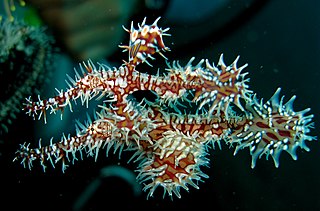
Solenostomus, also known as the ghost pipefishes, false pipefishes or tubemouth fishes, is a genus of fishes in the order Syngnathiformes. Solenostomus is the only genus in the family Solenostomidae, and includes six currently recognized species. Ghost pipefishes are related to pipefishes and seahorses. They are found in tropical waters of the Indo-Pacific.
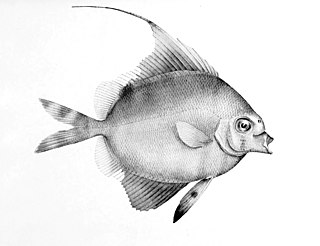
Sailfin moonfishes are a small family, Veliferidae, of lampriform fishes found in the Indian and western Pacific Oceans. Unlike other lampriforms, they live in shallow, coastal waters, of less than 100 m (330 ft) depth, rather than in the deep ocean. They are also much smaller than most of their relatives, up to 30 cm (12 in) in length, and have deep, rather than elongated, bodies. They are characterised by their ability to retract the anterior rays of their dorsal and anal fins into a sheath.
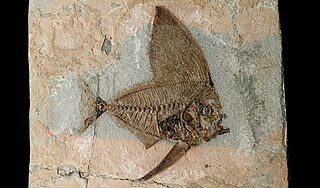
Exellia is a genus of extinct spadefish that lived in the Tethys Ocean during the early Paleogene. The adult form is shaped akin to a large spadefish or a short dolphinfish, with very large pelvic fins, and a long dorsal fin starting from in front of the eyes to near the base of the caudal peduncle. The juvenile form resembles a juvenile drumfish, with the dorsal fin forming a long crest on top of the head.

Eoluvarus bondei is a species of extinct bony fish once identified as being a luvar from the Fuller's Earth Ypresian formation of the Barmer District of Rajasthan, India. Later, better quality specimens were found, and E. bondei was reappraised as being a relative of the prehistoric spadefish, Exellia.

Avitoluvarus is a genus of extinct louvar that lived in the Peri-Tethys Sea during the early Paleogene. The first specimens were found from the Danata Formation Lagerstätten, of the Ypresian age of Turkmenistan, where they were originally thought to be smaller or juvenile individuals of the true louvar, Luvarus necopinatus. These specimens were later reexamined, and determined to be a separate genus comprising two species.

Ceratoichthys is an extinct genus of lookdown-like prehistoric jackfish that lived during the late Ypresian epoch, of the Early Eocene. It contains a single species, C. pinnatiformis of Monte Bolca, Italy. It and Vomeropsis are the only known members of the extinct subfamily Vomeropsinae.

Aeoliscoides is an extinct genus of prehistoric ray-finned fish that lived from the early Eocene. It is known from a single species, A. longirostris, from the famous Monte Bolca site of Italy. It was a member of Centriscidae, making it a relative of modern shrimpfish and snipefish. Its name references its close resemblance to the extant shrimpfish genus Aeoliscus.
Aulostomoides is an extinct genus of prehistoric marine ray-finned fish from the early Eocene. It contains a single species, A. tyleri from the Monte Bolca site of Italy. It is thought to be a member of Aulostomoidea, making it a relative of trumpetfish and cornetfish.
Calamostoma is an extinct relative of the ghost pipefish that lived during the early Eocene. It contains a single species, C. lesiniforme from the famous Monte Bolca site of Italy. It is one of the few known fossil ghost pipefishes. Calamostoma and the other Bolca solenostomid, Solenorhynchus, are both placed in the extinct subfamily Solenorhynchinae.
Aulorhamphus is an extinct genus of prehistoric marine ray-finned fish that lived from the early to middle Eocene. It contains four species known from the Early Eocene of Italy and the Middle Eocene of Russia. It was an aulorhamphid, an extinct family of syngnathiform fishes.
Anguilloides is an extinct genus of prehistoric marine eel that lived in the early Eocene. It contains a single species, A. branchiostegalis. Fossils are known from the famous Monte Bolca site of Italy.
Bolcanguilla is an extinct genus of prehistoric marine eel that lived during the early division of the Eocene epoch. It contains a single species, B. brachycephala from the Monte Bolca site of Italy. Its exact taxonomic affinities within the Anguilliformes remain uncertain.

Acanthonemus is an extinct genus of prehistoric marine ray-finned fish that lived from the early Eocene. It contains a single species, A. subaureus, known from the famous Monte Bolca site in Italy. It is the only genus in the extinct family Acanthonemidae.

Carangodes is an extinct genus of prehistoric ray-finned fish that lived during the early Eocene. It contains a single species, C. bicornis, from the famous Monte Bolca site in Italy. It is the only known member of the extinct perciform family Carangodidae.
Acanthopygaeus is an extinct genus of prehistoric marine perciform fish in the family Siganidae. It is known from the Eocene lagerstätte "Pesciara" in Bolca, Italy.
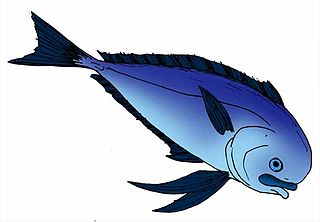
Aluvarus praeimperialis is an extinct ray-finned fish, known from two headless fossil specimens found in the Pabdeh Formation, a Late Eocene stratum from the Priabonian epoch, of what is now Iran. A. praeimperialis was originally thought to be a luvar, described as "Luvarus praeimperialis", as it was thought to be a predecessor to the modern luvar. A later reexamination of the specimens showed that they were too incomplete to demonstrate such a conclusion and had no clear exclusive shared traits with luvar, and were renamed "Aluvarus", meaning "not luvar" or "different than luvar". However, some authorities still retain it as a luvar.

Dalpiazella is an extinct genus of prehistoric marine eel from the Eocene of Europe. It contains a single species, D. brevicauda, from the late Ypresian-aged Monte Bolca lagerstatten of Italy. It is though to be closely related to the sympatric genus Paranguilla, with both genera together constituting the family Paranguillidae.
Caucasichthys is an extinct genus of perciform bony fish which existed in Russia during the middle Eocene epoch. It is known from the Gorny Luch locality of northern Caucasus. It was first named by Alexandre F. Bannikov, Giorgio Carnevale and N. V. Parin in 2011 and the type species is Caucasichthys kumaensis. The generic name comes from Caucas, from Caucasus and ichthys, fish. The specific name is derived from the Kuma Horizon, where the fossils were found.


