
Curetis bulis, the bright sunbeam, is a species of butterfly belonging to the lycaenid family. It is found in Asia.
Ypsolopha delicatella is a moth of the family Ypsolophidae. It is known from the United States, including Arizona and California.

Cosmopterix eukelade is a moth of the family Cosmopterigidae. It is known from Peru.

Cosmopterix gemmiferella is a moth of the family Cosmopterigidae. It is known from the United States and Canada (Ontario).
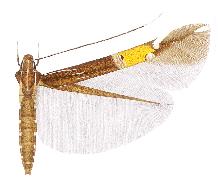
Cosmopterix helike is a moth of the family Cosmopterigidae. It is known from Goiás, Brazil.

Cosmopterix himalia is a moth of the family Cosmopterigidae. It is known from the Federal District of Brazil.

Cosmopterix interfracta is a moth of the family Cosmopterigidae. It is known from Brazil, Cuba, the Dominican Republic, Jamaica and Puerto Rico.
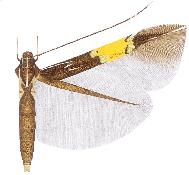
Cosmopterix isotoma is a moth of the family Cosmopterigidae. It is known from the Federal District and Pará in Brazil and from Guyana.

Cosmopterix lespedezae is a moth of the family Cosmopterigidae. It is known from the United States.
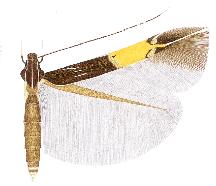
Cosmopterix teligera is a moth of the family Cosmopterigidae. It is known from the United States, Brazil, Colombia, Costa Rica, Cuba, Jamaica and Mexico (Tamaulipas).
Battaristis cyclella is a moth of the family Gelechiidae. It was described by August Busck in 1903. It is found in North America, where it has been recorded from Arizona and Utah.
Anacampsis kearfottella is a moth of the family Gelechiidae. It was described by August Busck in 1903. It is found in North America, where it has been recorded in Kentucky, Pennsylvania and New Jersey.
Aristotelia argentifera is a moth of the family Gelechiidae. It was described by August Busck in 1903. It is found in North America, where it has been recorded from California and western Nevada.
Monochroa angustipennella is a moth of the family Gelechiidae. It was described by James Brackenridge Clemens in 1863. It is found in North America, where it has been recorded from California, Illinois, Maine, New Jersey, New York, Ohio, Oklahoma and Pennsylvania.
Hamadera aurea is a moth in the family Depressariidae, and the only species in the genus Hamadera. It was described by August Busck in 1914 and is found in Panama.
Hastamea argentidorsella is a moth in the family Depressariidae, and the only species in the genus Hastamea. It was described by August Busck in 1911 and is found in Brazil (Paraná).
Filinota rhodograpta is a moth in the family Depressariidae. It was described by Edward Meyrick in 1915. It is found in Guyana and Pará, Brazil.
Filinota gratiosa is a moth in the family Depressariidae. It was described by Cajetan Felder, Rudolf Felder and Alois Friedrich Rogenhofer in 1875. It is found in Venezuela, Brazil and Peru.
Filinota ignita is a moth in the family Depressariidae. It was described by August Busck in 1912. It is found in Panama.
Chlamydastis acronitis is a moth in the family Depressariidae. It was described by August Busck in 1911. It is found in French Guiana and Guyana.

