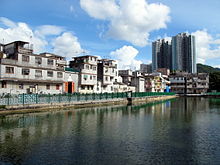
| Five Great Clans of the New Territories | |||||||||||
|---|---|---|---|---|---|---|---|---|---|---|---|
| Chinese | 新界五大氏族 | ||||||||||
| |||||||||||
The Five Great Clans of the New Territories are the five families that settled before the seventeenth century and became sizeable in the New Territories of Hong Kong.
They are the Tang ( 鄧 ),Man ( 文 ),Hau ( 侯 ),Pang ( 彭 ) and Liu ( 廖 ). [1]
Originated from Jishui of Jiangxi province, the Tangs were the first settled in the New Territories amongst the five clans, and were considered to be the first amongst all with the massive population and land. Tang Foo-hip migrated to now Kam Tin, Yuen Long in the early 11th century. [2] Two out of the five major branches remained in Hong Kong (Ping Shan and Kam Tin) while the other three moved back to mainland China. Descendants of Tang of Kam Tin further spread to Ha Tsuen, Tsz Tin Tsuen, Lung Yeuk Tau, Sha Tau Kok, Tai Po Tau, and other places. [3] Tangs also built ancestral and study halls, and markets near the villages, notably markets of Yuen Long and Tai Po, which were considered to have greatly contributed the development of New Territories. [4]
Man of San Tin had their ancestral root in Ji'an of Jiangxi. Man Tin-sui (文天瑞), the earliest traceable ancestor who is cousin of former Grand Chancellor Man Tin-cheung, fled to Dongguan during the late Southern Song dynasty. Man Sai-ko (文世歌), 7th general after Man Tin-sui, settled in San Tin during the era of Yongle Emperor's reign. At its peak, the Man Clan owned 40 million square feet of land in Lok Ma Chau. [5]
Ancestors of Liu Clan initially resided in Yongding of Fujian. During the Yuan dynasty, Liu Chung-kit (廖仲傑) moved to Tuen Mun and Futian until his eventual stay near Sheung Yue River. [6] His son Liu Chi-yuk (廖自玉) founded the village of Sheung Shui Heung after the Kans left. According to myths, the Lius dressed up as ghosts to spook the Kans, forcing them to relocate to Tsung Pak Long. Nowadays Liu Clan would still thank the Khan during their rituals. [7] Majority of the Liu Clan still lived in Sheung Shui Wai, whilst some branches moved to Cheung Muk Tau and Ngau Pei Sha.
The Liu Clan, during Qing's rule, established Shek Wu Hui, [8] and brought tremendous fortune to the clan because of its proximity with Shenzhen market, overtaking the Hau Clan in the same region. The family owned land as far as So Kon Po on the Hong Kong Island. [9]
The Hau Clan arrived in modern-day Hong Kong towards the end of the 12th century, during the Southern Song dynasty. They first settled at Ho Sheung Heung. They later settled three branch-villages: Yin Kong, Kam Tsin and Ping Kong. [1]
Hau Clan of Sheung Shui originated from Panyu of Guangdong. Hau Cheuk-fung (侯卓峰) later moved to Ho Sheung Heung, [10] with two sons relocating to Kam Tsin and other places. The then powerful clan formed two clans in Sheung Shui (near nowadays Hang Tau and Shek Wu Hui), but was eventually surpassed by the Liu Clan. Fanling Golf Course was built as a result of negotiation between the Hau Clan and the Hong Kong Government in 1908, which the former was compensated for the loss of ancestral land. [4]
Pang Clan rooted in Yichun, Jiangxi until Pang Kwai (彭桂) and his family relocated to Lung Yeuk Tau of Fanling. In the late Yuan dynasty Pangs were forced out by the migrating Tangs and lived in Fan Leng Lau instead. [11] Offspring of Pang Clan also resided in Tsiu Keng, Ting Kok, So Kwun Po, and So Kon Po of Liu Clan's leased land. [12] [13] In the late 1940s, Pang formed Luen Wo Hui with other nearby villages to challenge Tang's Shek Wu Hui. [14]
Yuen Long District is one of the districts of Hong Kong. Located in the northwest of the New Territories, it had a population of 662,000 in 2021.
Most of the walled villages of Hong Kong are located in the New Territories.
Sheung Shui is an area in the New Territories, Hong Kong. Sheung Shui Town, a part of this area, is part of the Fanling–Sheung Shui New Town in the North District of Hong Kong. Fanling Town is to its southeast.
Fanling is a town in the New Territories East of Hong Kong. Administratively, it is part of the North District. Fanling Town is the main settlement of the Fanling area. The name Fanling is a shortened form of Fan Pik Leng (粉壁嶺). The area has several public and private estates.
Sheung Shui Wai, also known as Sheung Shui Heung (上水鄉) is an area in Sheung Shui, in the northern part of the New Territories of Hong Kong. Its population is around 6,000 people.
Castle Peak Road is the longest road in Hong Kong. Completed in 1920, it runs in the approximate shape of an arc of a semi-circle. It runs West from Tai Po Road in Sham Shui Po, New Kowloon, to Tuen Mun, then north to Yuen Long then east to Sheung Shui, in the very north of the New Territories. It is divided into 22 sections. It serves south, west and north New Territories, being one of the most distant roads in early Hong Kong.
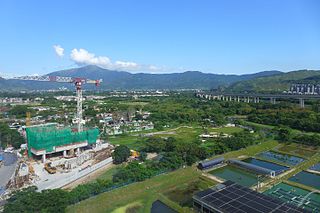
Kam Tin, or Kam Tin Heung, is an area in the New Territories, Hong Kong. It lies on a flat alluvial plain north of Tai Mo Shan mountain and east of Yuen Long town. It was formerly known as Sham Tin (岑田). Administratively, it is part of Yuen Long District.
Lam Tsuen is an area in Tai Po District, Hong Kong, noted for its Lam Tsuen wishing trees. The nearby Lam Tsuen River, empties into Tai Po Hoi.
Fanling Highway is a part of Route 9 in Hong Kong. It connects the new town of Tai Po and San Tin Highway, passing through Sheung Shui and Fanling on its way. The three lane expressway was constructed between 1983 and 1987.
Shap Pat Heung is an area in the New Territories of Hong Kong. Located south of Yuen Long and northeast of Tai Tong, the area occupies the plain north of hills of Tai Lam. The Cantonese name 'Shap Pat Heung' means 'eighteen villages' at its beginning. It was later expanded to thirty villages. Administratively, it is part of the Yuen Long District.
The Tang Clan of Hong Kong is one of the Five Great Clans of the New Territories. The others are Man (文), Hau (侯), Pang (彭) and Liu (廖).
There are three plains in Hong Kong, in the northern New Territories. These plains are Yuen Long, Fanling, and Tai Po.
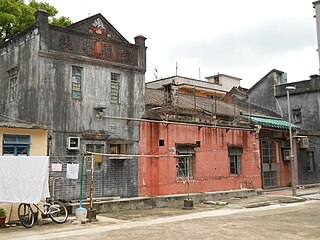
Kam Tsin, also known as Kam Tsin Tsuen (金錢村), is a village and an area in the North District, in the New Territories in Hong Kong.
Shui Tau Tsuen is a 17th century village in Kam Tin area, Yuen Long District, New Territories, Hong Kong. Kam Tin is the origins of Tang Clan (鄧), one of the Five Great Clans of Hong Kong.
Yuen Long Kau Hui is an area in Yuen Long, Yuen Long District, in the western New Territories of Hong Kong.
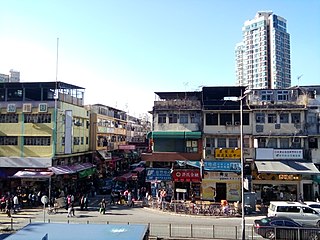
Shek Wu Hui is a non-administrative subdivision (neighbourhood) and former indigenous market town located in Sheung Shui in the North District of Hong Kong. The place name can be found in the record that published in 1819.
Hong Lok Yuen is a low-density luxury residential housing estate in Tai Po District, New Territories, Hong Kong, located near Cloudy Hill. It is north of Tai Po Town.
Tai Po Tsat Yeuk was an inter-village alliance in today's Hong Kong. It collectively comprised 64 villages.