The Yongle Emperor (2 May 1360 – 12 August 1424), personal name Zhu Di,[vi] was the third emperor of the Ming dynasty, reigning from 1402 to 1424. He was the fourth son of the Hongwu Emperor, the founder of the dynasty.
In 1370, Zhu Di was granted the title of Prince of Yan. By 1380, he had relocated to Beijing and was responsible for protecting the northeastern borderlands. In the 1380s and 1390s, he proved himself to be a skilled military leader, gaining popularity among soldiers[3] and achieving success as a statesman. In 1399, he rebelled against his nephew, the Jianwen Emperor, and launched a civil war known as the Jingnan campaign, or the "campaign to clear away disorders". After three years of intense fighting, he emerged victorious and declared himself emperor in 1402.
The reign of the Yongle Emperor is often described as the "second founding" of the Ming dynasty, reflecting the major changes he introduced to his father's political system.[4] In 1403, he elevated Beijing to the status of a second capital, diminishing the importance of Nanjing. Construction of the new capital between 1407 and 1420 employed hundreds of thousands of workers, with the Imperial City and the Forbidden City forming its core.[5] The Emperor also supervised the reconstruction of the Grand Canal, essential for supplying Beijing and the northern armies.
The Emperor strongly supported both Confucianism and Buddhism and sponsored the compilation of the vast Yongle Encyclopedia, employing around two thousand scholars. This work surpassed all earlier encyclopedias, including the Four Great Books of Song from the 11th century. He also ordered Neo-Confucian texts to be systematized and used as textbooks for training officials. The civil service examinations, held every three years, produced qualified candidates for government service. Although known for imposing harsh punishments on failure, the Emperor readily rewarded capable officials.[6] Unlike his father, he avoided frequent purges, resulting in longer ministerial tenures and a more professional, stable administration. The Emperor often ruled "from horseback", traveling between the two capitals in a manner reminiscent of the Yuan emperors. This approach, however, was criticized by officials who feared the growing influence of eunuchs and military elites, whose power depended on imperial favor.[7]
The Emperor made considerable efforts to reinforce the empire's hegemonic position in East Asia through an active foreign policy. Diplomatic missions and military expeditions were dispatched to "all four corners of the world", reaching regions both near and distant, including Manchuria, Korea, Japan, the Philippines, and the Timurid Empire in Central Asia. Zheng He's maritime expeditions extended even further, reaching the shores of Southeast Asia, India, Persia, and East Africa. The Mongols remained the most serious security threat to the empire. They were divided into three main groups: the southeastern Uriankhai, who were largely loyal, and the eastern Mongols and western Oirats, who posed ongoing challenges. The Ming court alternately supported and confronted these groups. The Emperor personally led five campaigns into Mongolia, and his decision to transfer the government from Nanjing to Beijing was driven largely by the need to closely monitor the unstable northern frontier.
The Yongle Emperor was a skilled military leader and placed great emphasis on the strength of his army, but his wars were ultimately unsuccessful. The war in Đại Việt (present-day northern Vietnam), which began with an invasion in 1407, lasted until the end of his reign. Four years after his death, the Ming army was forced to retreat back to China. Despite his efforts, the campaigns against the Mongols did not significantly alter the balance of power or ensure the security of the northern border.[8]
Zhu Di, the future Yongle Emperor, was born on 2 May 1360 as the fourth son of Zhu Yuanzhang. At the time, Zhu Yuanzhang was based in Nanjing and was a prominent leader in the Red Turban Rebellion, an uprising against the Mongol-led Yuan dynasty that controlled China. The rebellion aimed to restore Han Chinese rule after decades of Mongol domination. In the 1360s, Zhu Yuanzhang conquered China, established the Ming dynasty, and declared himself emperor.[9] He is commonly known by his era name as the Hongwu Emperor.[10]
After taking the throne, Zhu Di claimed to be the son of Zhu Yuanzhang's primary wife, Lady Ma, who had been empress since 1368, but other sources suggest that his real mother was a concubine of the Hongwu Emperor with the title Consort Gong, who was either Mongolian (from the Khongirad tribe)[11] or possibly Korean.[12] Zhu Di attempted to present himself as the Hongwu Emperor's legitimate successor by declaring himself and the Hongwu Emperor's fifth son, Zhu Su, as the only sons of Empress Ma in the 1403 edition of the official Veritable Records of Taizu.[vii] This was preposterous, as it was unlikely that a son of the Empress would not be named as successor during the Hongwu Emperor's lifetime. Therefore, in the later version of 1418, all of the Hongwu Emperor's eldest five sons were recognized as her children.[14]
Zhu Di spent his childhood in Nanjing, where he and his siblings were raised with a strong emphasis on discipline and modesty. Out of all his siblings, he had a special fondness for Princess Ningguo, Zhu Fu and Zhu Su. Zhu Su was only 15 months younger than Zhu Di, and they became close friends despite their contrasting personalities. While Zhu Di enjoyed activities such as archery and horseback riding, Zhu Su preferred studying literature and tending to plants.[15]
The Hongwu Emperor took great care in the education of his sons, appointing leading scholars of the empire as their tutors. Initially, Song Lian was appointed as the teacher for the heir to the throne, and also gave lectures to the other princes. Song Lian's successor, Kong Keren (孔克仁), who taught the Emperor's sons philosophy and ethics, had a significant influence on Zhu Di. His favorite subject was the history of the Han dynasty, particularly Emperors Gaozu and Wu of Han, but he often referenced examples from the life of Qin Shi Huang in his decrees as emperor.[16]
Youth
On 22 April 1370, the Emperor's sons, with the exception of the heir to the throne, were granted princely titles. Zhu Di was given the title of Prince of Yan, with his fief located in Beiping (present-day Beijing).[17] During the Mongol-led Yuan dynasty, Beiping served as the capital of China. After being conquered by the Ming dynasty in 1368, it became a crucial stronghold for the troops guarding the northern border and was also designated as the capital of the province with the same name.[18]
At that time, Zhu Di was given his own household, with advisor Hua Yunlong[viii] and tutor Gao Xian at its head. Gao Xian spent the next four to five years lecturing him on Confucian classics, history, agriculture, and irrigation. He also trained the prince in poetry and prose writing, and explained the rules of governance and the selection of subordinates. After Hua's death and Gao's dismissal, Fei Yu, Qiu Guang, Wang Wuban, and Zhu Fu took over Zhu Di's education.[19][ix] Despite receiving a comprehensive education from esteemed teachers, Zhu Di's true passion always lay in military pursuits rather than scholarly pursuits and palace discussions.[21]
In early 1376, Zhu Di married Lady Xu, the daughter of Xu Da, who was ranked first among the early Ming generals. She was two years younger than him.[21] Lady Xu was known for her intelligence, decisiveness, and energy. Their first son, Zhu Gaochi, was born on 16 August 1378.[22] The couple had two more sons, Zhu Gaoxu and Zhu Gaosui.[23]
A few weeks after his wedding, Zhu Di traveled to Fengyang (then known as Zhongdu, the Central Capital), where he spent seven months in military training alongside his elder brothers Zhu Shuang and Zhu Gang. Two years later, he returned to Fengyang with his younger brothers Zhu Su, Zhu Zhen, and Zhu Fu, remaining there for another two years. During this period, he not only trained in command and combat but also learned military logistics, including the acquisition and transport of supplies. It was at this time that his organizational abilities began to take shape, skills he later applied effectively in warfare. He also disguised himself as an ordinary soldier to experience the lives of common people, and later recalled his years in Fengyang as the happiest of his life.[24]
In 1376, Li Wenzhong, the nephew and adopted son of the Hongwu Emperor and the official responsible for northern defense, was tasked with preparing Zhu Di's palace in Beiping. Using former Yuan imperial palaces, he provided Zhu Di with a residence that was larger and more heavily fortified than those of his brothers, many of whom lived in converted temples or local government buildings. Li Wenzhong also strengthened the city's defenses, a decision that later proved significant during the civil war when his son, Li Jinglong, failed to capture Beiping in 1399.[25]
Prince of Yan in Beiping
In April 1380,[26] at the age of twenty, Zhu Di moved to Beiping, where he encountered strong Mongolian cultural influences that the government sought to suppress by banning Mongolian customs, clothing, and names.[27] The city had largely recovered from the famines and wars of the 1350s and 1360s and was undergoing renewed growth. It housed hundreds of thousands of soldiers, along with provincial officials, artisans, and laborers from across the empire. The primary challenge for local authorities was ensuring an adequate food supply. To address this, peasants were resettled in the north, soldiers and convicts were assigned to farm the land, and merchants were granted salt-trading licenses in exchange for transporting grain to the region.[18][x] The government also shipped food supplies directly to the city.[27]
Zhu Di's interest in the military was put into practice when he personally trained his own guard.[27] He used his detachments as a means of balancing the power of the provincial commander, who was unable to mobilize troops without authorization from the Emperor and approval from the prince. Meanwhile, Zhu Di had the freedom to train and deploy his own guard.[28][29] In 1381, he had his first experience in the field when he joined his father-in-law Xu Da's campaign against the Mongols, led by Nayur Buqa.[27]
In the 1380s, Zhu Di served in border defense under the leadership of Xu Da. After Xu Da died in 1385, his deputy Fu Youde took over leadership. In 1387, Zhu Di participated in a successful attack on the Mongols in Liaodong, led by Feng Sheng. The following year, a Ming army led by Lan Yu made a foray into eastern Mongolia and defeated the Mongol khan Tögüs Temür, capturing many prisoners and horses, but both generals were accused of mistreating captives and misappropriating booty, which the prince reported to the Emperor.[30]
In January 1390, the Emperor entrusted his sons with independent command for the first time. He gave the princes of Jin (Zhu Gang), Yan (Zhu Di), and Qi (Zhu Fu) the task of leading a punitive expedition against the Mongol commanders Nayur Buqa and Alu Temür, who were threatening Shanxi and Gansu. Zhu Di demonstrated excellent command skills when he defeated and captured both Mongol commanders in battle. They then served under him with their troops.[31] The Emperor appreciated Zhu Di's success, which contrasted with the hesitancy of Zhu Gang. Zhu Di continued to lead armies into battle against the Mongols repeatedly and with great success.[32]
In 1392, the Emperor's eldest son and heir, Zhu Biao, died, prompting court discussions over the succession. The principle of primogeniture, supported by Hanlin Academy scholars and senior officials, ultimately prevailed, and Zhu Biao's son, Zhu Yunwen, was named heir. Generals Feng Sheng, Fu Youde, and Lan Yu, who were related to the successor, were appointed as his tutors.[33] After a recommendation by Zhu Di, the Hongwu Emperor began to suspect these generals of treason.[34] Zhu Di had a poor relationship with Lan, and according to historian Wang Shizhen (1526–1590), he played a role in Lan's execution in March 1393. The other two generals died under unclear circumstances around 1394–1395. They were subsequently replaced by princes. In 1393, Zhu Gang was given command of all troops in Shanxi province, while Zhu Di was placed in command of Beiping province.[34] Zhu Shuang, Prince of Qin, was in charge of Shaanxi, but died in 1395.[35]
The Hongwu Emperor, who was deeply affected by the death of his two eldest sons and the strained relations between his remaining sons and his heir, made the decision to revise the rules governing the imperial family for the fourth time.[36] The new edition significantly limited the rights of the princes.[xi] These changes had little impact on Zhu Di's status as they did not affect his main area of expertise—the military.[38] Furthermore, Zhu Di was cautious not to give any reason for criticism. For example, he did not object to the execution of his generals Nayur Buqa and Alu Temür, who were accused of treason. He also exercised caution in diplomatic relations, such as when he welcomed Korean delegations passing through Beiping, to avoid any indication of disrespect towards the Emperor's authority.[38]
Out of the six princes[xii] responsible for guarding the northern border, Zhu Di was the second oldest but also the most capable. He had operated in a vast territory, stretching from Liaodong to the bend of the Yellow River. He was not afraid to take risks, as demonstrated by his defeat of the Mongols led by Polin Temür at Daning in the summer of 1396.[39] He also went on a raid with his brother Zhu Gang several hundred kilometers north of the Great Wall, which earned them a sharp reprimand from their father.[40] In April 1398, Zhu Gang died, leaving Zhu Di as the undisputed leader of the northern border defense.[41] Two months later, Zhu Di's father also died.[42]
After the death of the Hongwu Emperor, Zhu Yunwen ascended the throne as the Jianwen Emperor.[43] His closest advisors immediately began reviewing the Hongwu Emperor's reforms, with the most significant change being an attempt to limit and eventually eliminate the princes who were the sons of the Hongwu Emperor and controlled a significant portion of the empire's military power.[44] The government employed various methods to remove five of the princes,[xiii] including exile, house arrest, and even driving them to suicide.[45]
Zhu Di was regarded as the most dangerous of the princes.[46] As a seasoned military leader and the eldest surviving son of the Hongwu Emperor, he was seen as a serious threat to the regime. Consequently, the court treated him cautiously and sought to limit his power by replacing military commanders in the northeast with generals loyal to the Jianwen Emperor and transferring 15,000 troops away from his command in Beiping.[47] Despite these measures, Zhu Di succeeded in convincing the Emperor of his loyalty. He petitioned for leniency toward his brother Zhu Su[45] and requested the return of his sons, who had remained in Nanjing since the Hongwu Emperor's funeral and were effectively held as hostages.[12] In June 1399, the Emperor's advisor Huang Zicheng persuaded him that releasing Zhu Di's sons would help reduce tensions.[47]
In early August 1399, Zhu Di used the arrest of two of his officials as a pretext for rebellion.[48] He claimed that he was rising up to protect the Emperor from the corrupt court officials. With the support of Beijing dignitaries,[xiv] he gained control of the city's garrison and occupied the surrounding prefectures and counties.[49] He attempted to justify his actions through letters sent to the court in August and December 1399, as well as through a public statement.[48]
In his letters and statements, Zhu Di repeatedly claimed that he had no ambition for the throne, but as the eldest surviving son of the late emperor, he believed it was his duty to restore laws and order that had been undermined by the new government, out of respect for his father. He accused the reigning emperor and his advisors of concealing information about his father's illness and preventing him from attending the funeral. He also criticized their harsh treatment of the Emperor's uncles, who were his younger brothers. Zhu Di framed his actions as self-defense, not against the Emperor himself but against corrupt ministers, and described them as the Jingnan campaign—a campaign to clear away disorders.[48]
Civil war
Battles in northern China and the siege of Beiping, 1399
At the start of the war, Zhu Di commanded a force of 100,000 soldiers and only held control over the immediate area surrounding Beiping. Despite the Nanjing government's larger number of armies and greater material resources, Zhu Di's soldiers were of higher quality and he possessed a strong Mongol cavalry. Most importantly, his military leadership skills were superior to the indecisiveness and lack of coordination displayed by the government's generals.[50]
In September 1399, a government army of 130,000 soldiers, led by the experienced veteran general Geng Bingwen, marched towards Zhending, a city located southwest of Beiping, but by the end of the month, they were defeated. In response, the court appointed a new commander, Li Jinglong, who then led a new army to besiege Beiping on 12 November.[50] Zhu Di, who had been gathering troops in the northeast, swiftly returned and defeated the surprised Li army. The soldiers from the south, who were not accustomed to the cold weather, were forced to retreat to Dezhou in Shandong.[51]
In 1400, Zhu Di's army fought in the southern part of Beiping province and northwestern Shandong, with varying levels of success. In the spring, he led a successful attack into Datong, defeating Li Jinglong near Baoding in May and outside Dezhou in June, but due to concerns about potential enemy reinforcements, Zhu Di ended the siege of Jinan in September and retreated to Beiping. Li Jinglong's lackluster performance led the government to appoint Sheng Yong as the new commander of the counterinsurgency army.[51]
In 1401, Zhu Di attempted to weaken the enemy by attacking smaller units, which disrupted the supply of government troops. Both sides then focused on breaking through along the Grand Canal. In January, Zhu Di suffered a defeat at Dongchang, but in April he was victorious at Jia River. The front continued to move back and forth for the rest of the year.[52]
Zhu Di's Nanjing campaign, 1402
In 1402, instead of launching another attack along the Grand Canal, Zhu Di advanced further west and bypassed Dezhou. He then conquered Xuzhou in early March. The government troops retreated south to Zhili and were repeatedly defeated. In July, the rebels reached the north bank of the Yangtze River. The commander of the government fleet defected to Zhu Di's side, allowing the rebel army to cross the river without resistance and advance on Nanjing.[53] Due to the betrayal of Li Jinglong and Zhu Hui, Zhu Di's younger brother, the capital city was captured on 13 July 1402, with little resistance. During the clashes, the palace was set on fire, resulting in the deaths of the Emperor, his empress, and his son.[54]
Accession to the throne
On 17 July 1402, Zhu Di ascended the throne, officially succeeding his father. Even as late as the summer of 1402, the new emperor was still dealing with the Jianwen Emperor's followers, who denied the legitimacy of Zhu Di's rule. He responded by erasing the Jianwen Emperor's reign from history. This included abolishing the Jianwen era and extending the Hongwu era until the end of 1402.[54] He then adopted Yongle ("perpetual happiness") as his own era name.[55] He abolished the reforms and laws implemented by the Jianwen government, restored the titles and privileges of the princes, and destroyed government archives (with the exception of financial and military records).[56] He also attempted to involve respected supporters of the Jianwen Emperor, such as Fang Xiaoru and Liu Jing (劉璟), in his administration, but they refused and were subsequently executed.[57] Similarly, officials Huang Zicheng and Qi Tai were executed, along with their family members, teachers, students, and followers. Many others were imprisoned or deported to the border, resulting in a purge that affected tens of thousands of people.[58]
After the Yongle Emperor ascended to the imperial throne, the Veritable Records of Taizu were rewritten. The original version, created in 1402 at the court of the Jianwen Emperor, was deemed unacceptable by the new regime. In late 1402, the authors of the original version began to revise their work, completing it in July 1403, but the Emperor was dissatisfied with the revised version and in 1411, he ordered a new version to be prepared. This new version was completed in June 1418, and changes focused primarily on his claim to the throne. It included claims that he was the son of Empress Ma, that the Hongwu Emperor had considered appointing him as successor, that he was to be the regent of the Jianwen Emperor, and that he was an exceptionally talented military leader who was highly favored by his father.[59]
Domestic policy
Administration
Ming territory in 1415, during the Yongle Emperor's reign
In contrast to the frequent turnover of officials under the Hongwu Emperor, the upper levels of the Yongle Emperor's administration remained relatively stable.[60] Although the Emperor occasionally imprisoned ministers, the large-scale purges characteristic of the Hongwu era did not recur. Major political affairs were handled primarily by eunuchs and generals, while officials managed finance, judicial matters, and routine administration. As a result, the administrative fragmentation typical of the Hongwu Emperor's reign declined, enabling the Emperor to devote less attention to day-to-day details.[61][xv]
The political influence of the bureaucratic apparatus gradually increased, and under the Yongle Emperor's rule, ministers were able to challenge the Emperor, even at the cost of their freedom or lives. The most significant change was the emergence of the Grand Secretariat, which played a crucial role in the politics of the Yongle Emperor's successors. Led by the grand secretaries, officials gained control of the government.[64]
Princes and generals
The Emperor restored the titles of the princes of Zhou, Qi, and Min, which had been abolished by the Jianwen Emperor, but these titles did not come with the same power and authority as before.[65] During the latter half of his reign, the Yongle Emperor accused many of these princes of committing crimes and punished them by removing their personal guards. He had previously condemned the same actions when they were carried out by the Jianwen Emperor.[66] In order to reduce political threats, the Yongle Emperor relocated several border princes from the north to central and southern China.[xvi] By the end of his reign, the princes had lost much of their political influence.[65]
One of the Yongle Emperor's first actions upon assuming the throne was to reorganize the military command. He promoted loyal generals and granted them titles and ranks. In October 1402, he appointed two dukes (gong; 公)—Qiu Fu and Zhu Neng (朱能), thirteen marquises (hou; 侯), and nine counts (bo; 伯). Among these appointments were one duke and three counts from the dignitaries who had defected to his side before the fall of Nanjing—Li Jinglong, Chen Xuan (陳瑄), Ru Chang (茹瑺), and Wang Zuo (王佐). In June 1403, an additional nine generals from the civil war were appointed as marquises or counts. In the following years, meritorious military leaders from the campaign against the Mongols were also granted titles of dukes, marquises, and counts, including those of Mongolian origin.[67]
The Emperor established a new hereditary military nobility. Although their stipends from the state treasury were relatively modest (2,200–2,500 dan of grain for dukes, 800–1,500 for marquises, and around 1,000 for counts; with one dan equal to 107 liters), the prestige attached to these titles was far more important. They commanded armies in the Emperor’s name, at a time when the princes had been stripped of political influence. This nobility also enjoyed immunity from punishment by local authorities, though it differed significantly from the system of the Hongwu era. Under Hongwu, generals who had been the Emperor's comrades-in-arms held higher status, maintained personal followings, and exercised substantial regional power, which eventually posed a threat and led to their elimination. In contrast, during the Yongle era, members of the military nobility did not participate in civil or regional administration and were not assigned permanent military units. Instead, they led armies assembled on an ad hoc basis. The Emperor frequently led campaigns in person alongside them, strengthening personal bonds.[68] As a result, the military nobility remained closely tied to and loyal to the Emperor. There was no need for large-scale purges, and isolated punishments were due only to individual failures. Overall, this nobility enhanced imperial prestige and contributed to the military successes of the reign.[69]
Officials and authorities
The grand secretaries during the reign of the Yongle Emperor, from 1402 to 1424. The first two were appointed in August and September 1402, while the rest were appointed shortly thereafter.[63]
The Grand Secretariat was headed by Huang Huai briefly in 1402, followed by Xie Jin, and then by Hu Guang from 1407 until his death in 1418. Yang Rong then took over until the end of the Yongle Emperor's reign.[70]
The Emperor reorganized the civilian administration, gaining the support of officials who had often served under the previous government. He restored the administrative structure of the Hongwu era, while also making some changes. First and foremost, in 1402, the Grand Secretariat was created to act as an intermediary between the Emperor and the government, partially replacing the Central Secretariat that had been abolished in 1380. Despite their informal position, the grand secretaries quickly gained dominance in the civil administration.[69]
The Grand Secretariat was established in August 1402, when the Emperor began addressing administrative affairs during working dinners with Huang Huai and Xie Jin after the evening audience. In September 1402, he appointed five additional grand secretaries.[71] All were from the south or southeast[xvii] and were well educated and experienced administrators who had previously served in lower posts under the Jianwen administration. Although their formal rank was relatively low, at most fifth rank, they were granted prestigious titles within the household of the heir apparent. Over time, the grand secretaries evolved from clerks handling correspondence into influential political figures who proposed policy solutions. Their close access to the Emperor gave them an advantage over ministers, and some even accompanied him on his campaigns against the Mongols. During this period, the empire was governed by the heir to the throne with the support of the grand secretaries and selected ministers.[73] The heir formed a close relationship with them and became the de facto representative of the official bureaucracy.[64]
The Yongle Emperor was careful in selecting senior officials for the state administration, including members of the Grand Secretariat and key ministers. He placed special trust in those who had supported him during the civil war, such as Jin Zhong (金忠), Guo Zi, Lü Zhen (呂震), and Wu Zhong (吳中).[74] Although drawn from across China, these ministers were all well educated and capable administrators. Among them, the Minister of Revenue Xia Yuanji enjoyed the Emperor's greatest confidence. Xia promoted fiscal restraint and the use of resources for the benefit of the population, earning the Emperor's respect for his integrity.[75] Xia held office for nineteen years until 1421, when he, together with Minister of Justice Wu Zhong and Minister of War Fang Bin, opposed the costly Mongol campaign. Despite their protest, the Emperor proceeded; Fang committed suicide, while Wu and Xia were imprisoned. Following the Yongle Emperor's death, they were rehabilitated and restored to office. Other long-serving ministers included Jian Yi (蹇義), Song Li (宋禮), and Liu Quan (劉觀).[76]
Throughout most of the Yongle Emperor's reign, the leadership of four out of the Six Ministries (Personnel, Revenue, Rites, and Works) showed remarkable stability, with the same individual ministers typically heading each respective office for extended periods. Continuity in the highest offices persisted even after the Emperor's death, as many ministers continued to serve in their positions.[76]
The regular cycle of civil service examinations also contributed to the improvement and stabilization of administration at lower levels. In the second decade of the Yongle Emperor's reign, the examinations were held every three years.[64] A total of 1,833 individuals passed the examinations in the capital,[77] and the majority of these graduates were appointed to government positions. The Imperial University, which was previously responsible for selecting officials, lost its significance and became a place for candidates to study for the palace examinations.[78] By the end of the Yongle Emperor's reign, the Ministry of Personnel had a sufficient number of examination graduates to fill important positions at the county level and above. Overall, the administration became more qualified and stable.[77]
Eunuchs
The Yongle Emperor relied heavily on eunuchs, more so than his father did. He even recruited eunuchs from the Jianwen era, with whom he had been associated during the civil war. These eunuchs came from various backgrounds, including Mongolian, Central Asian, Jurchen, and Korean. In addition to their duties within the Forbidden City, the Yongle Emperor trusted their unwavering loyalty and often assigned them tasks outside the palace's walls, such as surveillance and intelligence gathering.[77]
Eunuchs also held positions of military command and led diplomatic missions, but their role as the Emperor's secret agents, responsible for monitoring both civilian and military officials, was well-known but also unpopular and feared. While they were known for exposing corrupt officials, they also had a reputation for abusing their power and succumbing to corruption themselves. In 1420, a special investigation office was established, informally known as the "Eastern Depot" due to its location in the palace. This office was responsible for overseeing the judiciary, but it became infamous for its role in the disappearance of individuals. Stories of innocent imprisonment, torture, and unexplained deaths involving the office circulated until the end of the dynasty.[79]
Sons and succession
The Yongle Emperor had four sons, the first three by Empress Xu, while the fourth, Zhu Gaoxi, died in infancy. The eldest son, Zhu Gaochi, was not physically fit and instead of warfare, he focused on literature and poetry. The second son, Zhu Gaoxu, was tall and strong, a successful warrior, but the third son, Zhu Gaosui, was mediocre in character and ability.[23]
Many influential officials, including General Qiu Fu, suggested that Zhu Gaoxu should be the heir to the throne. They argued for his prowess and military skills, citing his past actions of saving his father from danger and turning the tide of battles during the civil war. Grand Secretary Xie Jin disagreed and argued that the people would admire Zhu Gaochi for his humanity. He also reminded the Emperor of the future accession of Zhu Zhanji, the Emperor's favorite grandson and Zhu Gaochi's eldest son. Ultimately, the Emperor designated Zhu Gaochi as heir to the throne on 9 May 1404, and appointed Qiu Fu as his tutor the following day.[23]
At the same time, the Emperor appointed Zhu Gaoxu as the Prince of Han and entrusted him with control of Yunnan. Zhu Gaosui became the Prince of Zhao, based in Beijing. Zhu Gaoxu refused to go to Yunnan, and his father gave in to his wishes, which allowed him to provoke conflicts with his older brother, Zhu Gaochi. In the spring of 1407, Zhu Gaoxu succeeded in slandering Xie Jin, who was accused of showing favoritism towards Jiangxi natives in the examinations. As a result, Xie was transferred to the province and later imprisoned.[80] In 1414, Grand Secretaries Huang Huai and Yang Shiqi were accused of not observing proper court ceremony, and both were imprisoned for their support of Zhu Gaochi. Yang was soon released, but Huang remained in prison until the end of the Yongle era. In 1416, Zhu Gaoxu was given a new fief in Qingzhou Prefecture in Shandong. Once again, he refused to leave, which led his father to reprimand him. He then began to raise his own army and even had an army officer killed. As a result, his father stripped him of his titles, demoted him to a common subject, and later imprisoned him. The following year, he was deported to Shandong.[81]
The new capital
The Hall of Revering Heaven in the Forbidden City, Beijing. The current buildings of the palace complex are the result of restorations during the Qing dynasty, which did not significantly alter the appearance of the Ming constructions.
The Yongle Emperor's most significant accomplishment was the relocation of the capital to Beijing. The idea of moving the capital from Nanjing (then known as Yingtian)[xviii] to the north was first considered by the Hongwu Emperor in the early 1390s. Despite Nanjing's proximity to the empire's economic center in the Yangtze Delta, both the Hongwu and Yongle emperors faced the challenge of governing from a great distance from the empire's northern and western borders, which required a significant amount of attention. Additionally, as a foreigner in Nanjng, the Yongle Emperor likely felt more at home in Beijing, which served as his political base. Beijing was strategically located on the northern border,[83] accessible by the Grand Canal and in close proximity to the sea, making it a convenient location for supplies. Its history as the capital of the Liao, Jin, and Yuan dynasties also added to its significance.[84]
The relocation of the capital was a demanding undertaking that required the large-scale mobilization of people and resources from across the empire. In February 1403, the Emperor initiated the move by designating Beijing as a secondary capital[84] and renaming it from Beiping (Pacified North) to Shuntian (Obedient to Heaven), though it remained commonly known as Beijing (Northern Capital).[85] He appointed his eldest son, Zhu Gaochi, to administer the city and province and established branches of central ministries and chief military commissions there. In 1404, 10,000 families from Shanxi were relocated to the city,[84] and Beijing and its surrounding areas were granted a two-year tax exemption. The following year, more than 120,000 landless households from the Yangtze Delta were moved north,[86] and construction of government buildings began.[84] Timber was harvested from forests in Jiangxi, Huguang, Zhejiang, Shanxi, and Sichuan to supply the palaces in Beijing. Although artisans and laborers were dispatched from across the empire, construction progressed slowly due to supply constraints.[87]
In March 1409, the Emperor arrived in the north for the first time in seven years,[56] following the end of the first Mongol campaign. When he returned to Nanjing the following year, officials criticized the excessive expenditure on construction in Beijing, leading to reduced spending and a slowdown in construction that lasted several years.[87]
From 1414 to the end of 1416, the Emperor remained in Beijing during the campaign in Mongolia. The reconstruction of the Grand Canal was completed in 1415, which greatly aided in the supply of the north. Construction then resumed at a faster pace.[87] The exact number of workers involved in building the city is unknown, but it is estimated to have been several hundred thousand.[88][xix] The chief architects and engineers include Cai Xin (蔡信),[91][92]Nguyễn An (a Viet eunuch),[93]Kuai Xiang and Lu Xiang (陸祥).[91] By the end of 1417, most of the palaces were completed, but construction on the walls continued. In 1420, the city was deemed ready for the relocation of the government. On 28 October 1420, Beijing was officially declared the principal capital of the empire, and by February 1421, ministries and other government agencies had relocated to Beijing.[88] The Beijing authorities administered the empire from 1421. Some ministries remained in Nanjing, but their powers were limited to the southern metropolitan area and held little political significance.[88] The cost of supplying Beijing, which was located far from the economically developed regions of the country, was a constant burden on the state treasury.[94]
In 1421, a famine broke out in the northern provinces.[95] At the same time, three major audience halls in the newly built Forbidden City were destroyed by fire. The Emperor regarded the event as a sign of Heaven's displeasure. In response, he called upon government officials to critique the mistakes of the government. One of the officials, a junior secretary named Xiao Yi, strongly criticized the decision to build the capital in the north and was subsequently executed. This effectively silenced any further discussion on the matter.[88]
When the capital was relocated, the Yongle Emperor decided to establish new dynastic burial grounds. After consulting with feng shui experts, a site was chosen on the southern slopes of the Tianshou Mountains, approximately 50 km north of downtown Beijing. This became the final resting place for the Yongle Emperor and his twelve successors.[96]
The Emperor was also active in construction projects outside Beijing. He completed the Xiao Mausoleum, where his father was buried. A grand Sifangcheng pavilion was constructed, featuring an eight-meter stele carried by a bixi turtle. The stele bore an inscription honoring the virtues and accomplishments of the Hongwu Emperor. Originally planned to be 73 meters tall, the stele was ultimately left unfinished at the Yangshan Quarry due to difficulties in transportation and erection.[97] In Huguang, a large-scale construction project employed twenty thousand workers over a period of twelve years to build a complex of Taoist temples and monasteries on the Wudang Mountains. The result was a grand structure consisting of 9 palaces, 81 temples, and 36 monasteries, all connected by over 100 bridges.[98] Another notable construction project during this time was the Porcelain Tower in Nanjing, which was built between 1412 and 1422 by over a hundred thousand soldiers and workers.[99] This structure, made entirely of white "porcelain" bricks, stood at over 70 meters tall[xx] and served as a prominent landmark in Nanjing until its destruction during the Taiping Rebellion.[102]
Grand Canal
The Grand Canal in Yangzhou, located east of the city's historic center
In the centuries before the Yongle Emperor's reign, the Grand Canal had fallen into disrepair and was partly unusable.[xxi] Early in the Yongle Emperor's rule, rice supplies to Beijing and the northern armies relied on two routes. One ran from Liujiagang in the Yangtze Delta through the East China Sea to Tianjin, but this sea route was dangerous because of storms and piracy.[27] The other passed through inland rivers and canals in Anhui, Shandong, and Hubei, but required multiple transfers of cargo.[103] Annually, 480,000 to 800,000 dan of rice were shipped by sea, while inland routes carried even more, with a total of 2 to 2.5 million dan delivered to the north between 1410 and 1414.[104] This inefficient system placed a heavy burden on the population. The Emperor approved a petition from officials in Shandong for the restoration of a continuous north–south waterway.[103] The government mobilized 165,000 workers to rebuild the canal and constructed fifteen locks in western Shandong.[5][103] After completion in 1415, transport became faster and cheaper.[104] Rice shipments rose to 5 million dan in 1417 and 4.7 million in 1418, before later stabilizing at 2–3 million annually.[105] Transport was handled by 160,000 soldiers using 15,000 ships,[89] while 47,000 workers maintained the canal. The reopening of the Grand Canal stimulated economic growth along its route,[106][xxii] but also ended sea transport of grain to the north, contributing to a decline in naval shipbuilding.[107][xxiii]
The reopening of the Grand Canal had a positive impact on Suzhou. Its strategic location in the middle of the canal network south of the Yangtze (which was reconstructed after 1403)[108] allowed the city to regain its status as a major commercial hub and experience a return to prosperity after being deprived of it during the reign of the Hongwu Emperor. Meanwhile, Nanjing's political and economic influence declined, relegating it to a regional center, but it remained the foremost cultural center of the empire.[109]
Culture
The Emperor portrayed himself as a patron of education and a model Confucian leader in order to solidify his legitimacy. He actively promoted traditional education, commissioned the compilation of Confucian classics, and declared Confucianism as the official state ideology.[110] In 1414, he tasked scholars from the Hanlin Academy with creating a comprehensive collection of commentaries on the Four Books and Five Classics by Zhu Xi and other prominent Confucian thinkers of his school. This project was completed by October 1415 and became the official guide for teaching and examinations.[111]
One page of a surviving volume of the Yongle Encyclopedia
The Yongle Encyclopedia was the most significant and extensive collection of encyclopedias during the Yongle era. The Emperor commissioned Grand Secretary Xie Jin to compile a collection that included all known books, either partially or completely. This project involved 2,169 scholars from the Hanlin Academy and the Imperial University and took four years to complete, finishing in December 1407.[112] The scope of the encyclopedia was vast, consisting of 22,277 juan (chapters), with the contents alone spanning 60 juan,[a] but it was not published and only a few manuscripts were kept in the imperial libraries. Currently, only 700 juan have survived. This encyclopedia covered a wide range of topics and included materials from all fields of Chinese literature. Its significance lies in its contribution to the preservation of Chinese literature, as it was used by compilers in the 17th century.[114]
The lamas from Tibet impressed the Emperor, and there were no less than two thousand Tibetan monks in Beijing,[115] but his reverence for Buddhism had its boundaries. He only allowed his subjects to become monks to a limited extent, following the Hongwu Emperor's decree that only one man out of forty could do so.[116] On the other hand, he promoted the spread of Buddhism among the non-Chinese peoples of the empire, but with purely political motives—to pacify conflicts and maintain peaceful rule over them.[117]
The Ming government sought to integrate the Mongols into the tributary trade system, under which they exchanged horses and other livestock for paper money, silver, silk, cloth, and official titles. The Ming government also imposed strict limits on the volume of trade. When nomadic groups were unable to obtain sufficient goods through peaceful exchange, they often turned to raiding.[118] As a result, many Mongols migrated into China and frequently served in the military rather than being enrolled in the declining Weisuo system.[119]
The Mongols were divided into two main groups: the Western (Oirats) and Eastern Mongols. In addition, the Uriankhai formed a separate group.[118] The Ming dynasty had a strong relationship with the Uriankhai, who aided the Yongle Emperor during the civil war and earned his trust. As a result, the Emperor resettled them in the territory that had been vacated by Ming troops in 1403.[119]
Ming's campaigns into Mongolia during the Yongle era.
Ming dynasty,
Ming territory (north of the later Great Wall) abandoned after 1403.
Qiu Fu's campaign in 1409
Yongle Emperor's campaign:
in 1410,
in 1414,
in 1422,
in 1423,
in 1424.
In the early years of the Yongle Emperor's reign, the Eastern Mongols remained consistently hostile,[120] while the Ming court established relations with the weaker Oirats, whose envoys began visiting China regularly from 1408.[121] Encouraged by the Ming, the Oirats attacked the Eastern Mongols in 1409.[122] The Ming army also intervened but was defeated in September, resulting in the death of its commander, Qiu Fu.[123] This defeat led the Emperor to take direct action. In March 1410, he personally led a massive army from Beijing[xxiv] and, after a three-month campaign, defeated Öljei Temür Khan Bunyashiri and his chancellor Arughtai.[122] Afterward, the Emperor returned to China, and the Ming dynasty maintained peaceful relations with the Eastern Mongols, now under Arughtai's leadership, for the following decade.[125]
The period of peace in the north was short-lived. In April 1414, the Yongle Emperor launched a second campaign into Mongolia, this time against the formidable Oirats.[124] The Oirat cavalry suffered heavy losses in a battle along the upper Tuul River due to the superior firepower of the Ming artillery. By August, the Emperor was content with the situation and returned to Beijing.[126]
In 1421, renewed hostilities erupted when the Eastern Mongols began launching cross-border raids. Despite facing opposition from his ministers, the Yongle Emperor decided to march against them in 1422, 1423, and 1424, but his efforts were ultimately unsuccessful. The large amount of money spent on equipping the armies proved to be a waste when the Mongols refused to engage in battle.[127] The Emperor died while returning from his fifth campaign in Mongolia.[128]
Despite his best efforts, the Yongle Emperor was unable to subdue the Mongols. The campaign into Mongolia did not result in any lasting changes and proved to be extremely costly.[128] Although the Chinese had larger troops, more resources, and better weaponry, the nomads' mobility and the vastness of the battlefield negated these advantages.[129] The constant feuding among the Mongol leaders eventually led them to become hostile towards China. In the end, the Yongle Emperor's policies, particularly the decision to withdraw to the Great Wall, weakened the Ming dynasty's position in the steppe.[128]
Manchuria, Korea, and Japan
Among the Jurchens living in Manchuria, the Ming government aimed to maintain peace on the borders, counter Korean influence, acquire horses and other local products such as furs, and promote Chinese culture and values among them.[130] In 1403, the Yongle Emperor sent the first mission to Manchuria, offering Chinese goods and titles in exchange for the Jurchens' recognition of their subordination.[131] From 1411 onwards, the Yongle Emperor dispatched expeditions led by the eunuch Yishiha to the distant hunting tribes of northern Manchuria.[131] Yishiha's squadron sailed down the Amur River, reaching as far as its mouth at Tyr, and declared the local Jurchens as subjects of the Ming dynasty.[132]
By acknowledging Ming supremacy, the Koreans secured protection against northern tribes, especially the Jurchens, which brought border stability and enhanced the authority of their government through official recognition from China. The ruling Joseon dynasty only came into power in 1392.[133] The exchange of envoys, which had been frequent under previous emperors, continued during the Yongle Emperor's reign. The Emperor's first ambassadors went to Korea in 1402 to announce his ascension. In the years that followed, there were regular contacts between the two countries, with the Koreans sending two to three delegations per year. Some of the Ming's demands were seen as excessive and difficult by the Koreans, but they still fulfilled them. These demands included providing horses and oxen for military purposes,[xxv] bronze Buddha statues, relics, paper for printing Buddhist literature, and even sending girls to serve in the imperial harem.[133]
During the Hongwu era, relations with the Ashikaga government of Japan were at a standstill. Hu Weiyong, who was executed in 1380, was accused of conspiring with Japanese assistance.[134] In 1399, Shōgun Yoshimitsu (r.1369–1408) took the initiative to restore contacts in order to make profit from trade with China.[135] This led to another mission being sent in 1403, during which the Yongle Emperor's sovereignty was recognized. In the same year, the Ming government opened maritime trade offices in Ningbo, Quanzhou, and Guangzhou, which allowed Japanese merchants with government licenses to trade. In 1411, Shōgun Yoshimochi (r.1408–1428) implemented an isolationist policy and interrupted official relations. He also rejected the Ming's attempt to re-establish relations in 1417.[134] Despite this, the allure of Chinese coins and goods was too strong for the Japanese to resist,[135] and illegal private trade continued from the ports of southern Japan.[134]
In the late 14th century, Đại Việt, a kingdom in present-day northern Vietnam known to the Ming as Annam and ruled by the Trần dynasty, was facing internal weakness. In 1400, Lê Quý Ly overthrew the Trần dynasty and renamed the state Đại Ngu. Despite pleas from Viet refugees to the Ming government to restore the fallen dynasty, the Yongle Emperor recognized the new Viet government and confirmed Lê Quý Ly's son as the ruler of Đại Ngu in the winter of 1403, but relations between the two countries were strained due to escalating border disputes. Lê Quý Ly prepared for the impending conflict and continued to engage in border skirmishes. In the spring of 1406, his soldiers even ambushed a Ming diplomatic envoys accompanying the Trần pretender.[136] In response, the Yongle Emperor ordered an invasion. By late 1406, the Ming army had attacked Đại Ngu from two directions, quelling resistance by mid-1407. In July, the country was officially annexed to the Ming dynasty as Jiaozhi Province.[137]
Supporters of the Trần dynasty launched a rebellion in 1408, but the Ming army defeated them the next year.[138] However, this was not the end of unrest as another rebellion erupted shortly after and was only fully crushed in 1414 when the Chinese captured the rebel leader, Trần Quý Khoáng. Despite this, the majority of the Ming army was unable to withdraw until 1416.[138] By the end of 1417, the Viet people rose up in rebellion once again.[139] This time, they were led by Lê Lợi, a skilled military leader who gained widespread support from the population. Despite their efforts, the Ming generals were unable to suppress the rebellion until the end of the Yongle Emperor's reign.[140][xxvi]
The treasure voyages
A life-size model of one of the "medium-sized" treasure ships, measuring 63.25 meters in length, is on display at the historic Nanjing Treasure Shipyard, but there is still ongoing debate about the exact size of these treasure ships.
In 1405, the Yongle Emperor appointed his favorite commander, the eunuch Zheng He, as admiral of a fleet with the purpose of expanding China's influence and collecting tribute from various nations. A total of two thousand ships were constructed to aid Zheng He in his seven voyages, including numerous large "treasure ships",[143][144] and he embarked on six voyages to the Indian Ocean from 1405 to 1421. The first voyage took place from 1405 to 1407 and consisted of 250[145] or 317[146][147] ships, including 62 large "treasure ships".[145] A total of 27,800 people were on board.[148] The final voyage was made during the reign of the Xuande Emperor from 1431 to 1433. Chinese sailors followed the main trade routes of Southeast and South Asia, sailing into the Indian Ocean. During the first three expeditions, they sailed to South India, with their main destination being Calicut, the commercial center of the region. In the following four voyages, they reached Hormuz in Persia, while separate squadrons visited various ports in the Arabian Peninsula and East Africa.[149]
In the early years of the Yongle era, Timur's campaigns disrupted traditional trade connections with Central Asia. As a result, one of the initial goals of sending emissaries by sea to the Indian Ocean may have been to find potential allies against the Timurid Empire, but this goal became less relevant when Timur died in 1405, at the beginning of the campaign to China. The Ming dynasty then established proper relations with his successors.[150]
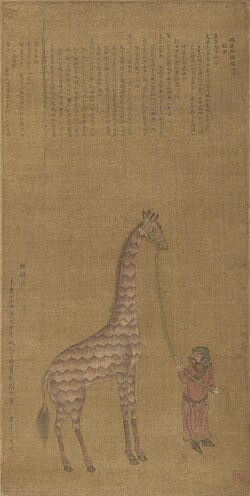
The giraffe, brought from Bengal in 1414, was depicted by Shen Du. The Chinese associated giraffes with the mythical creature Qilin
In addition to foreign policy and trade goals, Zheng's expeditions also had the task of mapping the countries visited and had an educational aspect as well.[151] The Chinese were interested in bringing back exotic animals and plants for medicinal purposes.[152] After the deaths of Zheng He in 1433 and the Xuande Emperor in 1435, large-scale maritime expeditions were discontinued. The loss of key supporters of long-distance sailing was just one factor in the decision to abandon an active maritime policy. In the eyes of the bureaucracy, the high costs of maintaining the fleet primarily meant an undue increase in the power of eunuchs, who controlled these funds. By this logic, cutting naval expenditures also reduced the eunuchs' influence at court.[153]
Death and legacy
The Chang Mausoleum of the Yongle Emperor in the Ming tombs complex near Beijing. He commissioned the construction of the Chang Mausoleum as a means of legitimizing his rule and solidifying Beijing as the capital of the Ming dynasty.
On 1 April 1424, the Emperor embarked on his final campaign into Mongolia, but the campaign was unsuccessful and he fell into a deep depression. He died on 12 August 1424 in Yumuchuan, located north of Duolun.[84] While official annals do not provide a specific cause of death, private records suggest that he suffered from multiple strokes in his final years, with the last one ultimately proving to be fatal.[155] He was buried in the Chang Mausoleum (長陵), the first of the Ming tombs located north of Beijing.[154]
The Yongle Emperor was given the posthumous name Emperor Wen (Cultured Emperor) and the temple name Taizong (Grand Ancestor), which was customary for second emperors of the dynasty.[xxvii] In 1538, the Jiajing Emperor changed the temple name to Chengzu (Accomplished Progenitor) in order to strengthen the legitimacy of his decision to elevate his father to imperial status after his death. The use of the character cheng, which means perfection, completion, or accomplishment, shows a high level of respect for the Yongle Emperor and his accomplishments.[157]
For Chinese historians in the following centuries, the Yongle Emperor represented the ideal ruler—an energetic and capable general who led China to power, while also being a Confucian and a restorer of traditional institutions. They credited him with unifying northern and southern China, but also criticized his violent overthrow of his predecessor and the subsequent purges. His high spending on foreign expansion and domestic projects, particularly the relocation of the capital, was met with sharp disapproval even during his lifetime. Late Ming historians, however, justified the negative effects of his rule as necessary for building a powerful empire. They also strongly condemned the Yongle Emperror's interventions in education, as his promotion of neo-Confucian orthodoxy led to a decline in scholarship and intellectual development.[158]
Modern historians such as Chan Hok-lam and Wang Yuan-kang[159][160] argue that the Yongle Emperor's desire for a unified China and domination over the world ultimately led to decisions that proved problematic in the long run.[159] They believe that abandoning the outer defense line north of the Great Wall was a strategic mistake, making the country more vulnerable to attacks. Additionally, the economic downturn at the time made it difficult to support large military operations, while the strict control over trade with the Mongols only worsened relations between the two.[160] The invasion of Đại Việt was also a mistake, as the Ming defeat weakened the empire's reputation in Southeast Asia.[161]
↑The Hongwu Emperor's Ancestral Instructions stipulated that imperial succession must follow primogeniture through the empress's direct male lineage, explicitly excluding sons born to concubines from eligibility for the throne.[13]
↑He held the second highest rank and served as the commissioner-in-chief of a military commission. For his participation in the campaign of 1370, he was appointed the Marquis of Huaian in June 1370. From February 1371, he governed the Beiping province; he was dismissed in 1374 and died on his way to Nanjing in the same year.[19]
↑Zhu Fu served under the prince from 1373 to 1388, becoming his chief tutor in 1377. He was diligent and honorable, and had a great influence on the prince, becoming his confidant. In 1416, Zhu Di posthumously awarded him the title of minister.[20]
↑Salt was then purchased from producers and sold to the population with a large profit.
↑The prince's right to visit his brothers after three or five years was lost. The government now appointed not only the highest but all officials of the princely households. The judicial authority of the princes was limited.[36] The maximum stipend for princes was reduced from 50,000 dan of grain to 10,000 in order to relieve the state treasury.[37]
↑They were, listed by age: Zhu Gang, Prince of Jin in Taiyuan; Zhu Di, Prince of Yan in Beiping; Zhu Gui, Prince of Dai in Datong; Zhu Zhi, Prince of Liao in Guangning; Zhu Quan, Prince of Ning in Daning; and Zhu Hui, Prince of Gu in Xuanfu.
↑Zhu Su, Zhu Gui, Zhu Bo, Zhu Fu and Zhu Bian.[45]
↑Li Youzhi, Beiping surveillance commissioner, and Zhang Xin (張信), Beiping regional military commissioner.[49]
↑The Hongwu Emperor abolished the Central Secretariat in 1380 and centralized authority entirely in his own hands, personally overseeing even minor administrative matters.[62] In contrast, the Yongle Emperor, while equally autocratic, recognized the impracticality of such an approach. He established the Grand Secretariat, delegating routine tasks to its members and institutionalizing their role in drafting documents and managing daily governance.[63]
↑For example, Zhu Hui, Prince of Gu, was relocated from Xuanfu to Changsha, while Zhu Quan, Prince of Ning, was moved from Daning to Nanchang.[65]
↑Huang Huai was from Zhejiang, Yang Rong from Fujian, and the remaining officials from Jiangxi. Jiangxi was known for its high level of education, with sixteen out of the top thirty students in the palace examination of 1400 coming from this province. However, many officials from Jiangxi, particularly Huang Zicheng, were associated with the Jianwen government and responsible for the civil war. After 1402, they refused to acknowledge the legitimacy of the Yongle Emperor. In an attempt to appease this resistance, the Emperor welcomed local elites into his court, but the young Hanlin scholars remained steadfast in their loyalty.[72]
↑During the Ming dynasty, Nanjing was known as Yingtian, while Nanjing (unofficially Nanzhili) referred to the metropolitan area governed by Nanjing authorities since 1421. This area encompassed the present-day Anhui and Jiangsu provinces.
↑According to American historian Patricia Ebrey, hundreds of thousands of workers were involved in the construction of Beijing.[89] Historian Ray Huang estimates that there were 100,000 artisans and 1 million laborers involved in the project.[90]
↑It was either 72 meters (236 feet)[100][101] or 79 meters (260 feet)[102] tall.
↑During the Yuan dynasty, rice was supplied to Beijing from the south via sea routes.
↑Later, officials opposed the resumption of rice transportation by sea in order to prevent the development of the naval fleet.[107]
↑The Yongle Emperor's army was said to have had either 300,000[124] or 500,000[122] soldiers.
↑In 1403, the king of Korea sent over 1,000 horses and 10,000 oxen. In 1404, 3,000 more horses were sent, and in 1407, before the first Mongolian campaign, another large number of horses was sent.[133]
↑The war finally came to an end in late 1427 when the Xuande Emperor made the decision to withdraw from Đại Việt. This withdrawal was carried out in the first few months of the following year.[141] By 1431, the newly established Viet state of the Lê dynasty was recognized as a tributary state, although it remained independent in all other aspects.[142]
↑The Yongle Emperor did not recognize his nephew, the Jianwen Emperor, as a legitimate emperor and abolished his era name in 1402.[156]
Chang, Michael G (2007). A Court on Horseback: Imperial Touring & the Construction of Qing Rule, 1680–1785. Cambridge: Harvard University Asia Center. Harvard University Press. ISBN978-0-674-02454-0.
Chan, Hok-lam (1988). "The Chien-wen, Yung-lo, Hung-hsi, and Hsüan-te reigns". In Mote, Frederick W.; Twitchett, Denis C (eds.). The Cambridge History of China Volume 7: The Ming Dynasty, 1368–1644, Part 1. Cambridge: Cambridge University Press. pp.184–304. ISBN0521243327.
Chan, Hok-lam (2005). "Xie Jin (1369-1415) as Imperial Propagandist: His Role in the Revisions of the "Ming Taizu Shilu"". T'oung Pao. 91 (Second Series) (1/3): 58–124. doi:10.1163/1568532054905142.
Chan, Hok-lam (2007). "Legitimating Usurpation: Historical revisions under the Ming Yongle Emperor (r. 1402–1424)". In Leung, Philip Yuen-sang (ed.). The Legitimation of New Orders: Case Studies in World History. Hong Kong: The Chinese University of Hong Kong. pp.75–158. ISBN978-962-996-239-5.
Church, Sally K (2005). "The Colossal Ships of Zheng He – Image or Reality?". In Salmon, Claudine (ed.). Zheng He – Images & Perceptions. South China and Maritime Asia. Wiesbaden: Harrassowitz. ISBN3-447-05114-0. ISSN0945-9286.
Cheng, Linsun (2009). Berkshire Encyclopedia of China (5-volume set, 2,800 pages). Berkshire Publishing Group. ISBN9780977015948.
Chen, Nan (September 2008). "Mingdai Zangchuan Fojiao dui Neidi de yingxiang" 明代藏传佛教对内地的影响[Influence of Tibetan Buddhism on the Hinterland in the Ming Dynasty]. China Tibetology (2).
Dreyer, Edward L (2007). Zheng He: China and the Oceans in the Early Ming Dynasty, 1405-1433. Library of World Biography Series. New York: Pearson Longman. ISBN978-0321084439.
Jaques, Tony (2007). Dictionary of Battles and Sieges: A Guide to 8,500 Battles from Antiquity Through the Twenty-first Century: F-O (volume 2). Westport, CT: Greenwood Press. ISBN9780313335389.
Langlois, John D (1988). "The Hung-wu reign, 1368–1398". In Mote, Frederick W.; Twitchett, Denis C (eds.). The Cambridge History of China Volume 7: The Ming Dynasty, 1368–1644, Part 1. Cambridge: Cambridge University Press. pp.107–181. ISBN0521243327.
Needham, Joseph (1971). Science and civilisation in China: Physics and physical technology. Vol.4. Cambridge: Cambridge University Press. ISBN0521070600.
Tan, Qian (1958) [1647]. Guoque國榷[Discussions about the state] (in Literary Chinese). Beijing: Zhonghua Book. ISBN7-101-00372-9.{{cite book}}: ISBN / Date incompatibility (help)
Wang, Yuan-Kang (2011). Harmony and War: Confucian Culture and Chinese Power Politics. New York; Chichester, West Sussex: Columbia University Press. ISBN978-0-231-15140-5.
Wade, Geoff (2006). "Ming Chinese colonial armies in Southeast Asia". In Hack, Karl; Rettig, Tobias (eds.). Colonial armies in Southeast Asia. Oxon; New York: Routledge. ISBN9780415334136.
Wang, Gungwu (1998), "Ming Foreign Relations: Southeast Asia", in Twitchett, Denis; Mote, Frederick W. (eds.), The Cambridge History of China: Volume 8, The Ming Dynasty, 1368–1644, Part 2, Cambridge and New York: Cambridge University Press, pp.301–332, ISBN978-0-521-24333-9
↑According to other sources, the Yongle Encyclopedia consisted of seven thousand volumes, 22,938 juan, and 50 million words,[113]
This page is based on this Wikipedia article Text is available under the CC BY-SA 4.0 license; additional terms may apply. Images, videos and audio are available under their respective licenses.