The President of the French Republic is the executive head of state of France in the French Fifth Republic. In French terms, the presidency is the supreme magistracy of the country.

An electoral college is a set of electors who are selected to elect a candidate to a particular office. Often these represent different organizations, political parties, or entities, with each organization, political party or entity represented by a particular number of electors or with votes weighted in a particular way. The system can ignore the wishes of a general membership.

The Senate is the upper house of the French Parliament. Indirectly elected by elected officials, it represents territorial collectivities of the Republic and French citizens living abroad. The Senate enjoys less prominence than the lower house, the directly elected National Assembly; debates in the Senate tend to be less tense and generally receive less media coverage.
The Senate was the upper house of the Parliament of South Africa between 1910 and its abolition from 1 January 1981, and between 1994 and 1997.
André Le Troquer was a French politician, socialist lawyer, and president of the National Assembly from 12 January 1954 to 10 January 1955, and a second time from 24 January 1956 to 4 October 1958.
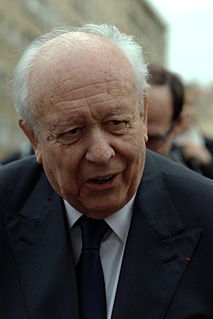
Jean-Claude Gaudin is a French politician for The Republicans. He has been Mayor of Marseille since 1995.

A referendum on the direct election of the President was held in France on 28 October 1962. The question was whether to have the President of the French Republic elected by direct popular vote, rather than by an electoral college. It was approved by 62.3% of voters with a 77.0% turnout. However, the reform was controversial because it strengthened the executive at the expense of Parliament, and because of the disputed constitutionality of the procedure used.

The European Democratic and Social Rally group, formerly the Democratic and European Rally group, is a parliamentary group in the Senate including representatives of the Radical Party of the Left (PRG) that historically consisted of radicals of both the left and right. Before 1989, the group was known as the Democratic Left group.

The Communist, Republican, Citizen and Ecologist group is a parliamentary group in the Senate including representatives of the French Communist Party (PCF).
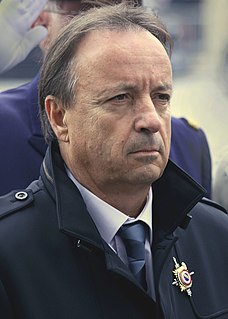
A Senate election was held for 165 of the 348 seats in the Senate of France on 25 September 2011. Senate members were primarily elected by municipal officials, and the number of senators was increased from 343 to 348, due to the growth of France's population since the previous election was held in 2008. The Socialist Party and other left-of-center parties gained a majority of seats in the upper house for the first time in the Fifth Republic.

The Socialist and Republican group is a parliamentary group in the Senate including representatives of the Socialist Party (PS).

The second senatorial elections of the Fifth Republic were held in France on September 23, 1962.
The third senatorial elections of the Fifth Republic were held in France on September 26, 1965.
The fourth senatorial elections of the Fifth Republic were held in France on September 22, 1968.
The fifth senatorial elections of the Fifth Republic were held in France on September 26, 1971.

The Senate is the upper house of the Parliament of Ivory Coast. The Senate was created after a new constitution was approved by a referendum in 2016.

Senatorial elections have been held on 24 September 2017 to renew 170 of 348 seats in the Senate of the French Fifth Republic.