The Union for a Popular Movement was a centre-right political party in France that was one of the two major contemporary political parties in France along with the centre-left Socialist Party (PS). The UMP was formed in 2002 as a merger of several centre-right parties under the leadership of President Jacques Chirac. In May 2015, the party was renamed and succeeded by The Republicans.

The Union for French Democracy was a centre-right political party in France. It was founded in 1978 as an electoral alliance to support President Valéry Giscard d'Estaing in order to counterbalance the Gaullist preponderance over the political right in France. This name was chosen due to the title of Giscard d'Estaing's 1976 book, Démocratie Française. The party brought together Christian democrats, liberals and radicals, and non-Gaullist conservatives, and described itself as centrist.

Regional elections in were held in France on 21 and 28 March 2004. At stake were the presidencies of each of France's 26 regions which, although they do not have legislative powers, manage sizeable budgets. The results were a triumph for the parties of the left, led by the French Socialist Party (PS) in alliance with minor parties including the French Communist Party (PCF), the Left Radical Party (PRG) and The Greens. The left has usually fared moderately well in regional elections, but this was their best result since the regional system was introduced.

The Senate is the upper house of the French Parliament. Indirectly elected by elected officials, it represents territorial collectivities of the Republic and French citizens living abroad. The Senate enjoys less prominence than the lower house, the directly elected National Assembly; debates in the Senate tend to be less tense and generally receive less media coverage.

The Radical Party of the Left is a social-liberal political party in France. A party in the Radical tradition, since 1972 the PRG was a close ally of the major party of the centre-left in France, the Socialist Party. After the 2017 presidential and legislative elections, negotiations to merge the PRG with the Radical Party began and the refounding congress to reunite the parties into the Radical Movement was held on 9 and 10 December 2017. However, a faction of ex-PRG members, including its last president Sylvia Pinel, split from the Radical Movement in February 2019 due to its expected alliance with La République En Marche in the European elections and plans to resurrect the PRG.

The French legislative elections took place on 9 June and 16 June 2002 to elect the 12th National Assembly of the Fifth Republic, in a context of political crisis.
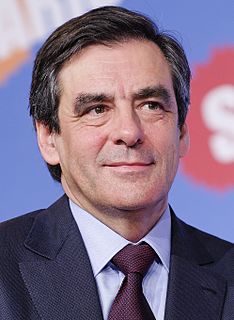
The French legislative elections took place on 10 June and 17 June 2007 to elect the 13th National Assembly of the Fifth Republic, a few weeks after the French presidential election run-off on 6 May. 7,639 candidates stood for 577 seats, including France's overseas possessions. Early first-round results projected a large majority for President Nicolas Sarkozy's UMP and its allies; however, second-round results showed a closer race and a stronger left. Nevertheless, the right retained its majority from 2002 despite losing some 40 seats to the Socialists.
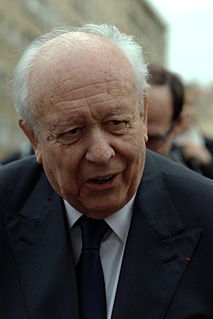
Jean-Claude Gaudin is a French politician for The Republicans. He has been Mayor of Marseille since 1995.
The Centrists, formerly known as New Centre and European Social Liberal Party, is a centre-right political party in France formed by the members of the Union for French Democracy (UDF) – including 18 of the 29 members of the UDF in the National Assembly) – who did not agree with François Bayrou's decision to found the Democratic Movement (MoDem) and wanted to support the newly elected president Nicolas Sarkozy, continuing the UDF-Union for a Popular Movement (UMP) alliance.
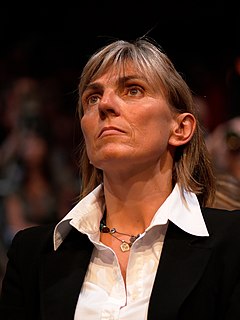
Valérie Létard is the former Secretary of State for Solidarity in the government of François Fillon from June 2007 to 14 November 2010.

The French municipal elections of 2008 were held on 9 March in that year to elect the municipal councils of France's 36,782 communes. The first task of each newly constituted municipal council was to elect a mayor for that commune.

Jean-Pierre Bel is a French retired politician who served as President of the Senate from 2011 to 2014. From the Ariège department, Bel is a member of the Socialist Party; he was elected to the Senate in September 1998 and re-elected in September 2008. Bel was President of the Socialist Group in the Senate from 2004 to 2011.
The Liaison Committee for the Presidential Majority is a structure initiated by Nicolas Sarkozy to coordinate the political parties that support his action.

The National Centre of Independents and Peasants is a liberal-conservative and conservative-liberal political party in France, founded in 1951 by the merger of the National Centre of Independents with the Peasant Party and the Republican Party of Liberty.

Legislative elections took place on 10 and 17 June 2012 to select the members of the 14th National Assembly of the French Fifth Republic – a little over a month after the French presidential election run-off held on 6 May.
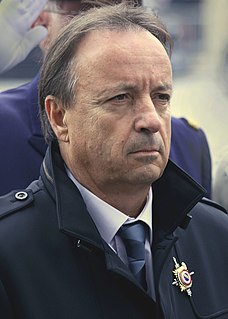
A Senate election was held for 165 of the 348 seats in the Senate of France on 25 September 2011. Senate members were primarily elected by municipal officials, and the number of senators was increased from 343 to 348, due to the growth of France's population since the previous election was held in 2008. The Socialist Party and other left-of-center parties gained a majority of seats in the upper house for the first time in the Fifth Republic.

The Leader of the Opposition in the Senate is the leader of the largest opposition group in the Senate of France. The status has no official recognition in the French Constitution. What is more, the ideological differences between groups in the Senate is smaller than as usual, as the powers of the Senate allow it, at best, to lengthen the time for a bill.

The Republicans group, formerly the Union for a Popular Movement group, is a parliamentary group in the Senate including representatives of The Republicans (LR), formerly the Union for a Popular Movement.