
Peniche is a seaside municipality and a city in the Oeste region, in the historical province of Estremadura, and in the Leiria District. It has 26,431 inhabitants, in an area of 77.55 km2. The city itself has a population of about 15,600 inhabitants. The present mayor is Henrique Bertino, elected by the independent coalition GCEPP. The idiomatic expression Friend from Peniche, used to describe someone who wants to receive things at the expense of other without giving anything in return, comes from here.
The Lines of Torres Vedras were lines of forts and other military defences built in secrecy to defend Lisbon during the Peninsular War. Named after the nearby town of Torres Vedras, they were ordered by Arthur Wellesley, Viscount Wellington, constructed by Colonel Richard Fletcher and his Portuguese workers between November 1809 and September 1810, and used to stop Marshal Masséna's 1810 offensive. The Lines were declared a National Heritage by the Portuguese Government in March 2019.

Torres Vedras is a municipality in the Portuguese district of Lisbon, approximately 40 kilometres (25 mi) north of the capital Lisbon. It is part of the intermunicipal community Oeste and the region Oeste e Vale do Tejo. The population as of 2011 was 83,075, in an area of 407.15 square kilometres (157.20 sq mi).
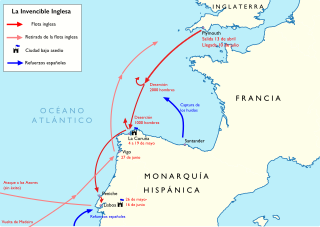
The English Armada, also known as the Counter Armada or the Drake–Norris Expedition, was an attack fleet sent against Spain by Queen Elizabeth I of England that sailed on 28 April 1589 during the undeclared Anglo-Spanish War (1585–1604) and the Eighty Years' War. Led by Sir Francis Drake as admiral and Sir John Norris as general, it failed to drive home the advantage that England had gained resulting from the failure of the Spanish Armada in the previous year. The Spanish victory marked a revival of Philip II's naval power through the next decade.

The Battle of Alcântara took place on 25 August 1580, near the brook of Alcântara, in the vicinity of Lisbon, Portugal, and was a victory of the Habsburg King Philip II over the other pretender to the Portuguese throne, Dom António, Prior of Crato.

The Fort of São João Baptista das Berlengas, or simply known as the Fort of the Berlengas, is located off western coast of Portugal, on the largest island of the archipelago of the Berlengas, in the municipality of Peniche in Oeste region. The fortification belonged to a group of defensive military structures meant to protect the municipality located on the coast.

Castelo de Torres Vedras is a castle in Torres Vedras, Portugal. Characterized by a mix of Gothic and Manueline features, it is classified by IGESPAR as a Site of Public Interest.

The Fort of São Julião da Barra is the largest and most complete military defence complex in the Vauban style remaining in Portugal. It is located in São Julião da Barra, on the point of São Gião, in the parish of Oeiras e São Julião da Barra, Paço de Arcos e Caxias, Oeiras Municipality, Lisbon District. Considered in the past as the most important maritime fortification in the country, it had originally, together with the Fort of São Lourenço do Bugio, the role of controlling access to the port of Lisbon. It is currently the official residence of the Portuguese Minister of National Defence.
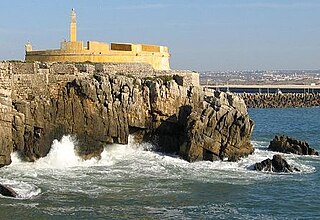
The Peniche Fortress is located in the municipality of Peniche in Leiria District, Portugal. Built on the site of the former Castle of Atouguia da Baleia, of which only a few vestiges remain, initial construction took place in 1557 and 1558 but there have been numerous subsequent modifications. Its defensive walls surround an area of two hectares, divided into upper and lower parts. The fortress has served a number of functions including that of a political prison during the authoritarian Estado Novo regime. It now contains a museum devoted to the resistance to the Estado Novo.
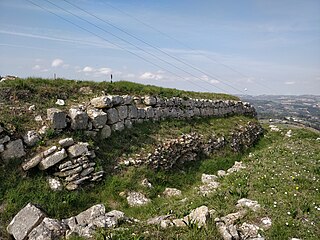
The Fort of Ribas, also known as the Redoubt of Ribas and the Redoubt of Freixial Alto, is one of a group of fortifications in Portugal that made up the second of the three defensive Lines of Torres Vedras, between the Atlantic Ocean and the River Tagus, which were designed to protect the capital, Lisbon, from possible invasion by French troops during the Peninsular War. It was designed for a garrison of 300 soldiers, with three or four cannon. The fort is situated near the town of Bucelas in the Lisbon District of Portugal.

The Fort of São Vicente is located in the town and municipality of Torres Vedras, in the Lisbon District of Portugal. In 1809 it was the first of 152 forts, redoubts and other defences to be developed as part of three defensive lines between the Atlantic Ocean and the River Tagus that were designed by the Duke of Wellington to protect the Portuguese capital, Lisbon, from possible invasion by French troops during the Peninsular War. These came to be known as the Lines of Torres Vedras. Together with the Fort of Alqueidão, it is considered the most important fortress of those constructed for the Lines.
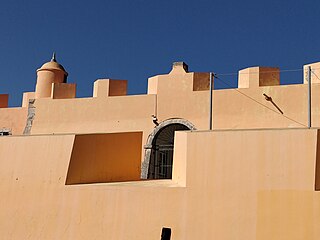
The Fort of São João das Maias, also known as the Fort of Oeiras, is located on the right bank of the River Tagus estuary, in the municipality of Oeiras in the Lisbon District of Portugal. It was constructed between 1644 and 1653. Until 2010 it had been allowed to fall into a state of advanced degradation but in that year it was restored.

The Fort of Casa was the most easterly of the forts and redoubts built in 1809-10 during the Peninsular War on the second line of the three defensive Lines of Torres Vedras aimed at protecting the capital of Portugal, Lisbon. It is situated in the town of Forte da Casa, in the municipality of Vila Franca de Xira, in the Lisbon District.

The Forts of Serra da Aguieira were three forts constructed within 100 metres of each other as part of the second line of defence of the so-called Lines of Torres Vedras, which were constructed by Anglo-Portuguese forces in 1810 in order to protect the Portuguese capital Lisbon from possible invasion by the French during the Peninsular War. The forts are situated in the municipality of Vila Franca de Xira, in the Lisbon District of Portugal. From north to south the three forts are the Fort of Aguieira, the Fort of Portela Grande, and the Fort of Portela Pequena.

The Fort of Arpim is in the parish of Bucelas in the municipality of Loures, in the Lisbon District of Portugal. It was constructed during the Peninsular War, forming part of the first of three defensive Lines of Torres Vedras aimed at protecting Lisbon, the capital of Portugal, from French invasion. The fort, which never saw battle, has been restored and can be visited.

The Fort of Subserra, also known as the Fort of Alhandra, is situated at 142 metres above sea level close to Alhandra in the municipality of Vila Franca de Xira in the Lisbon District of Portugal. Together with other smaller redoubts and batteries that also had the Subserra name, it was built during the Peninsular War (1807–14) as part of the first line of defence of the Lines of Torres Vedras planned by Arthur Wellesley, 1st Duke of Wellington to protect the Portuguese capital of Lisbon and, if necessary, his own retreat.

The Fort of Alqueidão, also known as Forte Grande, is located about 2 kilometres south of the parish of Sobral de Monte Agraço, in the municipality of Sobral de Monte Agraço, in the Lisbon District of Portugal. It was one of the first and one of the largest of 152 military works known as the Lines of Torres Vedras that were built in 1809-10 to defend Lisbon during the Peninsular War (1807–14). The fort played a major role in stopping the advance of Napoleonic troops.

The Forts of Ajuda are located in the parish of Bucelas, in the municipality of Loures in the Lisbon District of Portugal. Just a short distance apart, the Forts of Ajuda Grande (Big) and Ajuda Pequeno (Small) were built in 1810 as part of the Lines of Torres Vedras, which were defensive lines to protect the Portuguese capital Lisbon from invasion by the French during the Peninsular War (1807–14).
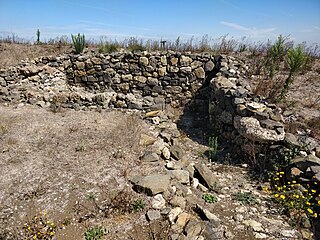
The Fort of Carvalha is located in the parish of São Tiago dos Velhos, at the highest point of the municipality of Arruda dos Vinhos, in the Lisbon District of Portugal. It was built in 1809-10 as part of the first of the three Lines of Torres Vedras, which were defensive lines to protect the Portuguese capital Lisbon from invasion by the French during the Peninsular War (1807–14) or, in the event of defeat, to safely embark a retreating British Army.

The Fort of Cego is located in the municipality of Arruda dos Vinhos, in the Lisbon District of Portugal. It is also known as the Fort of Saint Sebastian. The fort was built in 1809-10 as part of the first of the three Lines of Torres Vedras, which were defensive lines to protect the Portuguese capital Lisbon from invasion by the French during the Peninsular War (1807–14) or, in the event of defeat, to safely embark a retreating British Army.

