
Fuchsia is a genus of flowering plants that consists mostly of shrubs or small trees.

Pachypodium brevicaule is a species of plant that belongs to the family Apocynaceae.

Fuchsia loxensis is a species of fuchsia in the family Onagraceae. It is endemic to Ecuador.

Mimetes arboreus, or Kogelberg pagoda, is an evergreen, upright large shrub or small tree of 2–6 m (6½–20 ft) high in the family Proteaceae. It grows from a thick trunk with a smooth grey bark that branches at ½–1 m (1½–3 ft) above the ground. It has silvery, lance-shaped, pointy leaves of 5–8¼ cm (2.0–3.3 in) long and ¾–3¼ cm (0.3–1.3 in) wide, at an upward angle and overlapping each other. The inflorescences are set just below the top of the branches, are cylinder-shaped, 8–10 cm in diameter, topped by a crest of more or less horizontal pinkish or reddish tinged leaves. It consists of several flower heads in the axils of pinkish orange leaves that form a hood shielding the underlying flower head. Each flower head contains eight to thirteen individual flowers, with bright red styles and grey silky perianth lobes. It is endemic to the Fynbos ecoregion of South Africa, being confined to the Kogelberg mountain range.

Brunfelsia pauciflora is a species of flowering plant in the family Solanaceae, the nightshades. It is endemic to Brazil, and it is grown in cultivation. A shrubby perennial plant grown in gardens, its common names include today, tomorrow together, yesterday, today and tomorrow, morning-noon-and-night, kiss me quick, and Brazil raintree.
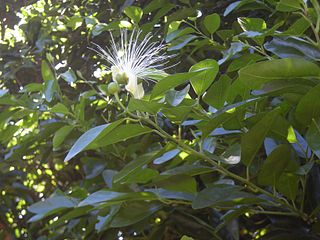
Capparis arborea is a bush or small tree occurring in eastern Australia. Its habitat is rainforest, usually riverine, littoral or the drier rainforests. It is distributed from the Hunter River, New South Wales to Cape Melville in tropical Queensland. Common names include native pomegranate, wild lime, wild lemon and brush caper berry.

Brunfelsia latifolia, commonly known as yesterday-today-tomorrow and kiss me quick, is a species of flowering plant in the nightshade family. Endemic to Brazil, it is an evergreen shrub that becomes semi-deciduous in cooler areas and grows up to 1.8 meters in height.

Fuchsia denticulata is a shrub in the family Onagraceae, native to Bolivia and Peru.
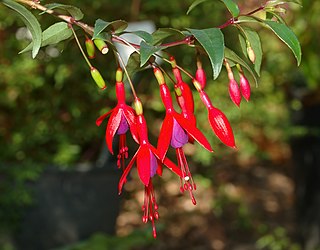
Fuchsia regia is a plant species in the genus Fuchsia native to Brazil.

Leucospermum grandiflorum is an evergreen, upright shrub of up to 2½ m high that is assigned to the family Proteaceae. It has elliptic, greyish green, softly hairy leaves and initially egg-shaped heads with yellow flowers, later flatter with flowers turning orange. From the center of each flower emerges a long pale yellow style with a pink thickened tip that is bent slightly clockwise, giving the entire head the appearance of a pincushion. Its flowers can be found between July and December. It is called grey-leaf fountain-pincushion or rainbow pincushion in English. L. grandiflorum is an endemic species that can only be found in nature in the Western Cape province of South Africa.

Fuchsia simplicicaulis is a species of shrub in the family Onagraceae. It is endemic to Peru. Its Herbaria type is electrotype MA 11/92 11.

Mimetes hottentoticus is an evergreen, upright shrub of 1½–3 m (5–10 ft) high from the family Proteaceae. It has silvery, broadly egg-shaped to egg-shaped leaves with three small teeth crowded at the tip. The flower heads and subtending leaves form a cylindric inflorescence, topped with a tuft of smaller, more or less upright silvery or pinkish leaves. Each flowerhead contains 8–12 flowers with conspicuously red styles, that are all parallel, projected straight up, pushing against the leaf subtending the higher flowerhead. The styles end in a short white zone topped by a thick blackish pollen presenter. Flowers can usually be found from January till March, few may persist into May. It is called silver pagoda or matchstick pagoda in English and Hottentotstompie in Afrikaans.
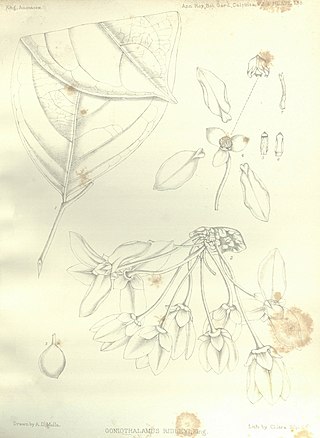
Goniothalamus ridleyi is a species of plant in the family Annonaceae. It is native to Borneo, Peninsular Malaysia, Sumatra and Thailand. George King, who first formally described the species, named it after the English botanist Henry Nicholas Ridley who collected the specimen King examined.
Goniothalamus rongklanus is a species of plant in the family Annonaceae. It is native to Thailand. Richard Saunders and Piya Chalermglin first formally described the species and named it after Phu Hin Rong Kla National Park in Thailand.
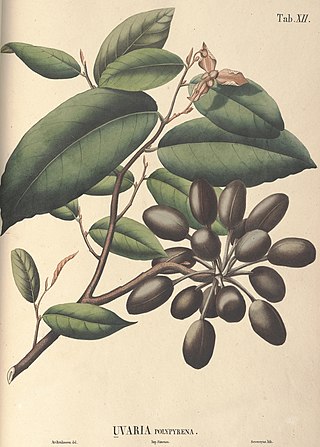
Mitrephora polypyrena is a species of plant in the family Annonaceae. It is native to Java, the Lesser Sunda Islands, and Myanmar. Carl Ludwig Blume, the German botanist who first formally described the species using the basionym Uvaria polypyrena, named it after the many stones or seeds in its fruit.

Fuchsia glazioviana, called Glaziou's fuchsia, is a species of flowering plant in the genus Fuchsia, native to southeast Brazil. It has gained the Royal Horticultural Society's Award of Garden Merit.

Fuchsia hatschbachii, called Hatschbach's fuchsia, is a species of flowering plant in the genus Fuchsia, endemic to the state of Paraná in Brazil. It has gained the Royal Horticultural Society's Award of Garden Merit. The species is named after Gert Hatschbach, Director of the Museu Botânico de Curitiba who collects and studies flora of Paraná.

Babiana vanzijliae is a species of geophyte of 4–12 cm (1.6–4.7 in) high that is assigned to the family Iridaceae. It has leaves that consist of a sheath and a blade that are at an angle with each other. The leaf blades are narrow, sword- to lance-shaped and have a left and right surface, rather than an upper and lower surface. The leaf blades are pleated and covered in velvety hairs. The inflorescence contains three to five pale bluish mauve to yellow flowers, but the lower lateral tepals are yellow becoming pale around the edges, and with three stamens crowding under the upper lip. Flowering occurs from early August to the middle of September. The flowers emit a strong scent. B. vanzijliae grows along the Bokkeveld Escarpment near Nieuwoudtville in the Northern Cape province of South Africa.
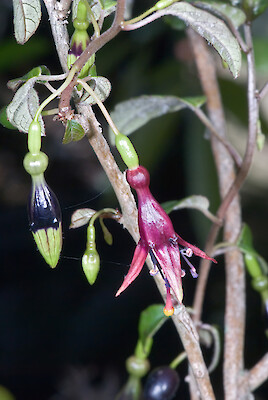
Fuchsia perscandens, commonly known as climbing fuchsia or scrambling fuchsia, is a species of plant endemic to New Zealand and belonging to the family Onagraceae. Fuchsia perscandens belongs to the South Pacific Skinnera section, which consists of three species and a hybrid.

Fuchsia bracelinae is a species of Fuchsia found in Brazil.


