This article includes a list of references, but its sources remain unclear because it has insufficient inline citations .(February 2013) (Learn how and when to remove this template message) |
| Bersaglieri Brigade "Garibaldi" | |
|---|---|
| Brigata Bersaglieri "Garibaldi" | |
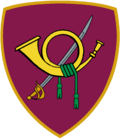
Coat of Arms Garibaldi Bersaglieri Brigade | |
| Active | 1 November 1975 - 1 July 1991 8th Mechanized Brigade Garibaldi 1 July 1991 - 1 September 1994 8th Bersaglieri Brigade Garibaldi 1 September 1994 - today Garibaldi Bersaglieri Brigade |
| Country | Italy |
| Allegiance | Italian Army |
| Branch | Army |
| Type | Brigade |
| Role | Bersaglieri |
| Part of | Division "Acqui" |
| Garrison/HQ | Caserta |
| Colors | dark red |
| Engagements | Bosnia SFOR Kosovo KFOR Afghanistan ISAF Iraq Multinational force in Iraq Lebanon UNIFIL |
| Commanders | |
| Current commander | Brigadier Luigi Scollo |
The Garibaldi Bersaglieri Brigade is a mechanized infantry brigade of the Italian Army, based in the south of the country. Its core units are the Bersaglieri, an elite infantry corps of the Italian Army. The brigade is named after Giuseppe Garibaldi a hero of the Italian wars of unification. The brigade is part of the Division "Acqui".
Mechanized infantry are infantry units equipped with armored personnel carriers (APCs) or infantry fighting vehicles (IFVs) for transport and combat.
A brigade is a major tactical military formation that is typically composed of three to six battalions plus supporting elements. It is roughly equivalent to an enlarged or reinforced regiment. Two or more brigades may constitute a division.
The Italian Army is the land-based component of the Italian Armed Forces of the Italian Republic. The army's history dates back to the unification of Italy in the 1850s and 1860s. The army fought in colonial engagements in China, Libya, Northern Italy against the Austro-Hungarian Empire during World War I, Abyssinia before World War II and in World War II in Albania, Balkans, North Africa, USSR and Italy itself. During the Cold War, the army prepared itself to defend against a Warsaw Pact invasion from the east. Since the end of the Cold War, the army has seen extensive peacekeeping service and combat in Afghanistan and Iraq. Its best-known combat vehicles are the Dardo infantry fighting vehicle, the Centauro tank destroyer and the Ariete tank and among its aircraft the Mangusta attack helicopter, recently deployed in UN missions. The headquarters of the Army General Staff are located in Rome opposite the Quirinal Palace, where the president of Italy resides. The army is an all-volunteer force of active-duty personnel.
The brigade was activated during the 1975 army reform: in 1975 the regiment level was abolished and battalions came under direct command of newly formed brigades, which combined units from different arms. On 1 November 1975 the 8th Mechanized Brigade Garibaldi was activated one month after its sister brigades the 32nd Armored Brigade Mameli and the 132nd Armored Brigade Manin had been activated by reforming the three regiments of the 132nd Armored Division Ariete.
With the 1975 reforms the Italian Army abolished the regimental level and replaced it with brigades made up of multiple arms. During the reform the army disbanded 48 regimental commands and reduced its force by 87 battalions. A further ten regimental commands were used to raise ten new brigade commands. Ten training centers, which for traditional reasons had carried the names of regiments, were also disbanded. The reduction in units also allowed to mechanize most of the remaining units in Northern Italy and Italy's defense strategy changed from a hold-at-all-costs territorial defense to one of mobile warfare.
The brigade's headquarters was in the city of Pordenone and most of its units came from the disbanded 8th Bersaglieri Regiment. Besides the traditions of the 8th Bersaglieri Regiment the brigade also received the traditions and name of the 182nd Armored Infantry Regiment Garibaldi. The name Garibaldi honored the Italian general and Italian unification hero Giuseppe Garibaldi and commemorated various partisan units of World War II. The brigade's sister brigades, the Manin and Mameli, were named in honor of Daniele Manin and Goffredo Mameli, both also heroes of the Italian unification. The Ariete was part of the 5th Army Corps based in North-Eastern Italy. The 5th Army Corps was tasked with defending the Yugoslav-Italian border against possible attacks by either the Warsaw Pact, or Yugoslavia or both. The Ariete Armored Division was the corps' armored reserve. The Garibaldi's authorized strength was 4,733 men (272 officers, 637 non-commissioned officers and 3,824 soldiers) and it consisted of the following units: [1]
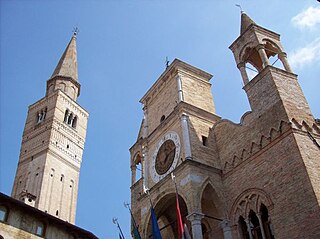
Pordenone is the main comune of Pordenone province of northeast Italy in the Friuli-Venezia Giulia region.
Italian unification, also known as the Risorgimento, was the political and social movement that consolidated different states of the Italian peninsula into the single state of the Kingdom of Italy in the 19th century. The process began in 1815 with the Congress of Vienna and was completed in 1871 when Rome became the capital of the Kingdom of Italy.
Giuseppe Maria Garibaldi was an Italian general and nationalist. A republican, he contributed to the Italian unification and the creation of the Kingdom of Italy. He is considered one of the greatest generals of modern times and one of Italy's "fathers of the fatherland" along with Camillo Benso, Count of Cavour, Victor Emmanuel II of Italy and Giuseppe Mazzini. Garibaldi is also known as the "Hero of the Two Worlds" because of his military enterprises in South America and Europe.
The M113 is a fully tracked armored personnel carrier (APC) that was developed and produced by the Food Machinery Corp (FMC). The M113 was sent to USAREUR to replace the mechanized infantry's M59 APCs in the 1961/62 time frame. The M113 was first tried out in combat in April 1962 after the United States provided the South Vietnamese Army (ARVN) with heavy weaponry such as the M113, under the Military Assistance Command, Vietnam (MACV) program. Eventually, the M113 was the most widely used armored vehicle of the U.S. Army in the Vietnam War, earning the nickname 'Green Dragon' by the Viet Cong as it was used to break through heavy thickets in the midst of the jungle to attack and overrun enemy positions. It was largely known as an "APC" or an "ACAV" by the allied forces.
An armoured personnel carrier (APC) is a broad type of armoured, military vehicles designed to transport personnel and equipment in combat zones. They are sometimes referred to colloquially as "battle taxis" or "battle buses". Since World War I, APCs have become a very common piece of military equipment around the world.
Zoppola is a comune (municipality) in the Province of Pordenone in the Italian region Friuli-Venezia Giulia, located about 90 kilometres northwest of Trieste and about 9 kilometres east of Pordenone.
Vivaro is a comune (municipality) in the Province of Pordenone in the Italian region Friuli-Venezia Giulia, located about 90 kilometres (56 mi) northwest of Trieste and about 15 kilometres (9 mi) northeast of Pordenone.
The M60 Patton is an American second generation main battle tank (MBT) introduced in March 1959. With the United States Marine Corps deactivation of their last (M103) heavy tank battalion in 1963, the M60 became the Army's primary main battle tank during the Cold War. Although developed from the M48 Patton, the M60 series was never officially classified as a Patton tank, but as a "product-improved descendant" of the Patton series. In March 1959, the tank was officially standardized as the Tank, Combat, Full Tracked: 105-mm Gun, M60. Over 15,000 M60s were built by Chrysler. Hull production ended in 1983, but 5,400 older models were converted to the M60A3 variant ending in 1990.
A main battle tank (MBT), also known as a battle tank or universal tank, is a tank that fills the armor-protected direct fire and maneuver role of many modern armies. Cold War-era development of more powerful engines, better suspension systems and lighter weight composite armor allowed a tank to have the firepower of a super-heavy tank, armor protection of a heavy tank, and mobility of a light tank all in a package with the weight of a medium tank. Through the 1960s, the MBT replaced almost all other tanks, leaving only some specialist roles to be filled by lighter designs or other types of armored fighting vehicles.
With the abolition of the divisional level in the Italian Army on October 1, 1986 the Garibaldi came under direct control of the 5th Army Corps and received a new coat of arms.
With the end of the Cold War and the following massive reorganization of the Italian Army the brigade was transferred to the South of Italy. The brigade finished the move south to the city of Caserta and declared full operational capability on 1 July 1991. Along with the move the brigade changed its name to 8th Bersaglieri Brigade Garibaldi to reflect the changed composition of its subordinated units:
The Cold War was a period of geopolitical tension between the Soviet Union with its satellite states, and the United States with its allies after World War II. The historiography of the conflict began between 1946 and 1947. The Cold War began to de-escalate after the Revolutions of 1989. The collapse of the USSR in 1991 was the end of the Cold War. The term "cold" is used because there was no large-scale fighting directly between the two sides, but they each supported major regional conflicts known as proxy wars. The conflict split the temporary wartime alliance against Nazi Germany and its allies, leaving the USSR and the US as two superpowers with profound economic and political differences.
Caserta is the capital of the province of Caserta in the Campania region of Italy. It is an important agricultural, commercial and industrial comune and city. Caserta is located on the edge of the Campanian plain at the foot of the Campanian Subapennine mountain range. The city is best known for the Royal Palace of Caserta.
Following the move the brigade became the first brigade in Italy to fully professionalize. From 1992 onwards all soldiers of the brigade were professional soldiers or long term volunteers. During the later 1990s the brigades composition changed slightly as a result of the massive reduction of forces after the Cold War and the Armys desire to preserve the names of the most decorated units of the Army. Therefore, most units changed names, although garrison and composition of the units did not change. The brigade itself shed the number from its name 1 on September 1994. The changes to the brigades units over the coming years follow below:
Today the Garibaldi Bersaglieri Brigade is one of two brigades of the Italian Army equipped with tracked vehicles. It has been employed, in Karbala Iraq during the Iraq War and in Herat in Afghanistan as part of the International Security Assistance Force. Currently its structure is:
The tank regiment is equipped with Ariete main battle tanks, the cavalry regiment with Centauro tank destroyers and VTLM Lince vehicles. The Bersaglieri regiments field Dardo infantry fighting vehicles. The artillery regiment is equipped with PzH 2000 self-propelled howitzers.
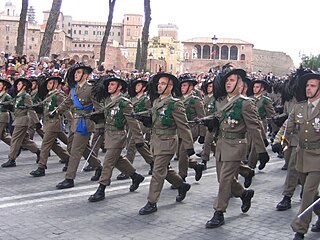
The Bersaglieri, singular Bersagliere, are a special unit of the Italian Army infantry corps. They were originally created by General Alessandro La Marmora on 18 June 1836 to serve in the Army of the Kingdom of Sardinia, later to become the Royal Italian Army. They have always been a high-mobility light infantry unit, and can still be recognized by the distinctive wide brimmed hat that they wear, decorated with black capercaillie feathers. The feathers are usually applied to their combat helmets. Another distinctive trait of the Bersaglieri is the fast jog pace they keep on parades, instead of marching.
The Ariete Armoured Division was an armoured division of the Italian Army during World War II. It was formed in 1939 as the second armoured division in the Italian Army after the 131 Armoured Division Centauro. The division fought in the North African Campaign until being destroyed during the Second Battle of El Alamein. After World War II the division was reformed as part of the Italian Army.
The article provides an overview of the entire chain of command and organization of the Italian Army after the reform of 1 October 2016 and includes all active units as of 1 July 2019. The Armed Forces of Italy are under the command of the Italian Supreme Defense Council, presided over by the President of the Italian Republic. The Italian Army is commanded by the Chief of the Army General Staff or "Capo di Stato Maggiore dell’Esercito" in Rome.
On March 1, 1984 the Italian Institute for Disarmament, Development and Peace (Istituto di ricerche per il disarmo, lo sviluppo e la pace in Rome published the entire Italian Army order of battle down to company level - this was justified for the radical party as one of its core demands was total disarmament of Europe, even though the data which was published was top secret. The Radical Party dissolved in 1989 and the IRDISP followed suit in 1990. But Radio Radicale has survived, and the OrBat can still be found today on the homepage of the radio.
The Pozzuolo del Friuli Cavalry Brigade is a brigade of the Italian Army, based in the Friuli Venezia Giulia and Veneto regions. The Brigade consists of a command unit, a cavalry regiment, an amphibious infantry regiment, an artillery regiment, an engineer regiment and a logistic regiment.
The Granatieri di Sardegna Mechanized Brigade is a mechanized infantry brigade of the Italian Army, based in Rome and central Italy. The brigade fields one of the oldest regiments of the Army and is one of the guard regiments of the Italian president. The name of the unit dates back to the Kingdom of Sardinia and not the eponymous Mediterranean island of Sardinia. The brigade is part of the Division "Acqui".
The Pinerolo Mechanized Brigade is a mechanized infantry brigade of the Italian Army, based in the southern region of Apulia. Carrying the name of the Piedmontese city of Pinerolo the brigade's coat of arms was modeled after the city's coat of arms. The brigade is part of the Division "Acqui".
The 131st Armoured Division Centauro was an armoured division of the Italian Army during World War II. It was formed in February 1939, by upgrading the 1st Armoured Brigade. It took part in operations in Albania, Greece and Yugoslavia before returning to Italy. Sent to North Africa in August 1942, it surrendered in Tunisia on 13 May 1943.
The Armored Brigade "Centauro" was an armored brigade of the Italian Army. Originally raised in 1975 as 31st Armored Brigade "Curtatone" it changed its name in 1986 when the Armored Division "Centauro" was disbanded. The brigade's headquarters was in the city of Novara and most of its tank and Bersaglieri units were based in the nearby city of Bellinzago Novarese, both located in the Province of Novara. The brigades name comes from the mythological race of half human-half horse creatures named Centaurs.
The Armored Brigade "Vittorio Veneto" was an armored brigade of the Italian Army. Its core units were armored and mechanized cavalry squadrons groups. The brigade's headquarters was in the city of Villa Opicina, with most of its units based in the Province of Trieste. The brigade's name was chosen to remember the decisive Italian World War I victory at the Battle of Vittorio Veneto.
The 32nd Armored Brigade "Mameli" was an armored brigade of the Italian Army. Its core units were tank and Bersaglieri battalions. The brigade was headquartered in the city of Tauriano, a subdivision of the city of Spilimbergo. All the brigade's units were based in Spilimbergo. The brigade's name was chosen to honor the Italian patriot Goffredo Mameli writer of the lyrics of the Italian national anthem. The brigade's sister brigades, the 132nd Armored Brigade "Manin" and 8th Mechanized Brigade "Garibaldi" were named to honor of Daniele Manin and Giuseppe Garibaldi, both heroes of the Italian unification.
The 132nd Armored Brigade "Manin" was a short-lived armored brigade of the Italian Army based in the country's North-East. Its core units were tank and Bersaglieri battalions from the disbanded 132nd Tank Regiment of the 132nd Armored Division "Ariete". The brigade's headquarters was in the city of Aviano and the brigade's name honored the Italian unification hero Daniele Manin.
The 132nd Armored Brigade "Ariete" is the only active armored brigade of the Italian Army. Its core units are Tank and Bersaglieri regiments. The brigade's headquarters is in the city of Pordenone. Most of its units are based in the North-East of Italy. The brigade's name comes from the battering ram. The brigade draws much of its historical traditions from the 132nd Armoured Division Ariete, active during the Second World War from 1939-42, and again active from 1948-1986. The brigade is part of the Division "Vittorio Veneto".

The 5th Army Corps was one of three corps the Italian Army fielded during the Cold War. Based in the regions of Veneto and Friuli-Venezia-Giulia the corps was the army's main combat force. The 5th Army Corps was arrayed close to the Yugoslavian border and tasked with meeting any Warsaw Pact forces that crossed the border. On the left flank of the corps the 4th Alpine Army Corps was tasked with blocking the Alpine passes and in the rear of the corps the 3rd Army Corps served as operational reserve. After the end of the Cold War the corps was reduced in size and on 1 October 1997 it became the 1st Defence Forces Command. In 2013 the COMFOD 1° was disbanded and its function and brigades taken over by the 20th Infantry Division Friuli in Florence.
The Folgore Mechanized Division was a mechanized division of the Italian Army. Its core units were three mechanized brigades. The brigades headquarters was in the city of Treviso.
The Order of Battle of the Italian Army at the end of 1989 is given below.
The 11th Bersaglieri Regiment is a Bersaglieri military unit of the Italian Army. One of the most decorated units of the Italian Royal Army in World War I, it is now garrisoned in Friuli-Venezia Giulia.