Pinerolo Mechanized Brigade

Last updated
Pinerolo Mechanized Brigade
Brigata Meccanizata "Pinerolo"
CoA of the Pinerolo Brigade.svg
Coat of Arms Pinerolo Mechanized Brigade
Active13 November 1831 – 25 October 1871
Pinerolo Brigade

2 January 1881 – 11 March 1926
Pinerolo Brigade
11 March 1926 – 1934
XXIV Infantry Brigade
1934–1939
24th Infantry Brigade Gran Sasso
1939 – 10 September 1943
24th Infantry Division Pinerolo
15 April 1952 – 1 September 1962
Infantry Division Pinerolo
1 September 1962 – 31 October 1975
Pinerolo Infantry Brigade
1 November 1975 – 31 January 1979
Pinerolo Motorized Brigade
1 February 1979 – 1997
Pinerolo Mechanized Brigade
1997 – 31 September 2011
Pinerolo Armored Brigade

1 October 2011 – today

Contents


Pinerolo Mechanized Brigade
Country Italy
Allegiance Italian Army
Branch Army
Type Brigade
Role Infantry
Part of Division "Acqui"
Garrison/HQ Bari
Colorsorange
Engagements World War I
World War II
Bosnia SFOR
Kosovo KFOR

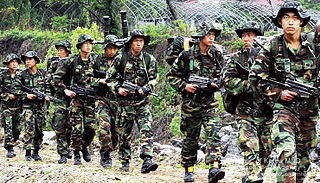
The Pinerolo Mechanized Brigade is a mechanized infantry brigade of the Italian Army, based in the southern region of Apulia. Carrying the name of the Piedmontese city of Pinerolo the brigade's coat of arms was modeled after the city's coat of arms. The brigade is part of the Division "Acqui".

Infantry military personnel who travel and fight on foot

Infantry is a military specialization that engages in military combat on foot, distinguished from cavalry, artillery, and tank forces. Also known as foot soldiers or infantrymen, infantry traditionally relies on moving by foot between combats as well, but may also use mounts, military vehicles, or other transport. Infantry make up a large portion of all armed forces in most nations, and typically bear the largest brunt in warfare, as measured by casualties, deprivation, or physical and psychological stress.

Brigade Military formation size designation, typically of 3-6 battalions

A brigade is a major tactical military formation that is typically composed of three to six battalions plus supporting elements. It is roughly equivalent to an enlarged or reinforced regiment. Two or more brigades may constitute a division.

Italian Army land warfare branch of Italys military forces

The Italian Army is the land-based component of the Italian Armed Forces of the Italian Republic. The army's history dates back to the unification of Italy in the 1850s and 1860s. The army fought in colonial engagements in China, Libya, Northern Italy against the Austro-Hungarian Empire during World War I, Abyssinia before World War II and in World War II in Albania, Balkans, North Africa, USSR and Italy itself. During the Cold War, the army prepared itself to defend against a Warsaw Pact invasion from the east. Since the end of the Cold War, the army has seen extensive peacekeeping service and combat in Afghanistan and Iraq. Its best-known combat vehicles are the Dardo infantry fighting vehicle, the Centauro tank destroyer and the Ariete tank and among its aircraft the Mangusta attack helicopter, recently deployed in UN missions. The headquarters of the Army General Staff are located in Rome opposite the Quirinal Palace, where the president of Italy resides. The army is an all-volunteer force of active-duty personnel.

History

1831 to 1914

After the ascension to the throne of Charles Albert of Sardinia on 27 April 1831 a major reform of the military of the Kingdom of Piedmont was undertaken. Thus on 13 November 1831 the Pinerolo Brigade was raised with two infantry regiments. These two regiments were the "His Royal Highness' Regiment of Saluzzo" (Reggimento di Saluzzo di Sua Altezza Reale) founded during 1672 as Regiment Lullin and a newly raised Infantry Regiment. From 1 November 1815 to 1821 the "HRH Regiment of Saluzzo" was known as "Saluzzo Brigade" (Brigata Saluzzo) and based in the city of Saluzzo. From 1821 to 13 November 1831 the brigade was known as "Brigade of Pinerolo" (Brigata di Pinerolo) and based in Genoa, however in size and function both brigades were akin to an infantry regiment with just two battalions. Initially each regiment of the brigade consisted of three battalions: the 1st and 2nd battalions fielded each three companies of fusiliers and one company of grenadiers, while the third battalions consisted of four companies of skirmishers. A fourth battalion was added to each regiment and the companies personnel strength was increased. By 1839 each regiment fielded four battalions, which in turn fielded 4 companies of 250 men each. In 1839 the regiments of the Pinerolo were numbered and renamed as 13th Infantry Regiment Pinerolo Brigade and 14th Infantry Regiment Pinerolo Brigade.

Charles Albert of Sardinia King of Sardinia and Duke of Savoy

Charles Albert was the King of Sardinia from 27 April 1831 to 23 March 1849. His name is bound up with the first Italian constitution, the Albertine Statute, and with the First Italian War of Independence (1848–1849).

Kingdom of Sardinia former Italian state (1324–1861)

The Kingdom of Sardinia was a state in Southern Europe from the early 14th until the mid-19th century.

Saluzzo Comune in Piedmont, Italy

Saluzzo is a town and former principality in the province of Cuneo, Piedmont region, Italy.

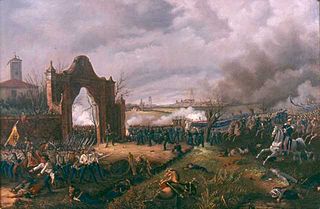
The brigade participated in the First Italian War of Independence fighting in the battles of Santa Lucia and Novara. In 1855 the brigade provided two battalions for the Sardinian Expeditionary Corps in the Crimean War. In the Second Italian War of Independence the brigade was employed in the battles of Magenta and Solferino. In the Third Italian War of Independence the brigade fought in the Battle of Custoza.

First Italian War of Independence

The First Italian War of Independence was part of the Italian unification or Risorgimento. It was fought by the Kingdom of Sardinia (Piedmont) and Italian volunteers against the Austrian Empire and other conservative states from 23 March 1848 to 22 August 1849 in the Italian peninsula.

The battle of Santa Lucia was an episode in the First Italian War of Independence. On 6 May 1848, when the king of Sardinia, Carlo Alberto, sent I Corps of the Sardinian army to assault the fortified positions held before the walls of Verona by the Austrian army under field marshal Josef Radetzky. The Austrian army, though outnumbered, managed to withstand the attack and hold their positions. The battle is named after the Santa Lucia district of Verona. Franz Joseph assisted at the battle.

Battle of Novara (1849)

This article is about the battle in 1849. For other battles here see Battle of Novara

World War I

At the outbreak of World War I the brigade was based in the city of Padua with its two regiments fielding three battalions each and each of the battalions consisting of four companies and a machine gun section. On 24 May 1915 the brigade advanced to the South of Palmanova into Austrian territory until it met Austrian positions near the village of Selz. During the First Battle of the Isonzo the brigade tried to take the area of Selz and the nearby fortified hill of Sei Busi but managed only to capture some Austrian trenches. During the Second Battle of the Isonzo the brigade again tried to take the two objects. The only success of the battle came on 24 July when the 14th Regiment managed to enter the Austrian trench system on Sei Busi, but the Austrian artillery fire and counterattacks drove the Italians back to their own positions by evening of the same day.

World War I 1914–1918 global war starting in Europe

World War I, also known as the First World War, the Great War, the Seminal Catastrophe, and initially in North America as the European War, was a global war originating in Europe that lasted from 28 July 1914 to 11 November 1918. Contemporaneously described as "the war to end all wars", it led to the mobilisation of more than 70 million military personnel, including 60 million Europeans, making it one of the largest wars in history. It is also one of the deadliest conflicts in history, with an estimated nine million combatants and seven million civilian deaths as a direct result of the war, while resulting genocides and the resulting 1918 influenza pandemic caused another 50 to 100 million deaths worldwide.

Padua Comune in Veneto, Italy

Padua is a city and comune in Veneto, northern Italy. Padua is on the river Bacchiglione, west of Venice. It is the capital of the province of Padua. It is also the economic and communications hub of the area. Padua's population is 214,000. The city is sometimes included, with Venice and Treviso, in the Padua-Treviso-Venice Metropolitan Area (PATREVE) which has a population of c. 2,600,000.

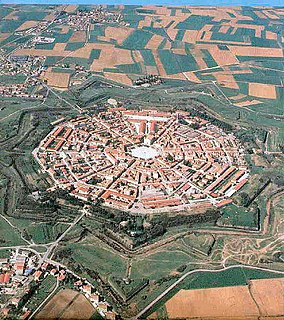
Palmanova Comune in Friuli-Venezia Giulia, Italy

Palmanova is a town and comune in northeastern Italy. The town is an example of star fort of the late Renaissance, built up by the Venetian Republic in 1593.

Having suffered horrendous casualties in the Second Battle of the Isonzo the brigade was taken out of the front for a two-month rest. In October the brigade returned to the front to participate in the Third Battle of the Isonzo. Again the brigade tried to take Sei Busi and Selz and once more the brigade suffered horrendous losses. Reduced to half its strength the brigade was not employed during the Fourth Battle of the Isonzo but sent to Monfalcone to be rebuilt once more.

Third Battle of the Isonzo A battle in 1915 on the Italian Front during the First World War

The Third Battle of the Isonzo was fought from 18 October through 4 November 1915 between the armies of Italy and Austria-Hungary.

Fourth Battle of the Isonzo A battle in 1915 on the Italian Front during the First World War

The Fourth Battle of the Isonzo was fought between the armies of Kingdom of Italy and those of Austria-Hungary on the Italian Front in World War I, between November 10 and December 2, 1915.

Monfalcone Comune in Friuli-Venezia Giulia, Italy

Monfalcone is a town and comune of the province of Gorizia in Friuli-Venezia Giulia, northern Italy, located on the Gulf of Trieste. Monfalcone means "Mount of Falcon" in Italian.

During the first half of 1916 the brigade was stationed on the front lines on the Kras Plateau and tasked with continuous attacks on the Austrian positions to impede the Austro-Hungarian Army from sending reinforcements to the stalled offensive on the Asiago Plateau. On 29 June 1916 the brigade managed to break Austrian defenses near Doberdò conquer important staging areas that ultimately led to the success of the Battle of Doberdò during the Sixth Battle of the Isonzo. On 14 August 1916 the brigade was ordered to conquer the mountains of Pecinka and Veliki Hriback near Lokvica. For three days the brigades soldiers tried to reach the two summits, but having suffered over 2,000 dead by 17 August, the Italian Supreme Command ordered to cease combat operations along the front.

Austro-Hungarian Army ground force of the Austro-Hungarian Dual Monarchy from 1867 to 1918

The Austro-Hungarian Army was the ground force of the Austro-Hungarian Dual Monarchy from 1867 to 1918. It was composed of three parts: the joint army, the Imperial Austrian Landwehr, and the Royal Hungarian Honvéd.

Battle of Asiago battle

The Battle of Asiago(Battle of the Plateaux) or the Trentino Offensive, nicknamed Strafexpedition by the Austrians, was a major counteroffensive launched by the Austro-Hungarians on the Italian Front on 15 May 1916, during World War I. It was an unexpected attack that took place near Asiago in the province of Vicenza after the Fifth Battle of the Isonzo.

Doberdò del Lago Comune in Friuli-Venezia Giulia, Italy

Doberdò del Lago is a comune (municipality) in the Italian region Friuli-Venezia Giulia, located about 30 kilometres (19 mi) northwest of Trieste and about 11 kilometres (7 mi) southwest of Gorizia, and borders the following municipalities: Duino-Aurisina, Fogliano Redipuglia, Komen (Slovenia), Miren-Kostanjevica (Slovenia), Monfalcone, Ronchi dei Legionari, Sagrado, and Savogna d'Isonzo. It is located in the westernmost part of the Karst Plateau.

Once again the brigade had to be rebuilt and was therefore sent to the city of Romans. However less than a month later the brigade was already back at the front for the Seventh and Eighth Battle of the Isonzo. Both times the brigade was again tasked with taking Pecinka and Veliki Hriback. Both times the brigades battalions did not manage to enter the Austrian trenches, this feat only was achieved during the Ninth Battle of the Isonzo when the 13th Regiment managed to break into the Austrian defenses and hold the newly conquered positions.

Until May 1917 the brigade saw little combat, alternating between front line duties and rest in the village of Hudi Log. In the Tenth Battle of the Isonzo the brigade was tasked to the take hills of Stari Lokva and Versic near Sela na Krasu. Although the first Austrian were taken, artillery fire forced the Italians back to their own positions. Again employed in the Eleventh Battle of the Isonzo the brigade suffered devastating casualties attacking heights 244 and 251 near the Kostanjevica Monastery.

After the Italian front was broken in the Battle of Caporetto the brigade fought rearguard actions during the general Italian retreat towards the Piave river. On 30 October 1917 the command of the 14th Regiment and one of its battalions had to surrender to German troops as the rapidly advancing German and Austrian forces had already blocked all crossings over the Livenza river. The remnants of the brigade were employed in defensive battles on the lower Piave until December 1917.

On 7 April 1918 the brigade entered the front on the Asiago Plateau, where it was surprised by the Austrian attack towards Vicenza during the Battle of the Piave River. In face of the massive Austrian offensive the brigade had to abandon all its forward positions and managed to hold onto only the las lines of defense. With Austrian offensive bogging down the brigade managed to recapture part of the lost territory.

When the Battle of Vittorio Veneto finally broke the Austrian Army the brigade managed to advance towards the Vezzena Pass, which it reached on 3 November 1918, just before the Armistice of Villa Giusti came into effect.

World War II

After the end of World War I the brigade moved to Abruzzo and was garrisoned in the city of Chieti. In 1926 the brigade gained the 255th Infantry Regiment Arezzo and changed its name to XXIV Infantry Brigade. Along with the 18th Artillery Regiment the brigade formed the 24th Territorial Division in Chieti. In 1934 the division and brigade gained the name Gran Sasso and were forthwith known as 24th Infantry Division Gran Sasso and XXIV Infantry Brigade Gran Sasso. In 1935 the division was sent to Eritrea and participated in the Second Italo-Abyssinian War. The division operated in the Tigray Region and fought in the Battle of Shire.

In 1939 the brigade lost the 255th Infantry regiment and was renamed 24th Infantry Division Pinerolo. This binary division consisted of only two infantry regiments (13th and 14th) and the 18th Field Artillery Regiment. In 1940 the Pinerolo took part in the Italian invasion of France. In January 1941 the division arrived in Albania to stabilize the crumbling Italian front during the Greek counteroffensive in the Greco-Italian War.

On 18 January 1941 the division was in Berat and entered the approaching front near Këlcyrë. The division fought defensive battles for the next month ending with the defense of Tepelenë. The division participated in the Italian Spring Offensive, and participated in a small offensive towards Ohrid in Macedonia during the German-led Invasion of Yugoslavia.

In June 1941 the division transferred to Larissa in Thessaly to suppress the growing Greek Resistance. During its time in Thessaly the Pinerolo division committed the Domenikon Massacre against Greek civilians. the division continued on anti-partisan duty until the Armistice between Italy and Allied armed forces of 8 September 1943. In the confusion after the armistice the division was the only one in continental Greece to refuse German demands to surrender. While the Piemonte, Forlì, Modena, Casale and Cagliari divisions surrendered to the inferior German forces the Pinerolo defended Larissa against German attacks and then retired towards the Pindus mountain range where it joined the Greek People's Liberation Army in fighting the Germans.

The remnants of the division were repatriated to Italy in March 1945.

Cold War

Map of Italia meridionale.svg
Pinerolo Mechanized Brigade battalions in 1989

On 1 April 1952 the Pinerolo Infantry Division was raised again in the city of Bari. The division consisted initially of the 9th Infantry Regiment Bari and the 13th Infantry Regiment Pinerolo. Both regiments fielded two battalions, one less than the other divisions of the Army at the time. The divisions was rounded out by the 14th Field Artillery Regiment, the 9th Engineer Company and the 9th Signal Company.

However already on 1 September 1962 the division was reduced to a brigade. It consisted now of the 9th Infantry Regiment Bari (with three infantry battalions) and the Field Artillery Group Pinerolo. Minor units of the brigade were a Signal and an Engineer company. During the next years the Pinerolo Logistic Battalion was raised in Bari and on 30 October 1965 the LX Armored Battalion joined the brigade.

With the 1975 reform the Italian Army abolished the regimental level and battalions came under direct command of the brigades. Therefore on 1 November 1975, the 9th Regiment was disbanded and its battalions came forthwith under direct command of the Pinerolo Motorized Brigade. [1] The new organization of the brigade was therefore:

On 1 February 1979 the 60th Armored Battalion M.O. Locatelli changed composition shedding its two VCC-2 armored personnel carrier companies and received two additional tank companies. The unit was renamed as 60th Tank Battalion M.O. Locatelli. Additionally the battalion was equipped with new Leopard 1 tanks and the brigade's infantry battalions were equipped with VCC-1 armored personnel carriers. Therefore, on 1 February 1979 the brigade was renamed as Pinerolo Mechanized Brigade, and the brigade's infantry battalions changed their name from motorized to mechanized on 8 October 1980. In 1981 47th Field Artillery Group Gargano was disbanded and replaced in the same location by the 11th Field Artillery Group Teramo. The Teramo later replaced its M114 155/23 towed howitzers with M109 self-propelled howitzers.

Recent history

82nd Infantry Regiment "Torino" Freccia mortar carrier Italian Army - 82nd Infantry Regiment "Torino" VBM Freccia Mortar Carrier.jpg
82nd Infantry Regiment "Torino" Freccia mortar carrier
21st Field Artillery Regiment "Trieste" FH-70 howitzer battery Italian Army 21st Field Artillery Regiment "Trieste" FH70 howitzer battery 02.png
21st Field Artillery Regiment "Trieste" FH-70 howitzer battery
11th Engineer Regiment during an exercise Italian Army 11th Engineer Regiment controlled explosion.jpg
11th Engineer Regiment during an exercise

In the early 1990s the battalions returned to their traditional regimental names. As example on 30 September 1992 the 9th Mechanized Infantry Battalion Bari was renamed 9th Infantry Regiment Bari without changing composition or size. On 31 December 1990 the Army wide reduction in forces after the end of the Cold War began at the Pinerolo brigade with the disbanding of the 13th Mechanized Infantry Battalion Valbella. On 1 July 1991 the brigade lost the 67th Bersaglieri Battalion Fagarè and the 11th Self-propelled Field Artillery Regiment Teramo to the Garibaldi Bersaglieri Brigade. The 11th Self-propelled Artillery Regiment was replaced by the 2nd Self-propelled Artillery Regiment Potenza in Barletta

On 17 October 1992 the 133rd Tank Regiment from the Ariete Armored Brigade moved to Altamura and joined the Pinerolo, while on 21 October 1992 the 11th Bersaglieri Battalion Caprera (formerly part of the Garibaldi Bersaglieri Brigade) moved to Bari and joined the brigade as 7th Bersaglieri Regiment. On 10 October 1995 the 131st Self-propelled Field Artillery Regiment Centauro from the Centauro Armored Brigade transferred to Barletta where it replaced the 2nd Self-propelled Artillery Regiment Potenza. On 20 May 1996 the 131st Artillery Regiment moved to Foggia. On 18 April 1997 the 11th Bersaglieri Battalion Caprera was renamed as 10th Bersaglieri Battalion Bezzecca. On 9 October 1995 the 31st Tank Regiment was transferred from the Centauro Armored Brigade to Altamura and joined the Pinerolo. On the same day the 133rd Tank Regiment moved to Lecce and became a reserve unit. With the arrival of the second tank regiment the brigade was renamed as Pinerolo Armored Brigade.

By the end of 1997 the brigade's composition was as follows:

The following years brought additional changes: In March 2001 the 131st Self-propelled Field Artillery Regiment Centauro was replaced with the 21st Self-propelled Field Artillery Regiment Trieste from the Friuli Mechanized Brigade. The same year on 5 November the 82nd Infantry Regiment Torino from the Ariete Armored Brigade moved to Barletta and joined the Pinerolo. The same year the 11th Engineer Regiment moved from Motta di Livenza in the north of Italy to Foggia and joined the brigade, while the 133rd Tank Regiment was disbanded.

Today

Structure of the brigade (click to enlarge) Struttura della Brigata Pinerolo.gif
Structure of the brigade (click to enlarge)
Italy Apulia location map.svg
Green pog.svg
Pink ff0080 pog.svg
Dark Red 800000 pog.svg
Green pog.svg
Green pog.svg
Black pog.svg
Yellow pog.svg
Purple pog.svg
Pinerolo Mechanized Brigade regiments in 2018

The last change in the brigades structure occurred when the 31st Tank Regiment transferred to the Cavalry School on 1 January 2011, followed by the renaming of the brigade on 1 October 2011 as Pinerolo Mechanized Brigade.

In 2013 the brigade received the Pinerolo Logistic Regiment. On 28 February 2017 the 31st Tank Regiment returned to the Pinerolo Brigade and remained in Lecce.

Today the brigade is composed of the following units:

All regiments are battalion sized. The army plans to re-activate the 15th Cavalry Regiment "Cavalleggeri di Lodi" as reconnaissance unit for the brigade.

Equipment

Freccia of the brigade Italian Army - Mechanized Brigade "Pinerolo" Freccia IFV.jpg
Freccia of the brigade

The tank regiment is equipped with Ariete Main battle tanks. The Bersaglieri and the two infantry regiments are equipped with Freccia wheeled infantry fighting vehicles. The brigade's artillery regiment fields 18x FH-70 towed howitzers. [2]

Sources

Related Research Articles

The article provides an overview of the entire chain of command and organization of the Italian Army after the reform of 1 October 2016 and includes all active units as of 1 July 2019. The Armed Forces of Italy are under the command of the Italian Supreme Defense Council, presided over by the President of the Italian Republic. The Italian Army is commanded by the Chief of the Army General Staff or "Capo di Stato Maggiore dell’Esercito" in Rome.

On March 1, 1984 the Italian Institute for Disarmament, Development and Peace (Istituto di ricerche per il disarmo, lo sviluppo e la pace in Rome published the entire Italian Army order of battle down to company level - this was justified for the radical party as one of its core demands was total disarmament of Europe, even though the data which was published was top secret. The Radical Party dissolved in 1989 and the IRDISP followed suit in 1990. But Radio Radicale has survived, and the OrBat can still be found today on the homepage of the radio.

Pozzuolo del Friuli Cavalry Brigade

The Pozzuolo del Friuli Cavalry Brigade is a brigade of the Italian Army, based in the Friuli Venezia Giulia and Veneto regions. The Brigade consists of a command unit, a cavalry regiment, an amphibious infantry regiment, an artillery regiment, an engineer regiment and a logistic regiment.

Airmobile Brigade "Friuli"

The Airmobile Brigade "Friuli" is an airmobile brigade of the Italian Army, based mainly in the Emilia-Romagna region. The brigade was part of the 1st Defence Forces Command until it was transferred to the Division "Friuli". The brigade's coat of arms depicts a stylized version of the Rocca di Monfalcone castle near the city of Monfalcone in the Friuli region, where the brigade distinguished itself during World War I.

Granatieri di Sardegna Mechanized Brigade

The Granatieri di Sardegna Mechanized Brigade is a mechanized infantry brigade of the Italian Army, based in Rome and central Italy. The brigade fields one of the oldest regiments of the Army and is one of the guard regiments of the Italian president. The name of the unit dates back to the Kingdom of Sardinia and not the eponymous Mediterranean island of Sardinia. The brigade is part of the Division "Acqui".

Bersaglieri Brigade "Garibaldi"

The Garibaldi Bersaglieri Brigade is a mechanized infantry brigade of the Italian Army, based in the south of the country. Its core units are the Bersaglieri, an elite infantry corps of the Italian Army. The brigade is named after Giuseppe Garibaldi a hero of the Italian wars of unification. The brigade is part of the Division "Acqui".

Aosta Mechanized Brigade

The Aosta Mechanized Brigade is a mechanized infantry brigade of the Italian Army, based on the island of Sicily. The Brigade is one of the oldest of the Italian Army and the name connects the brigade to its original area of recruitment the Aosta Valley and its coat of arms is modeled after Aosta's coat of arms. The brigade is part of the Division "Acqui".

131st Armoured Division Centauro

The 131st Armoured Division Centauro was an armoured division of the Italian Army during World War II. It was formed in February 1939, by upgrading the 1st Armoured Brigade. It took part in operations in Albania, Greece and Yugoslavia before returning to Italy. Sent to North Africa in August 1942, it surrendered in Tunisia on 13 May 1943.

Armored Brigade "Centauro"

The Armored Brigade "Centauro" was an armored brigade of the Italian Army. Originally raised in 1975 as 31st Armored Brigade "Curtatone" it changed its name in 1986 when the Armored Division "Centauro" was disbanded. The brigade's headquarters was in the city of Novara and most of its tank and Bersaglieri units were based in the nearby city of Bellinzago Novarese, both located in the Province of Novara. The brigades name comes from the mythological race of half human-half horse creatures named Centaurs.

Mechanized Brigade "Goito"

The Mechanized Brigade "Goito" was a mechanized brigade of the Italian Army. Its core units were mechanized Bersaglieri battalions. The brigade's headquarters was in the city of Milan. The brigade's name was chosen in memory of the First Italian War of Independence Battle of Goito, where the Bersaglieri corps had its baptism of fire.

5th Army Corps (Italy)

The 5th Army Corps was one of three corps the Italian Army fielded during the Cold War. Based in the regions of Veneto and Friuli-Venezia-Giulia the corps was the army's main combat force. The 5th Army Corps was arrayed close to the Yugoslavian border and tasked with meeting any Warsaw Pact forces that crossed the border. On the left flank of the corps the 4th Alpine Army Corps was tasked with blocking the Alpine passes and in the rear of the corps the 3rd Army Corps served as operational reserve. After the end of the Cold War the corps was reduced in size and on 1 October 1997 it became the 1st Defence Forces Command. In 2013 the COMFOD 1° was disbanded and its function and brigades taken over by the 20th Infantry Division Friuli in Florence.

Mantova Mechanized Brigade various Italian Army units, the last of which was disbanded in 1997

The Mantova Mechanized Brigade was a mechanized brigade of the Italian Army. Its core units were mechanized infantry battalions. The brigade's headquarters was in the city of Cividale del Friuli. All the brigade's units were based in the region of Friuli-Venezia Giulia. In 2003, the Mantova was raised again as a division command.

Mechanized Brigade "Legnano"

The Mechanized Brigade "Legnano" was a mechanized brigade of the Italian Army. Its core units were mechanized infantry battalions. The brigade's headquarters was in the city of Bergamo in Lombardy. The name of the brigade commemorates the Lombard League victory in the Battle of Legnano in 1176 and its coat of arms depicts the Monument to the Warrior of Legnano in the centre of Legnano.
Motorized Brigade "Cremona" military unit

The Motorized Brigade "Cremona" was an infantry brigade of the Italian Army. The brigade's headquarters was in the city of Turin. The brigade carried on the name and traditions of the 44th Infantry Division "Cremona".

Folgore Mechanized Division

The Folgore Mechanized Division was a mechanized division of the Italian Army. Its core units were three mechanized brigades. The brigades headquarters was in the city of Treviso.

The Order of Battle of the Italian Army at the end of 1989 is given below.

With the 1975 reforms the Italian Army abolished the regimental level and replaced it with brigades made up of multiple arms. During the reform the army disbanded 48 regimental commands and reduced its force by 87 battalions. A further ten regimental commands were used to raise ten new brigade commands. Ten training centers, which for traditional reasons had carried the names of regiments, were also disbanded. The reduction in units also allowed to mechanize most of the remaining units in Northern Italy and Italy's defense strategy changed from a hold-at-all-costs territorial defense to one of mobile warfare.

Ariete Armored Brigade Italian armored brigade

The 132nd Armored Brigade "Ariete" is the only active armored brigade of the Italian Army. Its core units are Tank and Bersaglieri regiments. The brigade's headquarters is in the city of Pordenone. Most of its units are based in the North-East of Italy. The brigade's name comes from the battering ram. The brigade draws much of its historical traditions from the 132nd Armoured Division Ariete, active during the Second World War from 1939-42, and again active from 1948-1986. The brigade is part of the Division "Vittorio Veneto".

References

  1. "9° Reggimento Fanteria "Bari" - La Storia". Italian Army. Italian Army. Retrieved 7 January 2018.
  2. "Obice da 155/39 FH-70". Esercito Italiano. Retrieved 23 June 2019.