
Geum, commonly called avens, is a genus of about 50 species of rhizomatous perennial herbaceous plants in the rose family and its subfamily Rosoideae, widespread across Europe, Asia, North and South America, Africa, and New Zealand. They are closely related to Potentilla and Fragaria. From a basal rosette of leaves, they produce flowers on wiry stalks, in shades of white, red, yellow, and orange, in midsummer. Geum species are evergreen except where winter temperatures drop below 0 °F (−18 °C). The cultivars 'Lady Stratheden', and 'Mrs J. Bradshaw' have gained the Royal Horticultural Society's Award of Garden Merit.

Cradle Mountain is a locality and mountain in the Central Highlands region of the Australian state of Tasmania. The mountain is situated in the Cradle Mountain-Lake St Clair National Park.

Nothofagus gunnii, the tanglefoot- or deciduous beech, or Australian beech, is a deciduous shrub endemic to the highlands of Tasmania, Australia. It was discovered in 1847 by R.C Gunn and evidence exists that it once lived in Antarctica. N. gunnii is a small woody tree with a shrubby appearance known to grow up to 10 metres (33 ft). It lives only on mountains due to temperature limitations within the Tasmanian maritime climate and can survive up to heights of 1,600 metres (5,200 ft). It grows in alpine and sub-alpine regions in the central portions of the state but is absent from the coast zones. Though capable of reaching the size of a small tree, it rarely exceeds 10 metres (33 ft) in height, instead growing as a thick shrub or as a woody ground cover hence its common name of "tanglefoot".

Athrotaxis cupressoides, is also known as pencil pine, despite being a species of the family Cupressaceae, and not a member of the pine family. Found either as an erect shrub or as a tree, this species is endemic to Tasmania Australia. Trees can live for upwards of 1000 years, sustaining a very slow growth rate of approximately 12 mm in diameter per year.

Eucalyptus coccifera, commonly known as the Tasmanian snow gum, is a small to medium-sized tree endemic to Tasmania. It has smooth, grey and cream-coloured bark, elliptic to lance-shaped adult leaves, flower buds in groups of between three and nine, usually white flowers and conical, hemispherical or cup-shaped fruit.

Gaultheria hispida, commonly known as the copperleaf snowberry, is an endemic eudicot of Tasmania, Australia. It is an erect multi-branched shrub, that can be found in wet forests and alpine woodlands. Its berries appear snowy white and leaves are tipped with a copper tinge, hence the common name.

Ewartia planchonii commonly known as creeping cushionherb, is an endemic herb to alpine areas of Tasmania. E. planchonii is commonly found in the western highlands of Tasmania. The Ewartia genus is described as cushion plants/herbs due to the characteristic growth habits of low growing, highly compact mats which are made up of highly packed stems. These mats are slow-growing and are often located in soils that contain low nutrients.

Solidago spithamaea is a species of flowering plant in the aster family known by the common name Blue Ridge goldenrod. It is native to a very small region around the border between North Carolina and Tennessee in the United States. Its three remaining populations are threatened by the loss and degradation of its habitat. It is a federally listed threatened species of the United States.
Persoonia moscalii, commonly known as the creeping geebung, is a shrub native to southwestern Tasmania.

Orites revolutus , also known as narrow-leaf orites, is a Tasmanian endemic plant species in the family Proteaceae. Scottish botanist Robert Brown formally described the species in Transactions of the Linnean Society of London in 1810 from a specimen collected at Lake St Clair. Abundant in alpine and subalpine heath, it is a small to medium shrub 0.5 to 1.5 m tall, with relatively small, blunt leaves with strongly revolute margins. The white flowers grow on terminal spikes during summer. Being proteaceaous, O. revolutus is likely to provide a substantial food source for nectivorous animal species within its range.

Agastachys odorata, commonly known as the white waratah, is the sole member of the genus Agastachys in the protea family. It is an evergreen shrub to small tree and is endemic to the heaths and button grass sedgelands of western Tasmania. It occurs most often in moist heath and scrub and occasionally in the alpine regions, but generally prefers well-drained but poor soils. It can grow in some rainforests where it forms a small tree but is normally a shrub in all other situations. The heaviest concentrations are along the island's south coast. Its leaves are dark green, hairless and almost succulent. Masses of white flowers are produced in erect spikes from the ends of the branches. Measuring 8 to 12 cm high, they appear in January and February.
Alpine vegetation refers to the zone of vegetation between the altitudinal limit for tree growth and the nival zone. Alpine zones in Tasmania can be difficult to classify owing to Tasmania's maritime climate limiting snow lie to short periods and the presence of a tree line that is not clearly defined.

Campynema is a genus in the family Campynemataceae first described in 1805. It contains only one known species (monotypic), Campynema lineare, endemic to the island of Tasmania in Australia. Its closest relative is Campynemanthe, endemic to New Caledonia, sole other genus of the family.

Astelia alpina called pineapple grass, silver astelia, or perching lily is a commonly found species in alpine and subalpine areas of Tasmania and the Australian Alps. It is a perennial herb that typically dominates its environment by growing in dense clusters, called mats, in alpine bogs. There are two subspecies: Astelia alpina var. novae hollandiae from New South Wales and Victoria and Astelia alpina var. alpina endemic to Tasmania. Both subspecies appear very similar to each other. The species was originally described by Robert Brown.

The vegetation in Tasmania's alpine environments is predominately woody and shrub-like. One vegetation type is coniferous shrubbery, characterised by the gymnosperm species Microcachrys tetragona, Pherosphaera hookeriana, Podocarpus lawrencei, and Diselma archeri. Distribution of these species is relevant with abiotic factors including edaphic conditions and fire frequency, and increasingly, the threat of climate change towards species survival exists. Conservation and management of coniferous shrubbery are necessary considering that the paleoendemic species, Microcachrys,Pherosphaera and Diselma, have persisted in western Tasmanian environments for millions of years.

Pherosphaera hookeriana, or Mount Mawson pine, is a dwarf conifer endemic to Tasmania, at altitudes above 600 meters. There are roughly 30 known sites, with population numbers in the tens of thousands. The species occurs in a range of habitats typically in areas near water bodies, mostly on dolerite geology. The species is highly fire sensitive and an increase in fire events associated with climate change may lead to local extinction in some areas and fragmentation of habitat
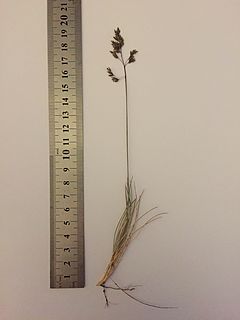
Poa gunnii is a Tasmanian endemic tussock grass considered one of the most abundant and common in alpine and subalpine environments from about 800 m to above 1400 m. However it can be found to near sea level in the south of the island state where a cooler climate is prevalent. The genus Poa belongs to the family Poaceae. Tasmania has 16 native and 6 introduced species of Poa.

Cotula alpina, also known as the alpine cotula, is a perennial herb in the family Asteraceae. It is a small flowering plant that forms ground covering mats and is well adapted to alpine environments.

Chionogentias diemensis is a flowering herbaceous alpine plant in the family Gentianaceae, endemic to the island of Tasmania in Australia. It is commonly known as the Tasmanian mountain gentian. Chionogentias diemensis has been classified into two sub-species: the Tasmanian snow-gentian and the Ben Lomond snow-gentian.
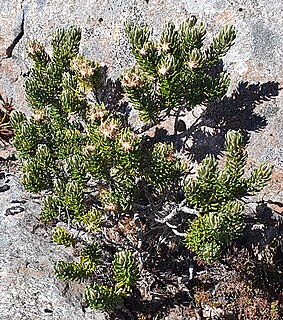
Olearia ledifolia, commonly known as the rock daisy bush, is a flowering shrub of the family Asteraceae. It is endemic to Tasmania and found at higher altitudes where it grows as a low, compact bush with tough leathery leaves and bears numerous small white daisy-like flowers in summer. The specific name ledifolia is derived from the Greek 'ledos' and the Latin 'folium' (leaf), referring to the hairy under surface of the leaves. It was initially described as Eurybia ledifolia by J.D. Hooker in 1860 and then as O. ledifolia by George Bentham in the 1867 census 'Flora Australiensis: a description of the plants of the Australian territory'.


