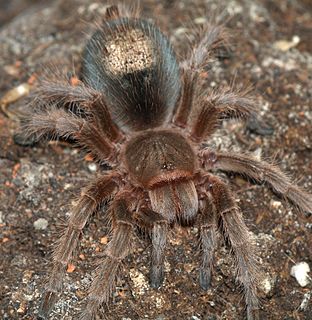
Urticating hairs or urticating bristles are one of the primary defense mechanisms used by numerous plants, almost all New World tarantulas, and various lepidopteran caterpillars. Urtica is Latin for "nettle", and bristles that urticate are characteristic of this type of plant, and many other plants in several families. This term also refers to certain types of barbed bristles that cover the dorsal and posterior surface of a tarantula's or caterpillar's abdomen. Many tarantula species eject bristles from their abdomens, directing them toward potential attackers. These bristles can embed themselves in the other animal's skin or eyes, causing physical irritation, usually to great discomfort. The term urticating hairs is a misnomer, as technically only mammals possess true hairs.

Avicularia is a genus of the family Theraphosidae containing various species of tarantulas. The genus is native to tropical Central and South America. Each species in the genus has very distinguishable pink foot pads.
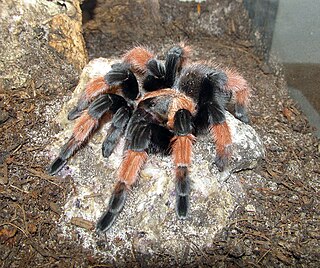
Brachypelma is a genus of spiders in the family Theraphosidae (tarantulas). They may have bodies up to 6 cm long with legs of similar or greater lengths. Some species have brightly colored legs, with red or orange marks and rings.

The Antilles pinktoe tarantula, also known as the Martinique red tree spider or the Martinique pinktoe is popular as a spider pet because of its docile character and unique coloration.
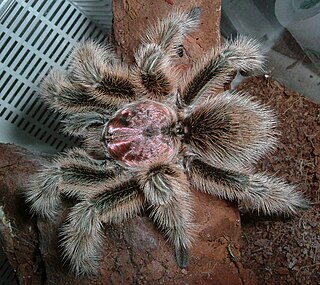
Grammostola is a genus of South American tarantulas that was first described by Eugène Louis Simon in 1892. These medium to large sized spiders are native to tropical South America, and are usually brown in color, with pinkish or orangish-red hairs. The very docile Chilean rose tarantulas are popular as a beginner's spider among tarantula enthusiasts.

Phormictopus is a genus of spiders in the family Theraphosidae (tarantulas) that occurs in the West Indies, mainly Cuba and Hispaniola, with three species probably misplaced in this genus found in Brazil and Argentina.

Tarantulas comprise a group of large and often hairy spiders of the family Theraphosidae. Currently, about 1,000 species have been identified. The term tarantula is usually used to describe members of the family Theraphosidae, although many other members of the same infraorder (Mygalomorphae) are commonly referred to as "tarantulas" or "false tarantulas". Some of the more common species have become popular in the exotic pet trade. Many New World species kept as pets have urticating hairs that can cause irritation to the skin, and in extreme cases, cause damage to the eyes.
Neischnocolus is a genus of spiders in the family Theraphosidae. It was first described in 1925 by Petrunkevitch. The genus Ami was separately described in 2008, but was later discovered to be a junior synonym of Neischnocolus. Species are native to Central America and northern South America.

The skeleton tarantula, Ephebopus murinus, is a species of spider belonging to the family Theraphosidae (tarantulas), sub-family Aviculariinae. A New World species, it is native to several South American countries. Its common name is derived from the skeleton-like markings on its legs.

Tapinauchenius is a genus of tarantulas that was first described by Anton Ausserer in 1871. The name is a combination of the Greek ταπεινός, meaning "low", and αὐχήν, meaning "neck". Several species, including T. gigas, have been moved to Pseudoclamoris.

The Aviculariinae are a subfamily of spiders in the family Theraphosidae (tarantulas). They can be distinguished from other theraphosids by a number of characters. Their legs have no or few spines on the underside of the tibial and metatarsal joints of the legs. The last two leg joints have brushes of hairs (scopulae) that extend sideways, particularly on the front legs, giving them a spoon-like (spatulate) appearance. Females have two completely separated spermathecae.

Typhochlaena seladonia is a species of aviculariine tarantula, and is the type species of the genus Typhochlaena. It is unique as an arboreal spider that constructs trapdoors in the bark of trees.

Sericopelma is a genus of tarantula, found in Central America from Nicaragua to Panama. The limits of the genus and its distribution have long been confused; it is closely related to the genus Aphonopelma. Sericopelma species are among the largest found in Central America. They can be kept as pets, although at least one species has been described as "very aggressive".
Tmesiphantes uru is a species of tarantula in the theraphosinae subfamily. It is endemic to Argentina.
Kochiana is a monotypic genus of Brazilian tarantulas containing the single species, Kochiana brunnipes. It was first described by C. L. Koch in 1841 under the name "Mygale brunnipes", and was transferred to its own genus in 2008. As of April 2020, it has only been found in Brazil.

Lasiodora difficilis, common name Brazilian red birdeater, is a species of tarantulas belonging to the family Theraphosidae.

Caribena is a genus of spiders in the family Theraphosidae (tarantulas), found in the Antilles. The two species accepted as of March 2017 were formerly placed in Avicularia. Apart from a different distribution – Avicularia species are found in mainland South and Central America – Caribena is distinguished by having longer and thinner type II urticating hairs in a conspicuous patch on the upper surface of the abdomen. Males also have a differently shaped palpal bulb.

Ybyrapora is a genus of spiders in the family Theraphosidae (tarantulas), found in Brazil. Its species were formerly placed in the genus Avicularia.

Avicularia juruensis is a species of spider in the family Theraphosidae, found in South America. Avicularia urticans was brought into synonymy in 2017. It has been given the English name Amazonian pink toe spider. Under the synonym Avicularia urticans, it is also known as the Peruvian pinktoe tarantula. It is a large mygalomorph spider, with a maximum body length over 30 mm (1.2 in) and the longest fully extended leg about 60 mm (2.4 in). Like other species in the genus Avicularia, specimens under this name are sold as pets, although their identity has not been confirmed by taxonomic studies.

Avicularia variegata is a species of spider in the family Theraphosidae found in Venezuela and Brazil. Previously described as Avicularia avicularia variegata, it is synonymous with Avicularia bicegoi.
