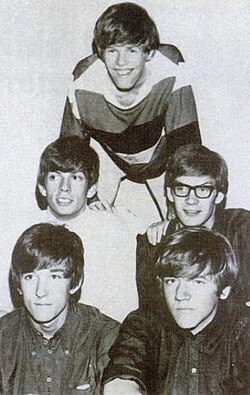
Herman's Hermits are an English pop rock group formed in 1963 in Manchester and formerly fronted by singer Peter Noone. Known for their jaunty beat sound and Noone's often tongue-in-cheek vocal style, the Hermits charted with numerous transatlantic hits in the UK and in America, where they ranked as one of the most successful acts in the Beatles-led British Invasion. Between March and August 1965 in the United States, the group logged twenty-four consecutive weeks in the Top Ten of Billboard's Hot 100 with five singles, including the two number ones "Mrs. Brown, You've Got a Lovely Daughter" and "I'm Henry VIII, I Am".
Herman's Hermits was formed from two different local bands. Keith Hopwood (rhythm guitar, backing vocals), Karl Green (lead guitar, backing vocals), Alan Wrigley (bass), Steve Titterington (drums) and Peter Noone (lead vocals) came from the Heartbeats where Hopwood had replaced rhythm guitarist Alan Chadwick.[2] The second-youngest member of a young group (four months older than Karl Green who was originally in the Balmains),[2] 15-year-old Noone was already an experienced actor on the popular British TV soap opera Coronation Street. Derek "Lek" Leckenby (lead guitar) and Barry Whitwam (drums) (born Jan Barry Whitwam) joined later from another local group, the Wailers. Whitwam replaced Titterington on drums, Green switched to bass guitar (replacing Wrigley) and Leckenby took over for Green as lead guitarist. After Leckenby joined the band, the group made a deal with producer Mickie Most and signed with EMI's Columbia label in Europe and MGM Records in the United States.[3]
The band's name came from a resemblance, noted by a publican in Manchester, England, between Noone and Sherman from the Rocky and Bullwinkle cartoons. Sherman was shortened to Herman and then became Herman and His Hermits, which was soon shortened to Herman's Hermits.[4]
1960s fame
Harvey Lisberg, in the summer of 1963, saw the group, then billed as Pete Novak & the Heartbeats, perform at Hartford Youth Club.[5] on the west side of Manchester, also referred to as The Collingwood Club by Harvey Lisberg. [citation needed][6] "After I discovered them in 1963, [they] went out as Herman and the Hermits."[7] He signed on as their manager and on April 22, 1964, Charlie Silverman, was added as co-manager.[5]
Cavern Club DJ Bob Wooler took an interest in the band, who played at the venue every Tuesday night, and promised them a couple of tracks in a proposed album called "The Cavern Presents". Although it never came to fruition, "it was good to have interest," wrote Keith Hopwood.[5]
The Plaza Ballroom, a popular venue where the band performed every Saturday night, was within close proximity to Granada TV, where music executive Johnnie Hamp and Michael Parkinson produced a nightly magazine show called "Scene at 6.30". Lisberg convinced Hamp and Parkinson to come to the Plaza. Arriving at the end of the show, Hamp saw the band perform their version of "Mashed Potatoes", introduced in 1959 by Nat Kendricks and the Swans. In the Herman's Hermits iteration, there was an abundance of kicking and leaping. Hamp made it a condition that this song be performed, and the show was piped to the A&R team at EMI.[5]
Hamp invited the band back for a second TV outing. Two songs, "Sweet & Lovely" and "Rip It Up" were recorded at the Urmston Recording Club. Following this, Hamp sent a crew to The Cavern to film the band performing their entire act, including unloading and setting up equipment and the sound check. The Kinks were also at the Cavern for a lunchtime session.[5]
Lisberg wrote: "At one of our lunchtime sessions at the plaza, I was in the manager Terry Devine's office and noticed an EMI letter signed by Derek Everett. He was a sales manager at EMI so I wrote to him. He said he had nothing to do with the music side of EMI but said there was a guy called Mickie Most who had just had some success with the Animals, and did I want to meet him?"[5]
The audition for Mickie Most on April 19, 1964 was at Kingsway Studios where Most recommended Alan Wrigley on bass guitar and Steve Titterington on drums be replaced.[5]
Keith Hopwood wrote: "...a couple of weeks later...Harvey asked Al about the name Herman and the Hermits. Al had registered it by posting a letter to himself which contained the name. This was a simple way of proving title in those days. For 200 pounds, the envelope was now Harvey's. Note-the manager now owned the name, not the band. This was a big mistake."[5]
On April 22, 1964, the new lineup of the band assembled in the basement of Charlie Silverman's house, where "the band immediately sounded better by a long way" and "with the change in personnel, we also changed the name, shortening it to 'Herman's Hermits".[5]
On May 19, 1964, Lisberg sent a plane ticket to London record producer Mickie Most so that Most could come to see the new lineup of the band play at the Beachcomber which had a similar atmosphere to the Cavern, was a favorite venue of the band, and was located in Bolton. Most, already successful with the Animals, became the group's producer and controlled the band's output.[5] He emphasized a simple and non-threatening clean-cut image.[8][citation needed]
Their chart debut was a cover of Gerry Goffin and Carole King's "I'm into Something Good" (a then-recent US Top 40 hit for Earl-Jean). In a three-hour recording session at Kingsway Studios on July 26, 1964, "I'm into Something Good" and B side "Your Hand in Mine" composed by Harvey Lisberg and Charles Silverman. Most booked jazz pianist Roger Webb who enabled the band to get the happier, more upbeat feel, compared to the Earl-Jean version.[6] Most, who initially thought the recording good, had second thoughts, until his wife Chrissie said "it's a smash, release it!" Within 12 days of recording, on August 7, 1964, Columbia Records, a part of EMI released the record, with an ad campaign "Hermania is coming" and "Hermania is Here!" Within 3 weeks, the record was a number one hit.[6] In September 1964, it replaced the Kinks' "You Really Got Me" at number one in the UK singles chart, and in December reached No. 13 in the US. The Hermits never topped the British charts again.
With their first release a success, the band hired agent Danny Betesh of Kennedy Enterprises, Andrew Loog Oldham and his partner Tony Calder, and Andy Wickham.[6] Most reunited with Peter Grant, with whom he had worked at 2i's and they set up an office at 155 Oxford Street on the 6th floor. Later, they would form RAK Music Management at this location.[6]
Mickie Most "was an absolutely key part of this success. His ability to pick a hit was uncanny, and once he had chosen a song, he'd book the best arrangers and session musicians and get everything ready. Jimmy Page and John Paul Jones, still a few years away from global mega-stardom with Led Zeppelin, were often involved…And the fact that he used session musicians didn't endear [Mickie Most] to the band but you don't argue with that kind of track record."[6]
"Since the 1960's there has been a lot of print about how our records were all played by session musicians…All our records which featured strings and brass were arranged by John Paul Jones and, yes, Jimmy [Page] played on them, along with other session guys. The fact is we played on all the records that were the biggest hits and Peter, Karl and myself sang them all. Once we had achieved a level of success that we did, particularly in the US, we hardly spent any time in the UK…This, coupled with the face that in those days singles were released much more regularly than now (seven singles and two albums in 1965) meant that Mickie sometimes prepared the tracks in our absence. We'd fly in for a couple of days, record the vocals, then back on the road we went…In 1965, we played at least 300 days out of 365..I'm also sure there would not have been anything like the coverage there has been of this if Jimmy Page and John Paul Jones had not become half of Led Zeppelin."[5]
However, in America in 1965—when Billboard magazine ranked them America's top singles act of the year (with the Beatles at No. 2)—they topped the Hot 100 with two non-UK releases: "Mrs. Brown You've Got a Lovely Daughter" and "I'm Henry VIII, I Am" (a remake of the 1910 Cockney-style music hall song "I'm Henry the Eighth, I Am"). The No. 12 debut of "Mrs. Brown" on the Hot 100 in April 1965 was the decade's third highest (behind the Beatles' "Hey Jude" and "Get Back").
The band played on most of its singles, including "I'm into Something Good", "Can't You Hear My Heartbeat", "Mrs. Brown You've Got a Lovely Daughter", "I'm Henry VIII, I Am" (said at the time to be "the fastest-selling song in history"),[9] "A Must to Avoid", "Listen People", "You Won't Be Leaving" and "Leaning on a Lamp Post". Leckenby soloed on "Henry" and Hopwood played rhythm guitar on "Mrs. Brown".[10] Despite the group's competent musicianship, some subsequent singles employed session musicians—including Big Jim Sullivan, Jimmy Page, John Paul Jones, Vic Flick and Bobby Graham—with contributions from the band, although the role of session players on Herman's Hermits records has been exaggerated in the rock media[citation needed] and in liner notes on the 2004 ABKCO Records compilation Retrospective (which does not credit the Hermits' playing). Mickie Most used session musicians on many records he produced; this was industry practice then.[11]
In April, 1965, as "Mrs Brown" was heading to the top of the charts, the band arrived in the US, the first British band to join the Dick Clark Caravan of Stars, a package tour featuring as many as 10 acts which traveled nationwide. This ran until June, and shortly after that, the band headed to MGM Studios in Hollywood to begin filming their movie debut "When the Boys Meet the Girls".[6]
Between late 1964 and early 1968, Herman's Hermits never failed to reach the Top 40 in the States. Six of their 11 US Top Tens were not released as A-side singles in their native UK, including the two aforementioned number ones plus "Can't You Hear My Heartbeat" (No. 2), "Listen People" (No. 3), a cover of Noel Gay's 1937 song "Leaning on a Lamp-post" (No. 9, under the title "Leaning on the Lamp Post") and their version of Ray Davies's "Dandy" (No. 5). Conversely they hit big in Britain between 1968 and 1970 with several major hits which failed to register in America, among them the four Top Tens "Sunshine Girl" (No. 8), "Something's Happening" (No. 6), "My Sentimental Friend" (No. 2) and "Years May Come, Years May Go" (No. 7). Their final UK hit, "Lady Barbara" (No. 13), released in the autumn of 1970, was credited to 'Peter Noone & Herman's Hermits'.
"Listen People" had been recorded for the film "When the Boys Meet the Girls" but had not been released. Early in 1966, MGM was looking for a single and since composer Graham Gouldman had already had successful hits, they took a chance on the song. It was a bit different from what Herman's Hermits had done before, particularly in the US where "Mrs Brown" and "Henry VIII" had fixed them in the public's mind as jokey funsters. This was more mature and reflective, albeit with a positive message. it was released in February 1966 and within weeks it had gone to number three in the US and the top of the charts in Canada."[6]
"Leaning on a Lamp Post" was the band's next single. Harvey Lisberg "suggested a song that neither Mickie nor the label would have come up with in a million years, but I had a hunch it might be perfect for them. I had always loved George Formby, the singer and actor who'd had loads of hits in the Thirties and Forties…He was from Lancashire and he had this cheeky chappie persona that wasn't that far removed from Peter's own image…Mickie didn't like the idea at all, but the band did and so did MGM…It suited them very well and gave them another top ten hit that summer."[6]
Herman's Hermits in 1965Herman's Hermits circa 1965
The 1966 film "Hold On" which was Herman's Hermits second film for MGM…was merely another excuse to string a bunch of songs together. "Leaning on a Lamp Post" was crowbarred in, as was "A Must to Avoid", composed by PF Sloan.[6]
P. F. Sloan wrote the Hermits soundtrack title track to the 1966 film Hold On!. Sloan and regular collaborator Steve Barri—whose songs include "Let Me Be", "You Baby" and "Secret Agent Man"—also co-wrote "Where Were You When I Needed You", "All the Things I Do for You Baby" and the Top Ten hit "A Must to Avoid", all recorded by Herman's Hermits.[13] "I had been to see Donovan at the Trip and was introduced to Mickie Most who was producing The Animals and Herman's Hermits. He said Herman's Hermits were doing a movie and did I want to write some songs for it. I borrowed Donovan's dressing room and spare guitar and wrote most of "A Must to Avoid" that night. We recorded it a couple of weeks later [and] I played with them on the session. I remember Keith Hopwood had a beautiful Gibson J200 acoustic put my Harmony Sovereign to shame. Herman's Hermits were sharp, smart, streetwise young men. To this day, some elitist rock types consider them to be fluff. I never did. I will always defend the legitimacy of Herman's Hermits."[5]
Ray Davies of the Kinks wrote "Dandy"—a 1966 US No. 5 hit for the Hermits—and Graham Gouldman wrote three of their 1966 hits: "Listen People", "No Milk Today" and "East West", the latter of which was covered in 2015 by Morrissey and the Smiths.[5]
"No Milk Today" was seen as a leap for the group, and for Peter in particular, but they jumped at the chance to try something with a bit more substance. Peter loved the track and believed it to be the best thing they ever did. No Milk Today went on to become a global hit and placed them into the UK top ten for the first time in almost a year.[6]
In November 1966 in the UK, after two consecutive Top 20 hits, the Hermits returned to the Top Ten with "No Milk Today", backed with "My Reservation's Been Confirmed".[14] For the US release of "No Milk Today" in 1967, MGM backed it with "There's a Kind of Hush". The latter climbed to No. 4 in March 1967. "No Milk Today" peaked at No. 35, though it was linked to "Hush" on local charts nationwide. "No Milk Today" also scored in its own right, including success on San Francisco Top 40 station KFRC, where in April 1967, it reached No. 1, ranking 6 for the year.[15]
In 1966 the group was nominated for three Grammy Awards including Best New Artist of 1965—they lost to singer Tom Jones—and two for their chart-topper "Mrs. Brown You've Got a Lovely Daughter": Best Performance by a Vocal Group and Best Contemporary (R&R) Performance – Group (Vocal or Instrumental). According to Noone and Hopwood, "Mrs. Brown" was recorded as an afterthought in two takes—using two microphones, with Hopwood on guitar, Green on bass guitar and Whitwam on drums. Noone and the band deliberately emphasised their English accents on the record, never intended to be a single. Hopwood recalls playing a Gretsch Country Gentleman guitar in the studio, with its strings muted to create the distinctive sound. When playing the song live, Hopwood often used a Rickenbacker guitar with a rag tied around the bridge to duplicate the sound, which can be seen clearly in old performance clips.[citation needed]
The following year the film "Mrs Brown You've Got a Lovely Daughter" was released. "It's not hard to see how the thinking went at MGM" Harvey Lisberg wrote, "the band had a huge hit with this song so let's make a movie with the same title." Allen Klein was producer and Saul Swimmer directed; both had worked together on two Beatles projects. Graham Gouldman composed "It's Nice to Be Out in the Morning", "Lemon and Lime", and Les Reed and Geoff Stephens composed "There's a Kind of Hush". The latter was written and recorded in 1966 when the composers were with The New Vaudeville Band; They had been having success with musical hall style songs, creating a Twenties jazz revival. The Beatles, attuned to the latest trends, had recorded "When I'm 64" which was in this vein. "There's a Kind of Hush" was released in early 1967 and went to number four in the US and number seven in the UK. It was their last top ten hit in the US, although as their popularity was beginning to wane there, it was picking up overseas. Many of their contemporaries were caught in a similar situation, while others managed to transition to rock. The Who had not yet become a success in the US, so in 1967, they opened concerts for Herman's Hermits who were still a big draw live.[6]
The 1967 album Blaze received critical acclaim,[citation needed] but barely made the Top 100 in the US and did not chart in the UK. The album included original songs by Leckenby, Whitwam, Hopwood, Green and Noone, including "Ace King Queen Jack" and the psychedelic "Moonshine Man".
"In April 1968, a short European tour was organized by British cosmetics company Yardley. This must have been one of the first examples of corporate sponsorship in the business and extended from the record right the way through to the live shows. Graham Gouldman had written The London Look which was the title of our EP which was given with Yardley samples to every girls in all of the audiences. Procol Harum and Dave Dee & Co were also featured and John Paul Jones on Hammond organ was musical director."[5]
"During 1969, we got the feeling that MGM had definitely taken their eye off the ball with regard to the band. Whether it was because they were more interested in some of their new acquisitions or other management problems or a combination of both, the end result was drastic. The final straw was their placing a full page ad in Billboard for our new single release, only for us to find out that it was advertising the wrong track," wrote Keith Hopwood. Mickie Most delayed any future recordings, some of which had already been big hits in other parts of the world. MGM withheld payments to the band and it was then that litigation ensued. "The end result was a swift conclusion to our American adventures as we were locked in legal battles with MGM and so had no other way to turn on the US." In the meantime, the band's records continued to do well in the UK and around the world. Sunshine Girl and Something is Happening were big hits at home and all over Europe." [5] "All the big hits that we had after that were when we fell out with the American label. We had 'Sunshine Girl' and 'My Sentimental Friend' and 'Sleepy Joe' and 'Years May Come, Years May Go.' They were huge number ones and number twos in England, but never were released in America," said Peter Noone in a 2024 interview.[16] Also in 1969, after hearing Ross D. Wylie's hit cover of Johnny Young's "Here Comes The Star", the band recorded it for release in the UK. Herman's Hermits followed the success of "My Sentimental Friend"—which peaked at No. 2 on the UK Singles Chart—with "Here Comes the Star," another ballad that reached No. 33. Their final release for Columbia Records, "Years May Come, Years May Go," returned the group to the UK Top 10 for the last time, reaching No. 7 in early 1970.[17]
Green, Leckenby, and Noone on the set of Hullabaloo, c.early 1966
In 1968, Hopwood and Leckenby eventually started a music company, Pluto Music, which is still in business as of 2023, working primarily on commercial and animation soundtracks.[citation needed]
Producer Mickie Most founded RAK Records in 1969, with Herman's Hermits enlisted to help promote the new label's launch in mid-1970. The band's reggae-influenced debut single on RAK, "Bet Yer Life I Do," co-written by Hot Chocolate members Errol Brown and Tony Wilson, marked a shift in style and reached the UK Top 30. A follow-up song, "Lady Barbara," credited to Peter Noone and Herman's Hermits, became the group's final UK Top 20 hit before Noone's departure.[18]"Lady Barbara" was an English adaptation by Errol Brown and Tony Wilson from the Italian-language song written by Totò Savio, Giancarlo Bigazzi, and Claudio Cavallaro and first released by Renato dei Profeti, founder of the group I Profeti.[19]
A 1969 two-disc album Herman's Hermits Rock 'n' Roll Party was never released.[citation needed]
1970s–present
On November 9, 1970, Peter Noone and Herman's Hermits were invited as part of the Royal Variety Command Performance in the presence of Her Majesty the Queen Mother at the London Palladium. Other invited performers included Dionne Warwick, Andy Williams and Freddie Starr. Originally there was an elaborate Broadway show number planned, featuring Noone singing a Barbra Streisand song, walking forward as the orchestra rose into the air on a riser. "Unfortunately," as Keith Hopwood, who thought the number was visually "absolutely stunning" said, Michael Grade, revised the act to a ten minute medley which included the Cockney song "Fish and Chips" and "If I Were a Rich Man" from Fiddler on the Roof. The Hermits were not dancers or actors, but according to Hopwood, "we managed to get through it without tripping up the girls, but...our show was nearly done, in every sense." Using their newly found dance skills, the band headlined at the London Palladium for 3 weeks that November, using the rising stage, and singing classic Noël Coward music, including "London Pride". Hopwood said that they were travelling on "Peter's road...not really the band's and certainly not mine."[5] Other songs on the set list that evening were: "Sunshine Girl", "Lady Barbara", "Sentimental Friend", "Mame", and two Peter Noone solos, "Where is Love" from the musical "Oliver!" and "There's a Kind of Hush".[20] According to Peter Noone, during his time with Herman's Hermits, many career decisions were constrained by the need to maintain the group's employment and financial security, preventing him from pursuing solo opportunities like a role replacing Tommy Steele in Half a Sixpence due to other members' financial obligations. He reflected that on many occasions he prioritized the group's collective needs over his individual goals due to his youth.[21]
Following "Lady Barbara" Peter Noone separated from the band in 1971 to pursue a solo career. While between management and without a recording contract, David Bowie had presented several songs to producer Mickie Most, who selected "Oh! You Pretty Things" (its original title) for release as a solo single by Peter Noone as opposed to having it released as a Herman's Hermits recording. When David Bowie played several songs for Noone and Most, Noone liked them all, saying Bowie reminded him of hitmaker PJ Sloan. Unable to find a session pianist who could reproduce the style in Bowie's demo, Bowie performed piano on the recording himself, his first such studio appearance, using "only the black notes so we had to record it in F-sharp." [22] In April, 1971, his debut single was David Bowie's composition, which was released under the title "Oh You Pretty Thing" and which peaked at number 12 in the UK, becoming Bowie's biggest success as a songwriter since his own single "Space Oddity" two years earlier.
When Noone left the group in 1971, the Hermits continued, first with singer Pete Cowap. They signed with RCA Records in the UK and, as "The Hermits", recorded two singles at Strawberry Studios and an unreleased album (under the name Sourmash) produced by Eric Stewart. The group subsequently cut one-off singles for Private Stock, Buddah, and Roulette in 1975, 1976, and 1977 without significant success. Noone did return to front Herman's Hermits during a 1973–1974 U.S. multi-artist tour of "British Invasion" acts, after which Whitwam, Leckenby, and Green (who assumed lead vocal duties until his 1980 retirement) continued to tour with newer members, including Rod Gerrard (formerly with Wayne Fontana & the Mindbenders and Salford Jets).[citation needed] Hopwood left in 1972.
Karl Green left the band in 1980 to spend more time with his family. He later opened a plumbing and tiling business in London.
In 1986, a group billed as "The Hermits", a touring incarnation by original members Whitwam and Leckenby, opened for the Hep Stars and the Monkees on their 1980s reunion tours of the US.
Hopwood has since become a composer of scores for film and television. Green has become a manager of sound systems for concert venues along London's South Bank.[24]
Herman's Hermits during their 50-year anniversary tour in April 2014. From left to right: Paul Cornwell, Barry Whitwam, Geoff Foot, Kevin Lingard
Leckenby died of non-Hodgkin lymphoma in 1994, leaving Whitwam as the only original member of the band. Noone continues to play solo shows billed as "Herman's Hermits starring Peter Noone".
On 8 June 1997, Hopwood, Green, and Whitwam reunited to play a one-off reunion concert with Noone.[25]
Karl Green has noted that he preferred harder rock but was grateful for the hand he was dealt.[26] Many of the band's singles and album tracks were written by some of the top songwriters of the day, but Noone, Leckenby, Hopwood and Green contributed lesser-known songs such as "My Reservation's Been Confirmed", "Take Love, Give Love", "Marcel's", "For Love", "Tell Me Baby", "Busy Line", Moonshine Man", "I Know Why" and "Gaslight Street". "I Know Why" enjoyed a limited A-side release.[27]
The Sourmash album from 1972 was finally released in 2000 under the title A Whale of a Tale! And Others.[28]
Scottish-born keyboardist Robert Birrell joined in May 2002. He was diagnosed with cancer a few years into being a Hermit, and Kevan Lingard was added in on keys in 2005 to fill in for dates Birrell couldn't attend. Robert eventually left in September 2006 and later died on 18 October 2008.[29]
In 2019, Noone won the "Entertainer of the Year" award at the Casino Entertainment Awards.[30] In 2023, Herman's Hermits Starring Peter Noone were scheduled to perform in over 100 concerts in countries such as the USA, Canada, Mexico, the United Kingdom and France.[31][needs update]
Geoff Foot, who, with the exception of Whitwam, was the longest serving member, left the Hermits after playing his last gig with them at a Butlin's on Saturday, 14 January 2023. Foot was replaced by John Summerton.[32]
Also, in 2023, Tony Hancox left the band after six years. He was replaced by Tony Young of Gerry's Pacemakers. Hancox's last performance with the Hermits was at the Leeds Grand Theatre on 29 October 2023, when they were touring in the "Sixties Gold" nostalgia tour.[33] In turn, Hancox filled Young's place in Gerry's Pacemakers.[34] As of April 2024, the current lineup of Herman's Hermits is: Barry Whitwam (drummer since 1964), Jamie Thurston (formerly of the Tornados starring Dave Watts; bassist and lead vocalist since 2020), John Summerton (formerly of Flintlock; guitarist since January 2023), and Tony Young (formerly of Gerry and the Pacemakers; keyboardist since October 2023).
Controversies and legal disputes
Disputes over recording contributions
Continuing acrimony among former members of Herman's Hermits has increased the amount of disinformation about the group's role on their records; the late Derek Leckenby, in particular, was a skilled guitarist. [citation needed] Mickie Most commented on the VH1My Generation: Herman's Hermits episode that the Hermits "played on a lot of their records, and some they didn't." The group played on all their UK and US No. 1 hits ("I'm Into Something Good", "Mrs Brown You've Got a Lovely Daughter", and "I'm Henry VIII, I Am"), on most of their US Top Ten singles, on several other singles and most album cuts. According to Peter Noone, Leckenby played the muted lead on "This Door Swings Both Ways".[35]
The riff in "Silhouettes" variously has been credited to Jimmy Page, Big Jim Sullivan and Vic Flick; however, according to Keith Hopwood and Karl Green, Leckenby replaced Flick in the studio and played the signature riff under Most's direction.[35] According to Hopwood, Green and Noone, Jimmy Page played on the single "Wonderful World" (although Big Jim Sullivan lists the song as part of a session he played); both may have added to the backing track. Several writers have claimed that session players played on "I'm into Something Good"; according to the surviving band members, the song was recorded on a two-track recorder, with only a piano player in addition to the Hermits.[35]
Legal disputes over "Herman's Hermits" name
Legal disputes between Whitwam and Noone have occurred since the 2000s. In 2003, members were forced to rename the band "Herman's Hermits starring Barry Whitwam" when they tour in North America, but remain billed as "Herman's Hermits" elsewhere.[36]
These legal disputes over the Herman's Hermits band name have highlighted broader issues surrounding trademark ownership and the control of band identities. In 2004 in Australia, Whitwam successfully registered ownership of the band name, restricting its use by other former members. Legal commentators noted that the case raised wider concerns about the registration of intellectual property rights without the knowledge or consent of collaborators. The dispute has been compared to other band-name controversies, including litigation involving Glen Shorrock and the Original Little River Band, as well as a 2007 disagreement within The Angels concerning use of that group's name. Four years after Noone left the group to pursue a solo career, Leckenby, Green, and Whitwam initiated legal proceedings in the High Court of England seeking to prevent Noone from using the word "Hermits." The case was settled, with Noone agreeing not to use the term, while the remaining members continued performing under the name Herman's Hermits. Whitwam later toured in Europe under the name Herman's Hermite Starring Barry Whitwam and successfully registered the band name in the United Kingdom and Europe. Ownership of the name in the United States remained with other former members. After Whitwam applied to register the name in Australia, other band members said that shared use was necessary to allow them to enter contracts and receive royalties and performance-related income, however, in a decision issued by hearing officer Jock McDonagh, it was determined that the earlier UK settlement permitted any of Green, Leckenby, or Whitwam to continue performing under the Herman's Hermits name. Following Leckenby's death, Whitwam was the only surviving member actively performing under that name, and the hearing officer concluded that exclusive registration was therefore unlikely to cause public deception.[37]
While Noone maintains a relationship with most of the original band members, he has acknowledged a strained dynamic with drummer Barry Whitwam over the ownership of the group's name. Noone noted that other band members shared this frustration after Whitwam assumed control of the Herman's Hermits trademark, which Noone believes should have been a collective asset. Despite this, Noone remains in contact with rhythm guitarist Keith Hopwood, with whom he continues to manage the band's business affairs, including recording contracts and publishing rights.[38]
One such case in 2009 had the band sued by Peter Noone when advertisements for their tour in the US had "Herman's Hermits" in large text, with "starring/featuring Barry Whitwam" in small text underneath, which would not have been noticed by people looking at the advertisement, possibly misleading them into thinking that they were seeing an ad for Noone. A lawsuit unravelled, and Whitwam ultimately decided to stop touring in the United States with his band:
In 2009, our last tour of America we did, we agreed in 2003 that if I would tour America that I was Herman's Hermits Starring Barry Whitwam and when Peter went out it would be Herman's Hermits Starring Peter Noone. In 2009, the promoters, the buyers, didn't read the rider properly, got it wrong and said Herman's Hermits. Then in small letters, Featuring or With Barry Whitwam. The promoters got it wrong. Peter got wired up and we went to battle, litigation and all that stuff. It could've been settled with a phone call because my agents and promoters were in the wrong because they didn't read the rider properly. Anyway, we agreed to go out as Herman's Hermits Starring Barry Whitwam and he agreed to go out as Herman's Hermits Starring Peter Noone. In 2009, it went pear-shaped and I decided it's not worth the hassle going out in America because every time you got booked, you got booked wrong, not the way it should have been. So 2009 was the last tour of America for me.
↑MacInnes, Colin (1965) "The Old English Music Hall Songs Are New." The New York Times, 28 November 1965, p. SM62: "Henry—which hit the top of the record lists and, according to one American expert, was 'the fastest-selling song in history'—was in fact an old English music hall song enjoying a new lease on life."
↑editor, Patrick DurkinBOSS deputy (20 February 2009). "Band's name a sticky issue". Australian Financial Review. Retrieved 8 February 2026.{{cite web}}: |last= has generic name (help)
This page is based on this Wikipedia article Text is available under the CC BY-SA 4.0 license; additional terms may apply. Images, videos and audio are available under their respective licenses.