
As the tenth-largest country in the world, and the largest in Africa and in the Mediterranean region, Algeria has a vast transportation system that includes a large and diverse transportation infrastructure.
Articles related to Algeria include:

Algeria, as of 2024, is divided into 58 wilayas (provinces). Prior to December 18, 2019, there were 48 provinces. The 58 provinces are divided into 1,541 baladiyahs (municipalities). The name of a province is always that of its capital city.

Sidi Bel Abbès is one of the provinces (wilayas) of Algeria. Its name is derived from the name of its capital, the city of Sidi Bel Abbès. It is situated in the northwestern part of the country.

Oran Province is a province (wilayah) in Algeria whose seat is the city of the same name.

Tlemcen is a province (wilaya) in northwestern Algeria. The Tlemcen National Park is located there.

The National Rail Transportation Company is Algeria's national railway operator. The SNTF, a state-owned company, currently has a monopoly over Algeria's rail network of 3,973 km (2,469 mi), although it is currently utilising only 3,572 km (2,220 mi). Out of the total railway network, 2,888 km (1,795 mi) are 1,435 mmstandard gauge and 1,085 km (674 mi) are 1,055 mm narrow gauge.

The 2009–10 Algerian Cup was the 46th edition of the Algerian Cup. ES Sétif won the Cup by defeating CA Batna 3–0 in the final with a brace from Hocine Metref and an own goal from Saber Chebana. It was the seventh time that Sétif won the trophy.
Aïn El Berd is a commune (baladiyah) in the Aïn El Berd district (daïra) in the Sidi Bel Abbès province (wilayah) of Algeria. It is situated in the northwestern part of the country, in the Hauts Plateaux region, and has a typical Mediterranean climate. Established as an official commune on April 15, 1886, Aïn El Berd is known for its beautiful countryside views and sites, as well as for its vineyards, olive trees, and wheat products. During the French colonial era, the surrounding areas, then called Saint-Marc and Saint-Henri, gave wines of good quality, and in 1889 and 1900 won silver and gold medals, respectively.

The 2014–15 Algerian Cup was the 51st edition of the Algerian Cup. The winners were MO Béjaïa who qualified to the 2016 CAF Confederation Cup.
The 2015–16 Algerian Cup is the 52nd edition of the Algerian Cup. The winners were MC Alger who qualified to the 2017 CAF Confederation Cup. MO Béjaïa were the defending champions, having beaten RC Arbaâ 1–0 in the previous season's final.
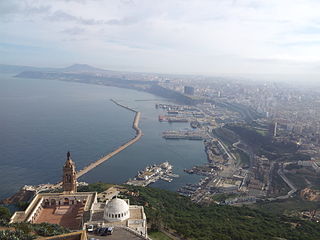
Oranais is a cultural region of the Maghreb, located in northwestern Algeria.
The 2016–17 Algerian Cup was the 53rd edition of the Algerian Cup. The eventual winners were CR Belouizdad who qualified for the 2018 CAF Confederation Cup.
The 1988–89 Algerian Cup is the 27th edition of the Algerian Cup. USM Alger are the defending champions, having beaten CR Belcourt 5–4 on penalties in the previous season's final.
The 2017–18 Algerian Cup was the 54th edition of the Algerian Cup. The winner qualified for the 2018–19 CAF Confederation Cup, The final was played in the July 5, 1962 Stadium. USM Bel Abbès were the eventual winners.
The 2020–21 Algerian Ligue Professionnelle 1 was the 59th season of the Algerian Ligue Professionnelle 1 since its establishment in 1962. A total of 20 teams contested the league. The Ligue Professionnelle 1 kicked off on 28 November 2020.
The 1997–98 Algerian League Cup called 1st November Cup is the 3rd season of the Algerian League Cup. The competition was open to all 64 Algerian clubs participating in the Algerian Championnat National and the Algerian Championnat National 2.

The history of rail transport in Algeria began in 1857 during the French colonization with the implementation of an initial plan for the creation of a 1,357 kilometres (843 mi) railway network. This plan, formalized by a decree from Emperor Napoleon III, defined the initial framework of the Algerian railway network, which continued to evolve throughout the second half of the 19th century, both in terms of its scale and structure.


