
Parodia is a genus of flowering plants in the family Cactaceae, native to the eastern slopes of the Andes in northwestern Argentina and southwestern Bolivia and in the lowland pampas regions of northeastern Argentina, southern Brazil, eastern Paraguay, and Uruguay. This genus has about 65 species, many of which have been transferred from Eriocactus, Notocactus and Wigginsia. They range from small globose plants to 1 m (3 ft) tall columnar cacti. All are deeply ribbed and spiny, with single flowers at or near the crown. Some species produce offsets at the base. They are popular in cultivation, but must be grown indoors where temperatures fall below 10 °C (50 °F).
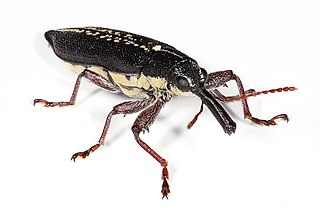
Belidae is a family of weevils, called belids or primitive weevils because they have straight antennae, unlike the "true weevils" or Curculionidae which have geniculate (elbowed) antennae. They are sometimes known as "cycad weevils", but this properly refers to a few species from the genera Parallocorynus and Rhopalotria.

Nemonychidae is a small family of weevils, placed within the primitive weevil group because they have straight rather than geniculate (elbowed) antennae. They are often called pine flower weevils. As in the Anthribidae, the labrum appears as a separate segment to the clypeus, and the maxillary palps are long and projecting. Nemonychidae have all ventrites free, while Anthribidae have ventrites 1-4 connate or partially fused. Nemonychidae lack lateral carinae on the pronotum, while these are usually present, though may be short, in Anthribidae.
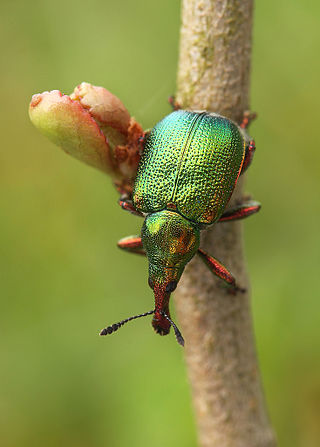
The tooth-nosed snout weevils, Rhynchitidae, are small beetles that are usually found in vegetation. They usually use buds, fruits, or seeds for oviposition. The tooth-nosed snout weevils receive this name due to the teeth on the edges of their mandibles.
Catalabus is a genus of leaf rolling weevils in the beetle family Attelabidae. There are about nine described species in Catalabus.

Attelabus is a genus of weevils belonging to the family Attelabidae.
Homapoderus is a genus of weevils in the family Attelabidae. The genus was named and described by Legalov in 2003.
Pterocolus is a genus of thief weevils in the beetle order Coleoptera. There are about 16 described species in Pterocolus.

Involvulus is a genus of leaf and bud weevils in the beetle family Attelabidae. There are more than 40 described species in Involvulus. The genus was first described in 1798 by Franz von Paula Schrank who specified the type species as Involvulus metallicus which is considered to be Involvulus cupreus.
Ochyromera is a genus of leguminous seed weevils in the beetle family Curculionidae. There are more than 30 described species in Ochyromera.

Stephanocleonus is a genus of cylindrical weevils in the beetle family Curculionidae. There are at least 70 described species in Stephanocleonus.
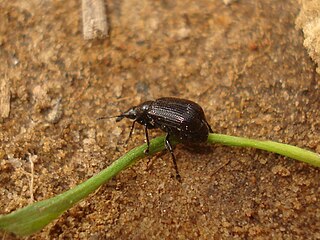
Deporaus is a genus of leaf and bud weevils in the beetle family Attelabidae. There are more than 200 described species in Deporaus.
Diocalandra is a genus of weevils in the subfamily Dryophthorinae and the monotypic tribe Diocalandrini. Species are distributed mostly in Africa, Asia and Australia and includes the lesser or four-spotted coconut weevil.

Apoderinae is a subfamily of leaf rolling weevils in the beetle family Attelabidae. There are at least 20 genera and more than 650 described species in Apoderinae, found in Europe, Asia, and Africa.
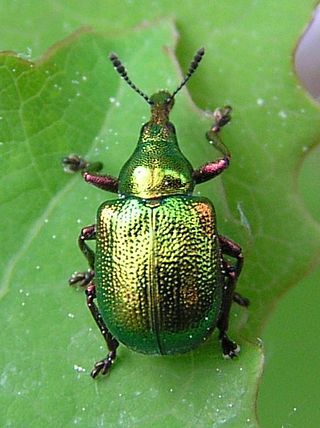
Byctiscus is a genus of beetles belonging to the family Attelabidae. Species of the genus are found in Europe and Japan.


