Kannappar

Last updated
Kannappa Nayanar
Kannappa.JPG
Kannappa Nayanar
Born
Dinna Vyadha

c. 3102/3101 BCE
Uduppura, Bharatavarsha
Known for Nayanmar

Kannappa was a staunch devotee of Shiva and is closely associated with Srikalahasteeswara Temple. [1] [2] He was a hunter and is believed to had plucked his eyes to offer to Srikalahasteeswara linga, the presiding deity of Srikalahasti Temple. [1] [2] He is also considered one of the 63 Nayanars or holy Saivite saints, the staunch devotees of Shiva. According to historical chronicles, he was Arjuna of the Pandavas in his past life.

Shiva Hindu god, supreme being of the universe

Shiva also known as Mahadeva is one of the principal deities of Hinduism. He is the supreme being within Shaivism, one of the major traditions within contemporary Hinduism.

Nayanars group of 63 Hindu saints

The Nayanars were a group of 63 saints in the 6th to 8th century who were devoted to the Hindu god Shiva in Tamil Nadu. They, along with the Alwars, their contemporaries who were devoted to Vishnu, influenced the Bhakti movement in Tamil. The names of the Nayanars were first compiled by Sundarar. The list was expanded by Nambiyandar Nambi during his compilation of material by the poets for the Tirumurai collection, and would include Sundarar himself and Sundarar's parents.

Arjuna character from Indian epic Mahabharata

Arjuna is a main central character of the ancient Indian epic Mahabharata and plays a key role in the Bhagavad Gita alongside Krishna. It is believed that Arjuna was the best archer in the world at their time. Arjuna was boon gift son of Indra, the king of the celestials, born of Kunti, the first wife of King Pandu in the Kuru Kingdom. In a previous birth he was a saint named Nara who was the lifelong companion of another saint Narayana an incarnation of Lord Vishnu who took rebirth as Lord Krishna. He was the third of the Pandava brothers and was married to Draupadi, Ulupi, Chitrāngadā and Subhadra at different times. His children included Srutakarma, Iravan, Babruvahana, and Abhimanyu. Arjuna was equal to 12 maharatha class warriors.

Contents

Birth and Life

Kannappa Nayanar is also known as Thinnappan, Dinna, Kannappa, Tinnappan, Dheera, Bhakta Kannappa, Thinnan, Kannappan, Dinnayya, Kannayya, Kannappa Nayanar or Nayanmar, Kannan, Bhakta Kannappan and Dheeran. He was born in a vyadha (hunter) family, the son of Raja Naga Vyadha and his wife in Uduppura (modern Vutukuru) near Sri Kalahasti, in present-day Utukkuru, Rajampet Andhra Pradesh. He is an ancestor of the modern-day Vettuvar community. His father was a notable gerent among their hunting community and a great Shaiva devotee of Sri Kartikeya. He was named Dinna or Dheera by his parents, which is known to Tamil-speakers today as Thinnan or Dheeran respectively.[ citation needed ] His wife's name was Neela.

Raja Monarch or princely ruler

Raja, is a title for a monarch or princely ruler in the Indian subcontinent and Southeast Asia.

Andhra Pradesh State in southern India

Andhra Pradesh is one of the 29 states of India. Situated in the south-east of the country, it is the seventh-largest state in India, covering an area of 162,970 km2 (62,920 sq mi). As per the 2011 census, it is the tenth most populous state, with 49,386,799 inhabitants. The largest city in Andhra Pradesh is Visakhapatnam. Telugu, one of the classical languages of India, is the major and official language of Andhra Pradesh.

Vettuva refers to a social group of people in Tamil Nadu, India, who once practised hunting but later adapted to agriculture.

History

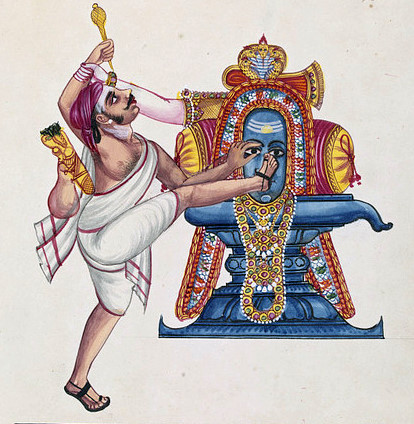
Kannappa stopped by Shiva as he tries to remove his second eye Kannappa.jpg
Kannappa stopped by Shiva as he tries to remove his second eye

Dinna was a staunch devotee of the Vayu linga of SriKalahasti which he found in the forest while hunting. Being a hunter, he did not know how to properly worship Lord Shiva. It is said that he poured water from his mouth on the Shiva lingam which he brought from the nearby river Swarnamukhi. He also offered Lord Shiva whatever animal he hunted, including swine flesh. But Lord Shiva accepted his offerings since Thinnan was pure at heart and his devotion was true. Once, Lord Shiva tested the unshakable devotion of Tinna. With his divine power, He created a tremor and the roof-tops of the temple began to fall. All the sages ran away from the scene except for Dinna who covered the linga with his body to prevent it from any damage. Hence he was named thereafter as Dheera (valiant one).

Lingam abstract or aniconic representation of Shiva, literally "sign, mark, evidence, representation, male procreative organ"

A lingam, sometimes referred to as linga or Shiva linga, is an abstract or aniconic representation of the Hindu deity Shiva in Shaivism. It is a votary symbol revered in temples, smaller shrines, or as self-manifested natural objects. The lingam is often represented within a lipped, disc-shaped platform called a yoni that symbolizes the goddess Shakti. Lingayats wear a lingam inside a necklace, called Ishtalinga.

Tinna noticed that one of the eyes of the Shiva linga was oozing blood and tears. Sensing that Lord Sri Bhalanetra's eye had been injured, Dheera proceeded to pluck his one eye out with one of his arrows and placed it in the spot of the bleeding eye of the Shiva linga. This stopped the bleeding in that eye of the linga. But to complicate matters further, he noticed that the other eye of the linga has also started oozing blood. So Tinna thought that if he were to pluck his other eye too, he would become blind to exactly know the spot where he has to place his own second eye over the bleeding second eye of the lingam. So he placed his great toe on the linga to mark the spot of the bleeding second eye and proceeded to pluck out his other and only eye. Moved by his extreme devotion, Lord Sri Priyabhakta appeared before Dinna and restored both his eyes. He made Dinna as one of the Nayanmars and he was called as Kannappan or Kannappa Nayanar.

When Arjuna was meditating on Sri Shiva for Pasupathastra, to test him Sri Shiva entered that forest as an animal hunter and due to word war between Sri Shiva and Arjuna, a battle took place between both and finally impressed by Arjuna's efforts, Sri Mahashiva gave him the Pasupathasthra. However, because of his boastful nature of being the greatest warrior, he is born again as a devotee in the Kali Yuga as Kannappa Nayanar and finally got liberation.

The Pashupatastra in Hindu mythology is an irresistible and most destructive personal weapon of Shiva, Kali and Adi Para Shakti, which can be discharged by the mind, the eyes, words, or a bow. Never to be used against lesser enemies or by lesser warriors, the Pashupatastra is capable of destroying creation and vanquishing all beings. Pashupatastra is one of the most destructive, powerful, irresistible weapons of all the weapons mentioned in the Hindu mythology. In Mahabharata, only Arjuna and in Ramayana only Indrajit are known to have possessed Pashupatastra. This weapon has to be obtained directly from Lord Shiva.

Kali Yuga in Hinduism is the last of the four stages the world goes through as part of a 'cycle of yugas' described in the Sanskrit scriptures. The other ages are called Satya Yuga, Treta Yuga, and Dvapara Yuga.

See also

Thirumangai Alvar last of the 12 Alvar saints of south India

Thirumangai Alvar, also spelt as Tirumangai Alvar and Thirumangai Mannan is the last of the 12 Alvar saints of south India, who are known for their affiliation to Vaishnava tradition of Hinduism. He is considered one of the most learned Alvar and the most superior Alvar in the context of composition of verses. He holds the title Narkavi Perumal, the mark of an excellent poet, and Parakala.

<i>Bedara Kannappa</i> 1954 film

Bedara Kannappa is a 1954 Indian Kannada film directed by H. L. N. Simha and written by G. V. Iyer. It stars Rajkumar and Pandari Bai in lead roles. Bedara Kannappa started as a play produced by the Gubbi Veeranna Nataka Company before it became a Kannada film. The release was a historic moment for the Kannada cinema industry causing its production of films to increase over the next ten years. The film was a launch pad to Rajkumar's career. It marked the debut of Narasimharaju, who went on to be named among Kannada cinema's finest actors, alongside Rajkumar.

<i>Bhakta Kannappa</i> 1976 film directed by Bapu

Bhakta Kannappa is a 1976 Telugu film directed by Bapu. The movie is a remake of 1954 Kannada movie Bedara Kannappa starring Rajkumar which was based on the life of Shaiva devotee, Kannappa Nayanar.

Bibliography

Related Research Articles

Srikalahasteeswara temple

Srikalahasti Temple is located in the town of Srikalahasti, in the state of Andhra Pradesh, India. It is one of the most famous Shiva temples in South India, and is said to be the site where Kannappa was ready to offer both his eyes to cover blood flowing from the Siva linga before the Siva stopped him and granted him mukti.

Kotilingeshwara

Kotilingeshwara Temple is a temple in the village of Kammasandra in Kolar district, Karnataka, India. The presiding deity of the temple is Lord Shiva. The temple has one of the largest Shivalingams in the world.
<i>Periya Puranam</i>

The Periya Puranam, that is, the great purana or epic, sometimes called Tiruttontarpuranam, is a Tamil poetic account depicting the lives of the sixty-three Nayanars, the canonical poets of Tamil Shaivism. It was compiled during the 12th century by Sekkizhar. It provides evidence of trade with West Asia The Periya Puranam is part of the corpus of Shaiva canonical works.

Manakanchara Nayanar Indian saint

Manakanchara Nayanar, also known as Manakkanychaara Nayanar, Manakkancharar, Manakanjara Nayanar, Mankkanjara Nayanar and Manakkanjarar, was a Nayanar saint, venerated in the Hindu sect of Shaivism. He is generally counted as the twelfth in the list of 63 Nayanars. Like other Nayanars, he was a fervent devotee of the god Shiva. Manakanchara Nayanar is dated to the 8th century and was a contemporary of Eyarkon Kalikkama Nayanar, a Nayanar saint and his son-in-law as well as Sundarar. He is described to have cut his daughter's hair and given it to Shiva disguised as a Shaiva ascetic, on her wedding day.

Kotpuli Hindu saint

Kotpuli, also known as Kotpuliyar and Kotpuli Nayanar, was a Nayanar saint, venerated in the Hindu sect of Shaivism. He is generally counted as the fifty-seventh in the list of 63 Nayanars.

Murdeshwar Town in Karnataka, India

Murdeshwar is a town in Bhatkal Taluk of Uttara Kannada district in the state of Karnataka, India. Murdeshwar is another name of the Hindu god Shiva. Famous for the world's second tallest Shiva statue, the town lies on the coast of the Arabian Sea and is also famous for the Murdeshwar Temple. Murdeshwar has a railway station on the Mangalore-Mumbai Konkan railway route.
Ernakulam Shiva Temple

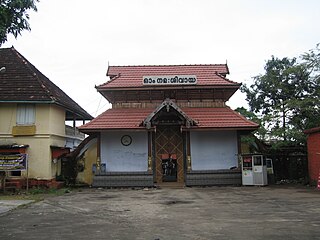
Ernakulam Shiva Temple, also known as Ernakulathappan Temple is one of the major temples of Kerala, located in heart of Ernakulam, the downtown area of the city of Kochi. The temple, dedicated to Lord Shiva, is considered as the city temple, with the presiding deity as the protector of the city, as per local Hindu faiths and traditions. As per the common practice in Kerala, the deity is reverently called Ernakulathappan, which means Lord of Ernakulam. The temple is located within the Durbar Hall Ground. The temple history itself has deep association with history of the city and was one of the 7 royal temples of Kochi Maharajas. The temple is now under administration of Cochin Devasom Board. The temple in its current form was built under active patronage of Diwan Sri Edakkunni Sankara Warrier in year 1846 and raised it level of a Royal temple in the Kochi Kingdom. The temple is built on 1-acre (4,000 m2) land. The temple is one of the major Shiva temples in Kerala counted along with the Ettumanoor Mahadevar Temple, Kaduthruthy Mahadeva Temple, Vaikom Temple, Chengannur Mahadeva Temple and Vadakkunathan temple.
Arivattaya Nayanar

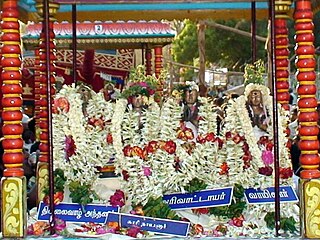
Arivattaya Nayanar or Thayanar was the 12th Nayanar, a group of 63 Shaivite saints, venerated as great devotees of the Hindu god Shiva. Nayanars lived before or during the lifetime of Sundaramurthy Nayanar.

Muruga Nayanar or Muruka Nayanar is the 15th Nayanar saint. Traditional hagiographies like Periya Puranam and Thiruthondar Thogai describe him as a great devotee of the Hindu god Shiva. He is described to have lived an ascetic life, filled with austerity and selfless devotion to Shiva, spending his time in collecting flowers from woodlands and decorating the Shiva Lingam with garlands and coronets.

Rudra Pasupathi Nayanar is the 16th Nayanar saint. Traditional hagiographies like Periya Puranam and Thiruthondar Thogai detail his legendary life and services to the Hindu god Shiva. Pasupathi Nayanar was a learned Brahmin devotee who practised chanting of the Shri Rudram Chamakam, a Vedic hymn dedicated to Rudra. Therefore, he is known by the name Rudra Pasupathi Nayanar.
Apputhi Adigal

Apputhi Adigal, also spelt as Apputhi Adikal, Atputhi Adigal, Apputi Adigal, Appoodi Adikal, Appoothi Adikal and Appudhi Adigal and known as Appuddi Nayanar, was a Nayanar saint, venerated in the Hindu sect of Shaivism. He is generally counted as the twenty-fifth in the list of 63 Nayanars. He is described as a contemporary of Appar or Thirunavukkarasar, one of the most prominent Nayanars.

Mangayarkkarasiyar (Tamil:மங்கையர்க்கரசியார்) was one of the 63 Nayanmars or holy Saivite saints who are revered in South India. She is one among the only three women who attained this distinction. Her devotion to Lord Shiva is recounted in the hagiographic poem Periyapuranam compiled by Sekkizhar as well as in the Tiruthhthondar Thogai written by the poet-saint Sundarar.

Kulachirai Nayanar was a minister of the Pandyan king, Koon Pandyan, and one of the 63 Nayanars mentioned in the Periya Puranam.

Satti Nayanar, also known as Satti (Sathi), Sathiyar, Shakti Nayanar, Shakti, Shaktiyar (Saktiyar), Sattiyandar and Thiru-Saththi Nayanar, is a Nayanar saint, venerated in the Hindu sect of Shaivism. He is generally counted as the forty-fifth in the list of 63 Nayanars. Satti Nayanar is described to cut off the tongue of whoever talked ill of his patron god Shiva or Shiva's devotees.

Murkha Nayanar

Murkha Nayanar, also known as Moorka Nayanar, Murka Nayanar, Moorkha Nayanar, Murgga Nayanar, Moorkka Nayanar and Murkhar, is a Nayanar saint, venerated in the Hindu sect of Shaivism. He is generally counted as the thirty-second in the list of 63 Nayanars.

Ilayankudi Maranar, also known Ilaiyangudi Nayanar, Ilaiyankuti Nayanar, Ilayangudi Mara Nayanar, is a Nayanar saint, venerated in the Hindu sect of Shaivism. He is generally counted as the fourth in the list of 63 Nayanars. He is also called Marar, Maran and Mara Nayanar, names he shares with Somasi Mara Nayanar. The two Nayanars are generally differentiated by the prefixes "Ilayankudi" and "Somasi".

Iyarpagai Nayanar

Iyarpagai Nayanar, also known as Iyarpagaiar, Iyarpahai Nayanar, Iyarpagaiya Nayanar and Iyarppakai Nayanar is a Nayanar saint, venerated in the Hindu sect of Shaivism. He is generally counted as the third in the list of 63 Nayanars.

Agnipureeswarar Temple, Thirupugalur

Agnipureeswarar Temple (also called Thirupugalur temple) in Thirupugalur, a village in Nagapattinam district in the South Indian state of Tamil Nadu, is dedicated to the Hindu god Shiva. Constructed in the Tamil style of architecture, the temple is believed to have been built during the Cholas period in the 10th century. Shiva is worshipped as Agnipureeswarar and his consort Parvathi as Karundar Kuzhali.

References

  1. 1 2 Michell, George (2013). Southern India: A Guide to Monuments Sites & Museums. Roli Books Private Limited. ISBN   81-7436-903-1.
  2. 1 2 E, Desingu Setty (1990). The Valayar of South India: Society and religion. Inter-India Publications. ISBN   81-2100-237-0.