
Chott el Djerid also spelled Sciott Gerid and Shott el Jerid, is a chott, a large endorheic salt lake in southern Tunisia. The name can be translated from the Arabic into English as "Lagoon of the Land of Palms".

A lacuna is a gap in a manuscript, inscription, text, painting, or musical work. A manuscript, text, or section suffering from gaps is said to be "lacunose" or "lacunulose".

Lakes of liquid ethane and methane exist on the surface of Titan, Saturn's largest moon. This was confirmed by the Cassini–Huygens space probe, as had been suspected since the 1980s. The large bodies of liquid are known as maria (seas) and the small ones as lacūs (lakes).
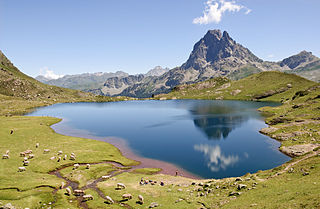
A lake is an often naturally occurring, relatively large and fixed body of water on or near the Earth's surface. It is localized in a basin or interconnected basins surrounded by dry land. Lakes lie completely on land and are separate from the ocean, although they may be connected with the ocean by rivers. Lakes, as with other bodies of water, are part of the water cycle, the processes by which water moves around the Earth. Most lakes are freshwater and account for almost all the world's surface freshwater, but some are salt lakes with salinities even higher than that of seawater. Lakes vary significantly in surface area and volume of water.
The Atacama Desert is the most arid desert in the world which is located in Chile.
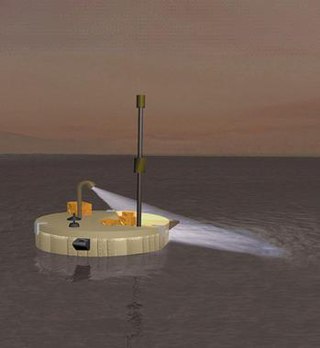
Titan Mare Explorer (TiME) is a proposed design for a lander for Saturn's moon Titan. TiME is a relatively low-cost, outer-planet mission designed to measure the organic constituents on Titan and would have performed the first nautical exploration of an extraterrestrial sea, analyze its nature and, possibly, observe its shoreline. As a Discovery-class mission it was designed to be cost-capped at US$425 million, not counting launch vehicle funding. It was proposed to NASA in 2009 by Proxemy Research as a scout-like pioneering mission, originally as part of NASA's Discovery Program. The TiME mission design reached the finalist stage during that Discovery mission selection, but was not selected, and despite attempts in the U.S. Senate failed to get earmark funding in 2013. A related Titan Submarine has also been proposed.
Kutch generally refers to the Kutch district, a district of Gujarat state in western India. It may also refer to:

Lake Woytchugga is an ephemeral lake situated to the west of Wilcannia, New South Wales, Australia. In late 2012 it became notable because the dry lake bed had caught on fire.
Eyre Lacuna is a feature on Saturn's largest moon, Titan, believed to be a currently dry bed of an intermittent hydrocarbon lake.

Ngami Lacuna is a feature on Saturn's largest moon, Titan, believed to be a currently dry bed of an intermittent hydrocarbon lake.

Bolsena Lacus is one of a number of hydrocarbon lakes found on Saturn's largest moon, Titan.
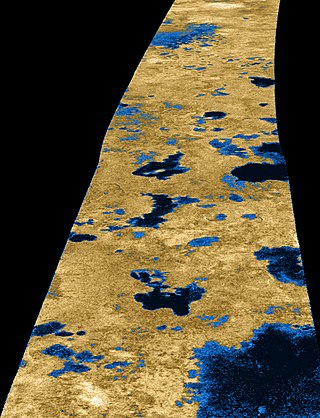
Neagh Lacus is one of a number of hydrocarbon lakes found on Saturn's largest moon, Titan. The lake is composed of liquid methane and ethane, and was detected by the Cassini space probe.
Sotonera Lacus is one of a number of hydrocarbon lakes found on Saturn's largest moon, Titan.

Woytchugga Lacuna is one of the largest lakes of Titan.
Hammar Lacus is one of a number of hydrocarbon seas and lakes found on Saturn's largest moon, Titan.
Koitere Lacus is one of a number of hydrocarbon lakes found on Saturn's largest moon, Titan. The lake is composed of liquid methane and ethane, and was detected by the space probe Cassini.
Müggel Lacus is one of a number of hydrocarbon seas and lakes found on Saturn's largest moon, Titan.
Nakuru Lacuna is the largest intermittent lake on Titan.


