Barry Bolton is an English myrmecologist, an expert on the classification, systematics, and taxonomy of ants, who long worked at the Natural History Museum, London. He is known especially for monographs on African and Asian ants, and for encyclopaedic global works, including the Identification Guide to Ant Genera (1994), A New General Catalogue of Ants of the World, Synopsis and Classification of Formicidae (2003), and Bolton's Catalogue of Ants of the World: 1758-2005 (2007). Now retired, Bolton is a Fellow of the Royal Entomological Society and Myrmecologist, Biodiversity Division, Department of Entomology, Natural History Museum, London.
Charles Thomas Brues was an American entomologist.

Myrmicaria is an ant genus within the subfamily Myrmicinae.

Leptanillinae is a subfamily of primitive ants consisting of three genera.
Leptanilla is a genus of ant in the subfamily Leptanillinae. Like other genera in this subfamily, the queen is fed by the hemolymph of their own larvae, which have specialized processes for this purpose.
Larval hemolymph feeding is a behaviour trait found in the queens of some species of ant. This is found mainly in the ants of the subfamily Amblyoponinae and give them the other name of Dracula ant. In colonies of the Amblyopone silvestrii the queens feed on the hemolymph of their larvae when food is not available. In one species, Myopopone castanea, worker ants consume larval hemolymph. This is said to be a precursor to trophallaxis in other ant families. The larvae themselves are not killed by this process. This behaviour is also seen in Proceratium and in Leptanilla the larvae have special organs that exude the haemolymph. On the other hand, the foundresses suppress larval hemolymph feeding (LHF) when prey is available, allowing them to rear the first workers more swiftly. The nondestructive form of cannibalism can be regarded as a nutritive adaptation related to: (1) the lack of social food transfer in this species, and (2) its specialized predation on large sporadic prey (centipedes). LHF similar to that in Amblyopone was found in Proceratium and another type of LHF, with a larval specialized exudatory organ, in Leptanilla.

The Metopininae are a subfamily of flies in the family Phoridae.
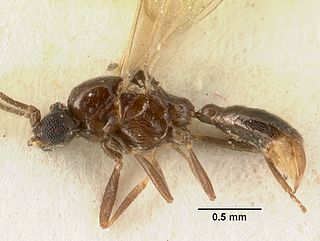
Yavnella is a genus of ants in the subfamily Leptanillinae. Its two species are distributed in India and Israel. The genus is known only from male specimens.

Leptanilla javana is a species of ant in the subfamily Leptanillinae.
Leptanillini is a tribe of Leptanillinae ants with two extant genera.

Tapinomini is a tribe of Dolichoderinae ants with 6 genera and one extinct genus.

Leptanilla copiosa is a species of ant in the subfamily Leptanillinae, first described by Petersen in 1968 as Noonilla copiosa based on a male specimen from the Philippines. Noonilla was initially placed in the subfamily Leptanillinae, but was later removed from the subfamily when Ogata, Terayama & Masuko (1995) reviewed the genus, leaving the genus incertae sedis in the family. It was later readded to Leptanillinae.
Leptanilla besucheti is a species of ant. It is found in Sri Lanka.

Leptanilla swani is a species of ant in the genus Leptanilla. Described by William Morton Wheeler in 1932, the species is endemic to Australia, and one of only two species of the genus Leptanilla to be found there. Workers are pale in colour, measuring 1.3 to 5 millimetres while queens are larger at 2 millimetres (0.079 in) long.

Pseudacteon is a genus of flies in the family Phoridae. There are over 70 described species of Pseudacteon fly. They are also known as ant-decapitating flies due to their parasitic larval stage. An egg is injected by the female fly into the shoulder joint of an ant worker. Soon after, the egg undergoes rapid inflation as it appears to absorb ant hemolymph. This first instar larva migrates into the ant head and consumes the jaw muscle and other tissues, leaving the mandibles hanging and preparing a future exit space. After about two weeks, the ant worker is termed a "zombie" because the fly larva has effectively taken control. The worker leaves the nest and dies in the leaf litter or in a crack in the soil. As it dies, the ant's head falls off, apparently because the fly larva releases an enzyme that dissolves the membrane attaching the ant's head to its body. The fly pupates in the detached head capsule, requiring a further two weeks before emerging through the ant's mouth. In tropical, subtropical areas the flies are active all year round, but in temperate regions they are active during all months except the winter months. Several Pseudacteon species were deliberately introduced to the United States to combat via biological control the invasive fire ant species Solenopsis invicta.

Leptanilla macauensis is a species of ant in the genus Leptanilla. Chi-Man Leong, an undergraduate student at National Taiwan University at the time, first collected specimens of this species. The species was subsequently formally described by Leong, Yamane & Guénard in 2018, the species is only known from specimens collected from Macau by means of a Winkler extractor. Workers are yellowish brown in colour, measuring 1.12 to 1.14 millimetres. The queen has yet to be described.
The Metopininae is a tribe of flies in the family Phoridae.
Acontistoptera is a genus of flies in the family Phoridae.

Leptanilla havilandi is a species of ant in the subfamily Leptanillinae. The species can be found in Singapore and Malaysia.

Leptanilla voldemort is a species of ant in the genus Leptanilla and was described in 2024.
