
Maja brachydactyla is a species of crab in the family Majidae. It was initially described as a subspecies of M. squinado. A review of the species complex published in 1998 was able to differentiate between specimens from the Mediterranean Sea and those from the Atlantic Ocean, and concluded that the Atlantic specimens were a separate species, accepted as M. brachydactyla Balss, 1922.

Majidae is a family of crabs, comprising around 200 marine species inside 52 genera, with a carapace that is longer than it is broad, and which forms a point at the front. The legs can be very long in some species, leading to the name "spider crab". The exoskeleton is covered with bristles to which the crab attaches algae and other items to act as camouflage.
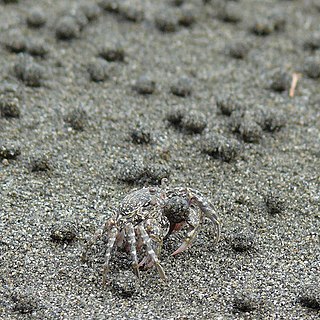
Sand bubbler crabs are crabs of the genera Scopimera and Dotilla in the family Dotillidae. They are small crabs that live on sandy beaches in the tropical Indo-Pacific. They feed by filtering sand through their mouthparts, leaving behind balls of sand that are broken up by the incoming high tide.
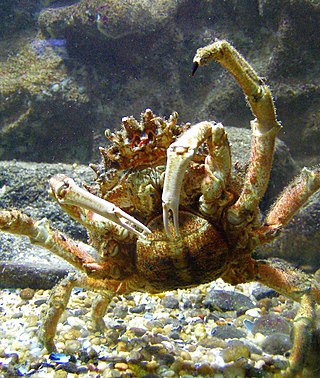
Maja is a genus of majid crabs erected by Jean-Baptiste Lamarck in 1801. It includes the following extant species:

Xanthoidea is a superfamily of crabs, comprising seven families. Formerly, a number of other families were included in Xanthoidea, but many of these have since been removed to other superfamilies. These include Carpilioidea, Eriphioidea, Hexapodoidea, Pilumnoidea and Trapezioidea. Even in this reduced state, Xanthoidea remains one of the most species-rich superfamilies of crabs.

The Majoidea are a superfamily of crabs which includes the various spider crabs.

Dromiidae is a family of crabs, often referred to as sponge crabs. They are small or medium-sized crabs which get their name from the ability to shape a living sponge into a portable shelter for themselves. A sponge crab cuts out a fragment from a sponge and trims it to its own shape using its claws. The last two pairs of legs are shorter than other legs and bend upward over the crab's carapace, to hold the sponge in place. The sponge grows along with the crab, providing a consistent shelter.

The Gecarcinucidae are a family of true freshwater crabs. They are found throughout South Asia, Southeast Asia and New Guinea, with a single genus found in Australia.

Hexapodidae is a family of crabs, the only family in the superfamily Hexapodoidea. It has traditionally been treated as a subfamily of the family Goneplacidae, and was originally described as a subfamily of Pinnotheridae. Its members can be distinguished from all other true crabs by the reduction of the thorax, such that only seven sternites are exposed, and only four pairs of pereiopods are present. Not counting the enlarged pair of claws, this leaves only six walking legs, from which the type genus Hexapus, and therefore the whole family, takes its name. Some anomuran "crabs", such as porcelain crabs and king crabs also have only four visible pairs of legs. With the exception of Stevea williamsi, from Mexico, all the extant members are found either in the Indo-Pacific oceans, or around the coast of Africa.

Pilumnoidea is a superfamily of crabs, whose members were previously included in the Xanthoidea. The three families are unified by the free articulation of all the segments of the male crab's abdomen and by the form of the gonopods. The earliest fossils assigned to this group are of Eocene age.

Actumnus is a genus of crabs in the family Pilumnidae. Alongside the 28 extant species, it has a fossil record extending back into the Miocene.
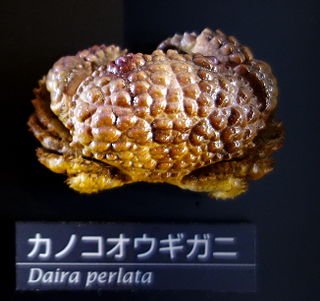
Dairoidea is a superfamily of crabs, comprising two families which each contain a single genus: Dairidae and Dacryopilumnidae (Dacryopilumnus) .
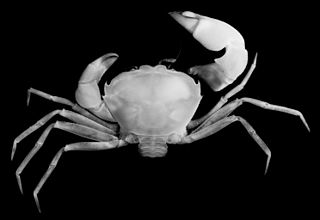
Pseudozioidea is a superfamily of crabs, formerly treated in the Eriphioidea, Carpilioidea, Xanthoidea, Pilumnoidea and Goneplacoidea. A number of fossils from the Eocene onwards are known from the family Pseudoziidae. Eleven genera are recognised in three families:

Karstarma is a genus of karst-dwelling crabs formerly included in Sesarmoides.

Medaeops is a genus of crabs in the family Xanthidae, containing the following species:

Xanthias is a genus of crabs in the family Xanthidae, containing two exclusively fossil species and the following extant species:

Trichia is a genus of crabs in the family Xanthidae, containing the following species:

Atergatopsis is a genus of crabs in the family Xanthidae, containing the following species:
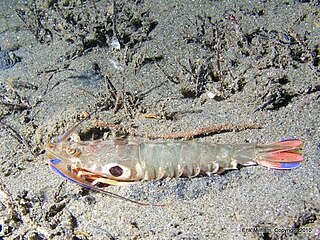
Sicyonia is a genus of prawns, placed in its own family, Sicyoniidae. It differs from other prawns in that the last three pairs of its pleopods are uniramous, rather than biramous as seen in all other prawns.

Around 65 species of crab occur in the waters of the British Isles. All are marine, with the exception of the introduced Chinese mitten crab, Eriocheir sinensis, which occurs in fresh and brackish water. They range in size from the deep-water species Paromola cuvieri, which can reach a claw span of 1.2 metres, to the pea crab, which is only 4 mm (0.16 in) wide and lives inside mussel shells.

