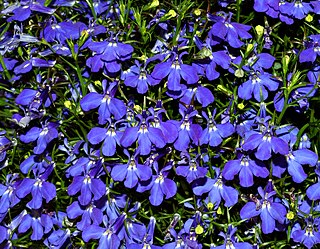
Lobelia is a genus of flowering plants comprising 415 species, with a subcosmopolitan distribution primarily in tropical to warm temperate regions of the world, a few species extending into cooler temperate regions. They are known generally as lobelias.

The family Campanulaceae, of the order Asterales, contains nearly 2400 species in 84 genera of herbaceous plants, shrubs, and rarely small trees, often with milky sap. Among them are several familiar garden plants belonging to the genera Campanula (bellflower), Lobelia, and Platycodon (balloonflower). Campanula rapunculus and Codonopsis lanceolata are eaten as vegetables. Lobelia inflata, L. siphilitica and L. tupa and others have been used as medicinal plants. Campanula rapunculoides may be a troublesome weed, particularly in gardens, while Legousia spp. may occur in arable fields.
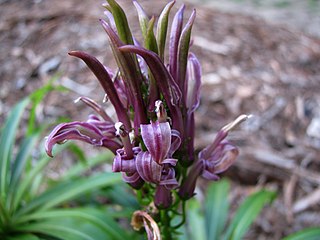
The Hawaiian lobelioids are a group of flowering plants in the bellflower family, Campanulaceae, all of which are endemic to the Hawaiian Islands. This is the largest plant radiation in the Hawaiian Islands, and indeed the largest on any island archipelago, with over 125 species. The six genera can be broadly separated based on growth habit: Clermontia are typically branched shrubs or small trees, up to 7 metres (23 ft) tall, with fleshy fruits; Cyanea and Delissea are typically unbranched or branching only at the base, with a cluster of relatively broad leaves at the apex and fleshy fruits; Lobelia and Trematolobelia have long thin leaves down a single, non-woody stem and capsular fruits with wind-dispersed seeds; and the peculiar Brighamia have a short, thick stem with a dense cluster of broad leaves, elongate white flowers, and capsular fruits.
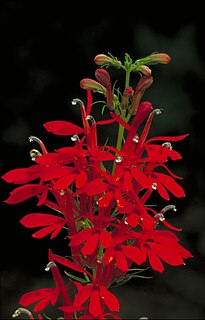
Lobelia cardinalis, the cardinal flower, is a species of flowering plant in the bellflower family Campanulaceae native to the Americas, from southeastern Canada south through the eastern and southwestern United States, Mexico and Central America to northern Colombia.

Isotoma is a genus of annual and perennial herbs in the family Campanulaceae and are native to Australia and New Zealand.

Lobelia erinus is a species of flowering plant in the bellflower family Campanulaceae, native to southern Africa.
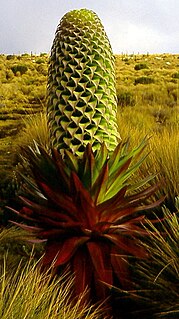
Lobelia deckenii is a species of flowering plant in the family Campanulaceae. It is a giant lobelia endemic to the mountains of Tanzania. It grows in moist areas, such as valley bottoms and moorland, in contrast to Lobelia telekii which grows in a similar but drier habitat. These two species produce occasional hybrids. Lobelia deckenii plants usually produce multiple rosettes. Each rosette grows for several decades, produces a single large inflorescence and hundreds of thousands of seeds, then dies. Because individual plants have multiple rosettes, they survive to reproduce repeatedly, and plants with more rosettes flower more frequently. It is iteroparous.
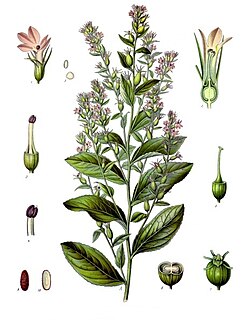
Lobelia inflata, also known as Indian tobacco or puke weed, is a species of Lobelia native to eastern North America, from southeastern Canada south through the eastern United States to Alabama and west to Kansas.
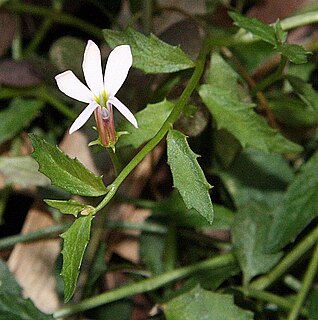
Lobelia purpurascens, commonly known as white root or purplish pratia, is a small herbaceous scrambling herb of eastern Australia. reaching 15 cm (6 in) high, it grows in damp, sheltered areas.

Lobelia rhombifolia, commonly known as tufted lobelia, is an annual plant from southern Australia. It is 0.05 to 0.3 metres high and produces purple flowers with a white throat and two recurved upper lobes. These appear at different times across their native range:

Lobelia dentata is a herb found in eastern Australia. The habitat is eucalyptus woodland and forest, often on sandy soils. It is an uncommon species, but may be locally abundant after bushfires.

Lobelia heterophylla is a blue to purple flowered herb found in Southern Australia. The specific epithet refers to the variety of leaf forms found on individual plants. The species was first described by Jacques Labillardière in his seminal work on Australian flora, Novae Hollandiae Plantarum Specimen. L. heterophylla has a wide distribution, due to its ability to inhabit a variety of soil types. The habit of the herbaceous plant is erect, up to 0.6 metres, with flowers appearing from August or October to December, or January to February. The flower whorl is deeply cleft, its colour range of blue, scarlet or purple is well known and it is considered to be a desirable specimen for use in gardens. The plant is commonly referred to as wing-seeded lobelia and Australian blue creeper. The species was featured and illustrated by Joseph Paxton in 1838.

Lobelia anceps, commonly known as angled lobelia, is a small herbaceous plant in the family Campanulaceae native to Western Australia, New Zealand, South America and South Africa.
Lobelia cleistogamoides is a small herbaceous plant in the family Campanulaceae native to Western Australia, and first described in 2007 by Neville Walsh and David Albrecht.
Lobelia dioica is a small herbaceous plant in the family Campanulaceae native to Western Australia.
Lobelia gibbosa, commonly known as tall lobelia, is a small herbaceous plant in the family Campanulaceae native to Western Australia.
Lobelia leucotos is a small herbaceous plant in the family Campanulaceae native to Western Australia.
Lobelia rarifolia is a small herbaceous plant in the family Campanulaceae native to Western Australia.
Lobelia rhytidosperma, commonly known as wrinkled-seeded lobelia, is a small herbaceous plant in the family Campanulaceae native to Western Australia.

Lobelia tenuior, commonly known as slender lobelia, is a small herbaceous plant in the family Campanulaceae native to Western Australia.

