| |||||||||||||||||||||||||
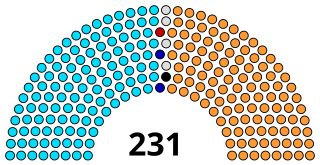
All 288 seats in the Madhya Pradesh Legislative Assembly 145 seats needed for a majority | |||||||||||||||||||||||||
| Turnout | 37.17% | ||||||||||||||||||||||||
| |||||||||||||||||||||||||
| |||||||||||||||||||||||||
Elections to the Madhya Pradesh Legislative Assembly were held on 25 February 1957. 1,108 candidates contested for the 218 constituencies in the Assembly. There were 69 two-member constituencies and 149 single-member constituencies. [1]
The Madhya Pradesh Vidhan Sabha or the Madhya Pradesh Legislative Assembly is the unicameral state legislature of Madhya Pradesh state in central India. The seat of the Vidhan Sabha is at Bhopal, the capital of the state. It is housed in the Vidhan Bhavan, an imposing building located at the centre of the Capital Complex in the Arera Hill locality of Bhopal city. The term of the Vidhan Sabha is five years, unless dissolved earlier. Presently, it comprises 230 members who are directly elected from single-seat constituencies and one nominated member.
On 1 November 1956, under States Reorganisation Act, 1956, Madhya Bharat (except the Sunel enclave of the Mandsaur district), Vindhya Pradesh, Bhopal State and the Sironj sub-division of the Kota district of Rajasthan were merged into Madhya Pradesh while the Marathi-speaking districts of Nagpur Division, (namely Buldana, Akola , Amravati , Yeotmal, Wardha , Nagpur, Bhandara and Chanda), were transferred to Bombay State. [2] This resulted in increase in assembly constituencies from 184 with 232 seats to 218 constituencies with 288 seats during 1957 elections.
The States Reorganisation Act, 1956 was a major reform of the boundaries of India's states and territories, organising them along linguistic lines.
Madhya Bharat, also known as Malwa Union, was an Indian state in west-central India, created on 28 May 1948 from twenty-five princely states which until 1947 had been part of the Central India Agency, with Jiwajirao Scindia as its Rajpramukh.
Vindhya Pradesh was a former state of India. It occupied an area of 23,603 sq. miles. It was created in 1948, shortly after Indian independence, from the territories of the princely states in the eastern portion of the former Central India Agency. It was named for the Vindhya Range, which runs through the centre of the province. The capital of the state was Rewa. It lay between Uttar Pradesh to the north and Madhya Pradesh to the south, and the enclave of Datia, which lay a short distance to the west, was surrounded by the state of Madhya Bharat.
| Political party | Flag | Seats Contested | Won | Net change in seats | % of Seats | Votes | Vote % | Change in vote % | |
|---|---|---|---|---|---|---|---|---|---|
| Indian National Congress | 288 | 232 | 40.74 | 36,91,999 | 49.83 | ||||
| Praja Socialist Party | 163 | 12 | New | 9.09 | 9,76,021 | 13.17 | New | ||
| Bharatiya Jana Sangh | 133 | 10 | 1.01 | 7,33,315 | 9.90 | ||||
| Akhil Bharatiya Ram Rajya Parishad | 53 | 5 | 1.29 | 2,29,010 | 3.09 | ||||
| Akhil Bharatiya Hindu Mahasabha | 48 | 7 | 0.25 | 3,45,122 | 4.66 | ||||
| Communist Party of India | 25 | 2 | 3.28 | 1,20,549 | 1.63 | ||||
| Independent | 372 | 20 | 34.26 | 12,22,003 | 16.49 | N/A | |||
| Total Seats | 288 ( | Voters | 1,99,31,685 | Turnout | 74,08,768 (37.17 %) | ||||
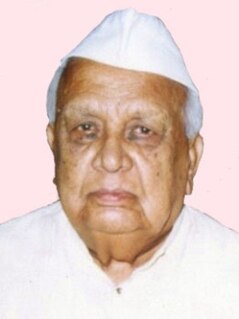
Shivanand was an Indian politician and a freedom fighter from Satna district of Madhya Pradesh.He was President of Rewa Rajya Praja Mandal from December 1946 to January 1948 and was jailed five times during freedom struggle and expelled from Rewa state many times. He was elected from Satna Constituency to the Vindhya Pradesh Legislative assembly in 1952 and sworn in as Speaker of that assembly. He was also member of Madhya pradesh Legislative assembly from 1957-62 along with Vishweshwar Prasad.
Pandit Ram Kishore Shukla was an Indian politician and an activist for Indian independence.
Elections to the Bhopal Legislative Assembly were held on 27 March 1952.
Elections to the Legislative Assembly of the Indian state of Bombay were held on 26 March 1952. 1239 candidates contested for the 260 constituencies in the Assembly. There were 1 three-member, 47 two-member constituencies and 212 single-member constituencies.
Elections to the Legislative Assembly of the Indian state of Madhya Bharat were held on 26 March 1952. 440 candidates contested for the 79 constituencies in the Assembly. There were 20 two-member constituencies and 59 single-member constituencies.
Elections to the Madhya Pradesh Legislative Assembly were held on 26 March 1952. 1,122 candidates contested for the 184 constituencies in the Assembly. There were 48 two-member constituencies and 136 single-member constituencies. On 1 November 1956, under States Reorganisation Act, 1956, Madhya Bharat, Vindhya Pradesh, and Bhopal state were merged into Madhya Pradesh and the Marathi-speaking districts of Nagpur Division were transferred to Bombay State. Hence the constituencies were re-organized during 1957 elections.
Elections to the Rajasthan Legislative Assembly were held on February 29, 1952. 616 candidates contested for the 140 constituencies in the Assembly. There were 20 two-member constituencies and 120 single-member constituencies.
Elections to the Legislative Assembly of the Indian state of Vindhya Pradesh were held on March 26, 1952. 252 candidates contested for the 48 constituencies in the Assembly. There were 12 two-member constituencies and 36 single-member constituencies.
Elections to the Andhra Pradesh Legislative Assembly were held on February 25, 1957. 319 candidates contested for the 85 constituencies in the Assembly. There were 20 two-member constituencies and 65 single-member constituencies.
Elections to the Bombay Legislative Assembly were held on 25 February 1957. 1146 candidates contested for the 339 constituencies in the Assembly. There were 57 two-member constituencies and 282 single-member constituencies.
Elections to the second Rajasthan Legislative Assembly were held in 1957.
| This Indian elections-related article is a stub. You can help Wikipedia by expanding it. |