
Ionization cones are cones of ionized material extending from active galactic nuclei, predominantly observed in type II Seyfert galaxies. They are detected through their emission of electromagnetic radiation in the visible and infrared parts of the spectrum. The main method of observation is through spectroscopy, using spectral line analysis to measure the shape of the ionized region and the condition of the material such as temperature, density, composition, and degree of ionization.

NGC 5144 is an unbarred spiral galaxy located in the constellation of Ursa Minor. It has a velocity of 3,202 ± 9 km/s corresponding to a Hubble Distance of 47.2 ± 3.3 megaparsecs. It was discovered by William Herschel in May 1791.

NGC 4102 is an intermediate barred spiral galaxy located in the northern constellation of Ursa Major. It is visible in a small telescope and has an apparent visual magnitude of 11.2. The galaxy was discovered April 12, 1789 by William Herschel. J. L. E. Dreyer described it as "bright, pretty small, round, brighter middle and bright nucleus". This galaxy is located at a distance of 60 million light years and is receding with a heliocentric radial velocity of 837 km/s. It is a member of the Ursa Major group of galaxies.
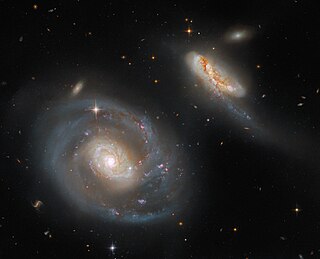
NGC 7469 is an intermediate spiral galaxy in the constellation of Pegasus. NGC 7469 is located about 200 million light-years away from Earth, which means, given its apparent dimensions, that NGC 7469 is approximately 90,000 light-years across. It was discovered by William Herschel on November 12, 1784.

NGC 7674 is a spiral galaxy located in the constellation Pegasus. It is located at a distance of about 350 million light years from Earth, which, given its apparent dimensions, means that NGC 7674 is about 125,000 light years across. It was discovered by John Herschel on August 16, 1830.
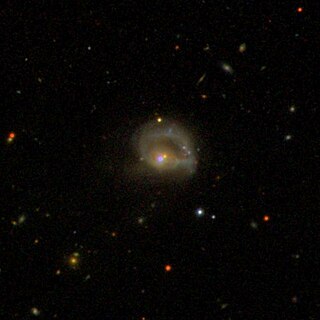
NGC 985 is a ring galaxy in the constellation of Cetus. It is located about 550 million light years away from Earth, which means, given its apparent dimensions, that NGC 985 is approximately 160,000 light years across. It was discovered by Francis Leavenworth in 1886. It is a type 1 Seyfert galaxy.
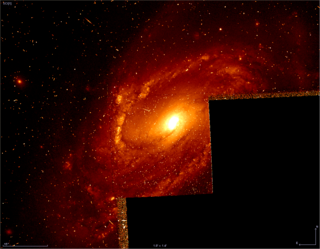
NGC 1241 is a spiral galaxy located in the constellation Eridanus. It is located at a distance of circa 150 million light years from Earth, which, given its apparent dimensions, means that NGC 1241 is about 140,000 light years across. It was discovered by William Herschel on January 10, 1785. It is classified as a Seyfert galaxy.

NGC 1142 is a distorted spiral galaxy in the constellation of Cetus. It is located about 370 million light years away from Earth, which means, given its apparent dimensions, that NGC 1142 is approximately 170,000 light years across. It is a type 2 Seyfert galaxy. It interacts with the elliptical galaxy NGC 1141.

Markarian 590, also known as NGC 863, NGC 866, and NGC 885, is a spiral galaxy located in the constellation Cetus. It is located at a distance of about 300 million light years from Earth, which, given its apparent dimensions, means that NGC 863 is about 110,000 light years across. It is a change looking Seyfert galaxy.

Markarian 273 is a galaxy merger located in the constellation Ursa Major. It is located at a distance of about 500 million light years from Earth, which, given its apparent dimensions, means that Markarian 273 is about 130,000 light years across. It is an ultraluminous infrared galaxy and a Seyfert galaxy.
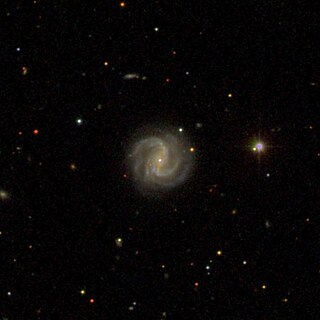
NGC 5940 is a barred spiral galaxy located in the Serpens constellation. The galaxy was found on April 19, 1887, by Lewis Swift, an American astronomer. NGC 5940 is located 500 million light-years away from the Milky Way and it is approximately 140,000 light-years across in diameter.
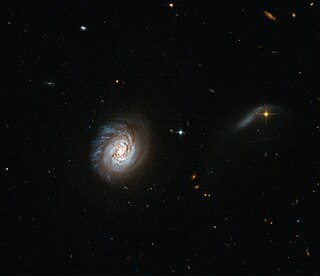
MCG -03-04-014 or PGC 4167, is a spiral galaxy located 450 million light-years in the constellation of Cetus. MCG -03-04-014 is classified as a luminous infrared galaxy, meaning it has high star-formation regions. MCG -03-04-014 has a galactic center that is obscured by dust lanes and presents an abundant supply of molecular gas. The reasons behind the luminosity of this galaxy are debated among astronomers. Some attribute it to recent starbursts, while others point to activity in the galaxies' supermassive black holes. It is also considered that both factors may contribute. The exact cause remains uncertain.
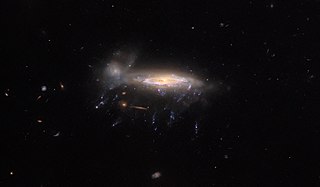
PGC 29820 is a spiral galaxy located 600 million light-years away from the Solar System in the Sextans constellation. The galaxy is about 120,000 light-years in diameter and is a member of Abell 957, a low-mass galaxy cluster. The first known reference to this galaxy is from volume I of the Catalogue of Galaxies and of Clusters of Galaxies compiled by Fritz Zwicky in 1961, where it was listed as CGCG 008-077.
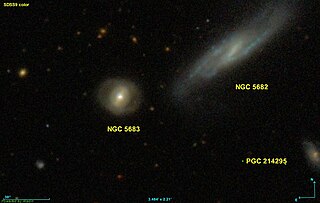
NGC 5683 is a type S0-a lenticular galaxy with a bar located in the Boötes constellation. It is 513 million light-years away from the Solar System and has an approximate diameter of 256,000 light-years meaning it is larger compared to the Milky Way. NGC 5683 was discovered by George Johnstone Stoney on April 13, 1850.

IC 1166 are a pair of galaxies in the Corona Borealis constellation comprising IC 1166 NED01 and IC 1166 NED02. They are located 977 million light-years from the Solar System and were discovered on July 28, 1892, by Stephane Javelle.

NGC 3758 known as the Owl Galaxy, is a type Sb spiral galaxy in the constellation of Leo. It is located 447 million light-years from the Solar System and an approximate diameter of 70,000 light-years. NGC 3758 was discovered by Ralph Copeland on March 18, 1874, but also independently discovered by Edouard Stephan ten years later.
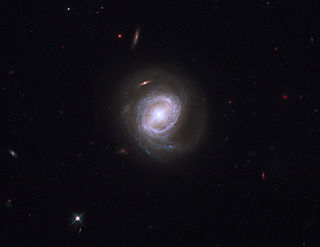
Markarian 817 is a barred spiral galaxy located in the constellation Draco. It is located 456 million light-years from Earth, which, given its apparent dimensions, means that Markarian 817 is about 80,000 light-years across. It is a Seyfert galaxy.

IC 3078 is a spiral galaxy with a ring structure located in Virgo. Its redshift is 0.066148, meaning IC 3078 is located 905 million light-years from Earth. With an apparent dimension of 0.50 x 0.5 arcmin, IC 3038 is about 133,000 light-years across. It was discovered by Royal Harwood Frost on May 7, 1904 and is listed in the Virgo Cluster catalogue as VCC 174. However, it is not a member of the Virgo Cluster, but instead a background galaxy.
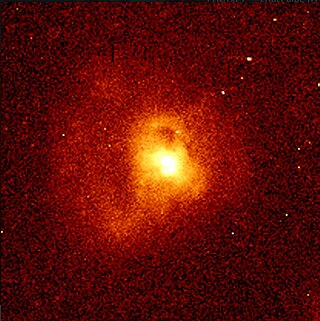
IRAS 13218+0552 known as SFRS 263, is a galaxy merger located in the Virgo constellation. Its redshift is 0.202806, putting the object at 2.6 billion light-years away from Earth. It is a Seyfert galaxy and a luminous infrared galaxy.

NGC 1320 is a spiral galaxy located in the constellation Eridanus. Its speed relative to the cosmic microwave background is 2,620 ± 15 km/s, which corresponds to a Hubble distance of 38.6 ± 2.7 Mpc. It was discovered by the German-British astronomer William Herschel in 1784.
