Related Research Articles

Clark Peninsula is a rocky peninsula, about 3 km (2 mi) long and wide, lying 5 km (3 mi) north-east of Australia's Casey Station at the north side of Newcomb Bay on the Budd Coast of Wilkes Land in Antarctica.
Mabus Point is a point on the coast of Antarctica lying just south of the Haswell Islands, marking the eastern limit of McDonald Bay. It stands 1 nautical mile(2 km) Northwest of Morennaya Hill. It was first charted by the Australasian Antarctic Expedition, 1911–14, under Douglas Mawson, and was recharted by G.D. Blodgett in 1955 from aerial photographs taken by U.S. Navy Operation Highjump, 1946–47. The point was named by the Advisory Committee on Antarctic Names for Lieutenant Commander Howard W. Mabus, U.S. Navy, executive officer of the icebreaker Edisto, who was instrumental in providing close support to U.S. Navy Operation Windmill parties in establishing astronomical control stations along this coast, 1947–48. Mabus Point subsequently became the site of the Soviet scientific station, Mirny.

Bell Glacier is a glacier draining northward into Maury Bay immediately eastward of Blair Glacier. It was mapped by G.D. Blodgett (1955) from aerial photographs taken by U.S. Navy Operation Highjump (1946–47), and named by the Advisory Committee on Antarctic Names for Thomas G. Bell, boatswain on the sloop Peacock during the United States Exploring Expedition (1838–42) under Lieutenant Charles Wilkes.
Blair Glacier is a glacier draining northward to the western corner of Maury Bay. It was delineated from aerial photographs taken by U.S. Navy Operation Highjump (1946–47), and named by the Advisory Committee on Antarctic Names for James L. Blair, Midshipman on the sloop Peacock during the United States Exploring Expedition (1838–42) under Lieutenant Charles Wilkes.
Buchanan Passage is a marine channel separating Liard Island from Adelaide Island at the north end of Hanusse Bay. It was discovered and first charted by the French Antarctic Expedition, 1908–10, under Jean-Baptiste Charcot, and named by the UK Antarctic Place-Names Committee for Captain Peter Buchanan, Royal Navy, commanding officer of HMS Endurance in the Antarctic Peninsula area, 1968–70, who proved that the passage can be used to approach Marguerite Bay from the North, through The Gullet.
The Butler Glacier is a broad glacier draining the north side of Edward VII Peninsula in the vicinity of Clark Peak, and flowing generally northeastward through the Alexandra Mountains to its terminus in Sulzberger Bay.
Campbell Glacier is a glacier, about 60 nautical miles long, originating near the south end of Mesa Range and draining southeast between the Deep Freeze Range and Mount Melbourne to discharge into north Terra Nova Bay in Victoria Land, Antarctica.
Cape Carr is a prominent, ice-covered cape, lying 15 nautical miles (30 km) northeast of Cape Morse.
Clark Point is an ice-covered headland at the east side of the entrance to Paulding Bay. It was delineated by G.D. Blodgett (1955) from aerial photographs taken by U.S. Navy Operation Highjump (1946–47), and named by the Advisory Committee on Antarctic Names for George W. Clark, Midshipman on the sloop Peacock during the United States Exploring Expedition (1838–42) under Lieutenant Charles Wilkes.

Weir Glacier is a glacier 8 nautical miles (15 km) long, flowing north into the south part of Barilari Bay between Prestoy Point and Byaga Point, on the west coast of Graham Land. First sighted and roughly charted in 1909 by the French Antarctic Expedition under Charcot. It was surveyed in 1935-36 by the British Graham Land Expedition (BGLE) under Rymill and later named for William D. Weir, 1st Viscount Weir of Eastwood, and his son, the Hon. James K. Weir, who contributed toward the cost of the BGLE, 1934–37.
Driscoll Glacier is a glacier 13 nautical miles (24 km) long in the Heritage Range, draining southeast between the Collier Hills and the Buchanan Hills to enter Union Glacier. It was mapped by the United States Geological Survey from surveys and U.S. Navy air photos, 1961–66, and was named by the Advisory Committee on Antarctic Names for Commander Jerome M. Driscoll, an administration officer with U.S. Navy Squadron VX-6 during Operation Deep Freeze 1965.
Elliott Glacier is a small channel glacier that drains northward to the Budd Coast of Antarctica, midway between Cape Hammersly and Cape Waldron. It was delineated from aerial photographs taken by U.S. Navy Operation Highjump (1946–47), and named by the Advisory Committee on Antarctic Names after Samuel Elliott, a midshipman on the sloop Vincennes during the United States Exploring Expedition (1838–42) under Lieutenant Charles Wilkes.
Flanagan Glacier is a glacier in the Pioneer Heights of the Heritage Range, Antarctica, draining east from Thompson Escarpment between the Gross Hills and the Nimbus Hills to the confluent ice at the lower end of Union Glacier. It was mapped by the United States Geological Survey from surveys and U.S. Navy air photos, 1961–66, and was named by the Advisory Committee on Antarctic Names for Lieutenant Walter B. Flanagan, an assistant maintenance officer with U.S. Navy Squadron VX-6 at McMurdo Station during Operation Deep Freeze 1963 and 1964.
Hutchison Hill is a hill 1.5 nautical miles (3 km) northeast of Lampitt Nunatak on Avery Plateau, Graham Land, Antarctica. This hill is one of the few features on the plateau that is readily visible from Darbel Bay. It was named by the UK Antarctic Place-Names Committee in 1960 for Sir Robert Hutchison, a Scottish physician who made contributions to knowledge of the scientific principles of nutrition.
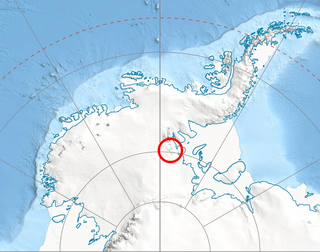
Hyde Glacier is a short glacier flowing east through the Edson Hills to join Union Glacier, in the Heritage Range, Antarctica. It was mapped by the United States Geological Survey from surveys and U.S. Navy air photos, 1961–66, and was named by the Advisory Committee on Antarctic Names for William H. Hyde, an ionospheric scientist at Little America V Station in 1958.
Macdougal Bay is a small bay lying between Ferguslie Peninsula and Watson Peninsula on the north coast of Laurie Island, in the South Orkney Islands, Antarctica. It was charted in 1903 by the Scottish National Antarctic Expedition under William Speirs Bruce, who named it for J. Macdougal, third mate of the expedition ship Scotia.
Holmes Glacier is a broad glacier debouching into the western part of Porpoise Bay about 10 nautical miles (20 km) south of Cape Spieden. It was delineated from aerial photographs taken by U.S. Navy Operation Highjump (1946–47), and was named by the Advisory Committee on Antarctic Names after Dr. Silas Holmes, Assistant Surgeon on the brig Porpoise during the United States Exploring Expedition (1838–42) under Lieutenant Charles Wilkes.
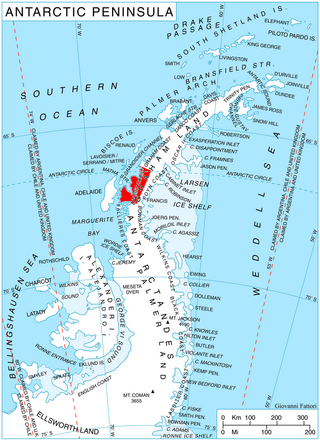
Hopkins Glacier is a glacier situated south of Erskine Glacier and flowing westwards into the head of Tlachene Cove in Darbel Bay on the west coast of Graham Land, Antarctica. It was photographed by Hunting Aerosurveys Ltd in 1955–57, and mapped from these photos by the Falkland Islands Dependencies Survey. It was named by the UK Antarctic Place-Names Committee in 1958 for Sir Frederick Hopkins, founder of the School of Biochemistry at Cambridge University, who made pioneer investigations on synthetic diets and vitamins which contributed greatly to the development of present ideas on concentrated rations.
Cape Lewis is an ice-covered cape at the west side of Maury Bay, on the coast of Antarctica. It was delineated by G.D. Blodgett (1955) from air photos taken by U.S. Navy Operation Highjump (1946–47), and was named by the Advisory Committee on Antarctic Names after Thomas Lewis, a crew member on the sloop Peacock during the United States Exploring Expedition (1838–42) under Lieutenant Charles Wilkes.
This is a list of rock formations in the French Antarctic territory of Adélie Land.
References
- ↑ "Maury Bay". Geographic Names Information System . United States Geological Survey, United States Department of the Interior . Retrieved 2013-08-30.
 This article incorporates public domain material from "Maury Bay". Geographic Names Information System . United States Geological Survey.
 | This Wilkes Land location article is a stub. You can help Wikipedia by expanding it. |