
The National Farmers' Bank of Owatonna, Minnesota, United States, is a historic bank building designed by Louis Sullivan, with decorative elements by George Elmslie. It was built in 1908, and was the first of Sullivan's "jewel box" bank designs. The building is clad in red brick with green terra cotta bands, and features two large arches on its street-facing facades. Single-story wings, originally housing bank offices, extend along each side. Internal elements include two stained-glass windows designed by Louis J. Millet, a mural by Oskar Gross, and four immense cast iron electroliers designed by Elmslie and cast by Winslow Brothers Company.

Claude and Starck was an architectural firm in Madison, Wisconsin, at the turn of the twentieth century. The firm was a partnership of Louis W. Claude (1868-1951) and Edward F. Starck (1868-1947). Established in 1896, the firm dissolved in 1928. The firm designed over 175 buildings in Madison.

The Steele County Courthouse is the seat of government for Steele County, located in Owatonna, Minnesota, United States. It was built in 1891. The courthouse is a three-story Austin red-brick building with red mortar, accented with Lake Superior brown stone. It was designed by T. Dudley Allen of Minneapolis in a Romanesque Revival and Italianate style, featuring corner towers, a turret, and a large clock on four sides. Windows are arched and a statue representing Mercy, Law, and Justice sits above the north face of the building. Polished granite columns support double arches at the entrances. The interior is decorated with wainscoting, woodwork, and an ornate oak staircase. The courthouse was listed on the National Register of Historic Places in 1976 for having local significance in the themes of architecture and politics/government. It was nominated for its Romanesque Revival architecture and long service as Steele County's government seat.

The Minnesota Judicial Center, adjacent to the State Capitol, houses the state's Supreme Court and Court of Appeals, as well as the Workers' Compensation Court of Appeals and the state law library. Its address is 25 Rev. Dr. Martin Luther King, Jr., Blvd., Saint Paul, Minnesota, United States.

The Winona Public Library is the public library serving Winona, Minnesota, United States. It is a member of Southeastern Libraries Cooperating, a Minnesota library region. Housed in an 1899 Neoclassical building, the Winona Public Library was listed on the National Register of Historic Places in 1977 for having local significance in architecture and education. It is Minnesota's oldest library to continuously operate in a purpose-built facility.

This is a list of the National Register of Historic Places listings in Steele County, Minnesota. It is intended to be a complete list of the properties and districts on the National Register of Historic Places in Steele County, Minnesota, United States. The locations of National Register properties and districts for which the latitude and longitude coordinates are included below, may be seen in an online map.

The Old Downtown Des Moines Library is a historic building in downtown Des Moines, Iowa, United States that was built in 1903. It was individually listed on the National Register of Historic Places in 1977, and became a contributing property in the Civic Center Historic District in 1988. The building ceased to be a library in 2006 and now houses the Norman E. Borlaug | World Food Prize Hall of Laureates for the World Food Prize.

Ottumwa Public Library is a public library located in downtown Ottumwa, Iowa, United States. The current building was built in 1901. It is part of the Central Park area, which is the civic center of the community. It includes the Wapello County Courthouse, Ottumwa City Hall, and St. Mary of the Visitation Catholic Church. The library was listed on the National Register of Historic Places in 1984.
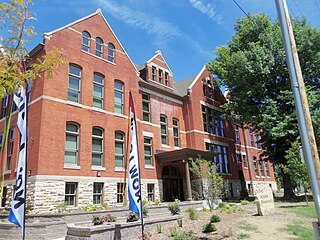
School Number 6, also known as Jackson School and Holy Family School, is an historic building located in Davenport, Iowa, United States. It was listed on the Davenport Register of Historic Properties and on the National Register of Historic Places in 2011.

The Eldon Public Library is a public library and historic building located in Eldon, Iowa, United States. Established in 1906, the present building, completed in 1913 with a donation from Andrew Carnegie, is listed on the National Register of Historic Places.

The Perry Carnegie Library Building, also known as the Carnegie Library Museum, is a historic structure located in Perry, Iowa, United States. The Perry Library Association was established in 1894, and William Tarr served as its first librarian. Andrew Carnegie accepted Perry's application for a grant for $10,600 on January 13, 1903. The Des Moines architectural firm of Liebbe, Nourse & Rasmussen designed the Neoclassical building that was built by local contractor Courtney and Bolt. It opened in September 1904 was dedicated on December 10.

The Bemidji Carnegie Library is a former library building in Bemidji, Minnesota, United States. It was built as a Carnegie library in 1909 and housed the city's public library until 1961. It was listed on the National Register of Historic Places in 1980 for its local significance in the themes of architecture and education. It was nominated for being a well-preserved example of a Carnegie library and of public Neoclassical architecture.
Owatonna High School (OHS) is a public school in Owatonna, Minnesota, United States, located in the heart of the town. The school was established in 1877. Construction of the current building started in 1920 and the school was completed in 1921. It is the third high school built in Owatonna. It has just over 1,500 students students and 145 faculty members.

The historic Duluth Public Library is a former Carnegie library building at 101 West Second Street in Duluth, Minnesota, United States. It was constructed in 1902 as the first purpose-built facility of the Duluth Public Library. It was listed on the National Register of Historic Places in 1978 for its local significance in the themes of architecture and education. It was nominated for its Neoclassical architecture and association with early community education efforts.

The Owatonna Firemen's Hall, formerly the Owatonna City and Firemen's Hall, is a historic government building in Owatonna, Minnesota, United States. It was built from 1906 to 1907 to house the Owatonna Fire Department and city government offices. The city offices were relocated to the former campus of the Minnesota State Public School for Dependent and Neglected Children in 1974. The Firemen's Hall continues to serve as the headquarters for the Owatonna Fire Department.

The Mason City Public Library is located in Mason City, Iowa, United States. The building that was funded by Andrew Carnegie, and is now an office building, was listed on the National Register of Historic Places in 1989. It was included as a contributing property in the Mason City Downtown Historic District in 2005.

The Marion Carnegie Public Library is a historic building located in Marion, Iowa, United States. The Marion Federation of Women's Clubs was established in 1901 with the purpose of organizing a public library. Adeliza Daniels was the primary force behind the organization, and she contacted Andrew Carnegie to donate funds for the building. After he agreed to a grant of $11,500, the Cedar Rapids architectural firm of Dieman and Fiske designed the brick Neoclassical building. Cedar Rapids contractor A.H. Conner was responsible for construction. It is a single-story structure built over a raised basement and a proment pedimented main entrance. The new library was dedicated on March 16, 1905, and served the community in that form until 1957. In that year the auditorium in the basement was remodeled into a children's reading room. A three-story addition, which doubled the size of the building, was completed in 1961. The building was individually listed on the National Register of Historic Places in 1994. The Marion Public Library has subsequently moved to a new facility, and the Carnegie building is now part of the First United Methodist Church complex. In 2009 it was included as a contributing property in the Marion Commercial Historic District.

The Janesville Free Public Library is the public library in Janesville, Minnesota, United States. It is housed in a Carnegie library building constructed in 1912. It is part of the Waseca-Le Sueur Regional Library System, which is a participant in the Traverse des Sioux Library System. The Janesville library building was listed on the National Register of Historic Places in 1982 for its local significance in the themes of architecture and educaction. It was nominated for being a well-preserved example of the 65 libraries founded in Minnesota by Andrew Carnegie's philanthropy, and for its Neoclassical architecture.

The Morris Carnegie Library is a former library building in Morris, Minnesota, United States, now occupied by a historical society. It was built in 1905 as one of the 2,500 Carnegie libraries funded by steel magnate Andrew Carnegie. It was listed on the National Register of Historic Places in 1983 for having local significance in the themes of architecture and education. It was nominated for being a longstanding focus of education in Morris, with locally distinctive and well preserved Neoclassical architecture.


