
Cydia is a large genus of tortrix moths, belonging to the tribe Grapholitini of subfamily Olethreutinae. Its distinctness from and delimitation versus the tribe's type genus Grapholita requires further study.

Lecithocera is a genus of moths in the lecithocerid subfamily Lecithocerinae. The genus was erected by Gottlieb August Wilhelm Herrich-Schäffer in 1853.

Grapholita is a large genus of tortrix moths. It belongs to subfamily Olethreutinae, and therein to the tribe Grapholitini, of which it is the type genus.

The Oecophorinae are the nominate subfamily of moths in the concealer moth family (Oecophoridae). They are part of the insufficiently studied superfamily Gelechioidea, and like their relatives, the circumscription of this taxon is disputed.

Alucita is the largest genus of many-plumed moths ; it is also the type genus of its family and the disputed superfamily Alucitoidea. This genus occurs almost worldwide and contains about 180 species as of 2011; new species are still being described and discovered regularly. Formerly, many similar moths of superfamilies Alucitoidea, Copromorphoidea and Pterophoroidea were also placed in Alucita.
Lobesia lithogonia is a moth of the family Tortricidae first described by Alexey Diakonoff in 1954. It is found in Thailand, Sri Lanka, Java, Borneo and New Guinea.

Xyloryctidae is a family of moths contained within the superfamily Gelechioidea described by Edward Meyrick in 1890. Most genera are found in the Indo-Australian region. While many of these moths are tiny, some members of the family grow to a wingspan of up to 66 mm, making them giants among the micromoths.
Pectinimura is a genus of moths in the family Lecithoceridae.
Alexey Diakonoff full name Alexey Nikolaievich Diakonoff was a Russian entomologist who specialised in Microlepidoptera.
Meridarchis is a genus of moths in the family Carposinidae erected by Philipp Christoph Zeller in 1867.
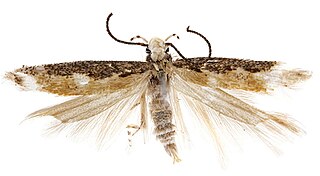
Gelechiinae is a subfamily of moths in the family Gelechiidae. It was described by Henry Tibbats Stainton in 1854.
Ardozyga catadamanta is a species of moth in the family Gelechiidae. It was described by Alexey Diakonoff in 1954. It is found in New Guinea.
The Hypertrophinae are a subfamily of small moths in the family Depressariidae. The subfamily was described by Thomas Bainbrigge Fletcher in 1929.

The Stenomatinae are a subfamily of small moths in the family Depressariidae.

Agriophara is a genus of moths in the subfamily Stenomatinae. The genus was erected by Rudolph Rosenstock in 1885.
Chironeura chrysocyma is a moth in the family Xyloryctidae, and the only species in the genus Chironeura. Species and genus were both described by Alexey Diakonoff in 1954 and are found New Guinea.
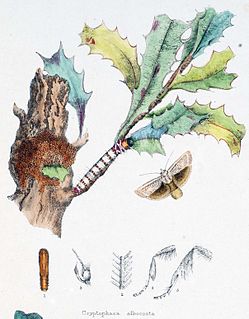
Cryptophasa is a genus of moths of the family Xyloryctidae.
Pansepta is a genus of moths of the family Xyloryctidae.
Pansepta languescens is a moth in the family Xyloryctidae. It was described by Alexey Diakonoff in 1954. It is found in New Guinea.
