| Paombong | ||
|---|---|---|
| Municipality | ||
| Bayan ng Paombong(Municipality of Paombong) | ||
| ||
| Nickname(s): Vinegar Capital of the Philippines | ||
| Motto(s): Abante Bagong Paombong Pantay Pantay na Karapatan sa Pag-asa sa Kaunlaran | ||
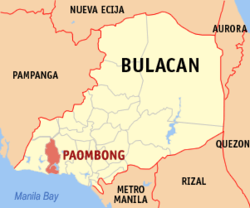
Map of Bulacan showing the location of Paombong | ||
| Coordinates: 14°49′52″N120°47′21″E / 14.83111°N 120.78917°E Coordinates: 14°49′52″N120°47′21″E / 14.83111°N 120.78917°E | ||
| Country | Philippines | |
| Region | Central Luzon (Region III) | |
| Province | Bulacan | |
| District | 1st District | |
| Founded | 1619 | |
| Barangays | 14 | |
| Government | ||
| • Mayor | Mary Ann "Ann" Marcos (Independent) | |
| • Vice Mayor | Cristina Gonzales (Liberal Party) | |
| Area [1] | ||
| • Total | 46.34 km2 (17.89 sq mi) | |
| Highest elevation | 15 m (49 ft) | |
| Population (2015 census) [2] | ||
| • Total | 53,294 | |
| • Density | 1,200/km2 (3,000/sq mi) | |
| • Poverty rate | ||
| Demonym(s) | Paombongenyo | |
| Time zone | PST (UTC+8) | |
| ZIP code | 3001 | |
| IDD : area code | +63 (0)44 | |
| Income class [3] | 3rd Class; Partially Urban | |
| • Revenue (2017) | ||
| • Expenses (2017) | ||
| • Total Assets (2017) | ||
| Electricity | Manila Electric Company | |
| • Consumption | 12.18 million kWh (2003) | |
Paombong (Filipino: Bayan ng Paombong; Kapampangan: Balen ning Paombong) is a third class partially urban [4] municipality in the province of Bulacan, Philippines. Dubbed as the "Vinegar Capital of the Philippines", Paombong is famous for its vinegar [5] extracted from the sap of sasa (nipa), thus the term "Sukang Paombong" (Paombong vinegar) became known in Luzon and other parts of the Philippines. According to the 2015 census, it has a population of 53,294 people. [2]
Filipino is the national language of the Philippines. Filipino is also designated, along with English, as an official language of the country. It is a standardized variety of the Tagalog language, an Austronesian regional language that is widely spoken in the Philippines. As of 2007, Tagalog is the first language of 28 million people, or about one-third of the Philippine population, while 45 million speak Tagalog as their second language. Tagalog is among the 185 languages of the Philippines identified in the Ethnologue. Officially, Filipino is defined by the Commission on the Filipino Language as "the native dialect, spoken and written, in Metro Manila, the National Capital Region, and in other urban centers of the archipelago."
Kapampangan, Pampango, or the Pampangan language is a major Philippine language. It is spoken in the province of Pampanga, most of Tarlac and Bataan. Kapampangan is also understood in some municipalities of Bulacan and Nueva Ecija and by the Aeta people of Zambales. The language is known honorifically as Amánung Sísuan.
The Philippines, officially the Republic of the Philippines, is an archipelagic country in Southeast Asia. Situated in the western Pacific Ocean, it consists of about 7,641 islands that are categorized broadly under three main geographical divisions from north to south: Luzon, Visayas, and Mindanao. The capital city of the Philippines is Manila and the most populous city is Quezon City, both part of Metro Manila. Bounded by the South China Sea on the west, the Philippine Sea on the east and the Celebes Sea on the southwest, the Philippines shares maritime borders with Taiwan to the north, Vietnam to the west, Palau to the east, and Malaysia and Indonesia to the south.
Local legend has it that the name "Paombong" was taken from the long bamboo tube called "bumbong" or "tukil" which is used for collecting nipa sap. The practice of extracting nipa sap with bumbongs made the town known as the town with many bumbongs.
The local people claimed that the Spaniards who first visited the place were so amused with the bumbong that, after learning its name from the natives, they named the town after the container, a name which later evolved to Paombong.
Paombong was originally one of the visitas (barrio) of Malolos mentioned in Capitulo XXXVI of Conquistas de Las Islas libro segundo by Fray Gaspar San Agustin.In a meeting held in Tondo Convent,the Provincial Chapter created the Town of Malolos in June 1580 with Fray Matheo de Mendoza OSA as its first minister,together with Barrios of Mambog under the patronage of San Roque,Matimbo with Santa Cruz and Paombong with Saint James Apostle.In 1619 Augustinians already established Paombong Convent but the town was administered by the justice of friars from Malolos.Paombong is not wealthy as its neighbor towns of Malolos and Hagonoy at time and it did not sustain its township and it was degraded again as barrio and being a visita in 1638.
In 1639 Paombong was turned over to the Town of Calumpit from its mother town Malolos and in 1649 it was returned again to Malolos but on November 28, 1650 it was finally given its own civil government establishing Paombong its full township with Don Agustin Mananghaya as its first Gobernadorcillo.
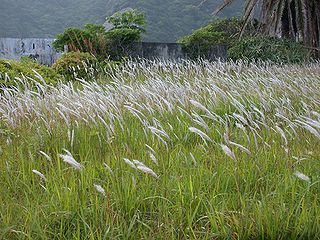
In the middle of the 1750s, Paombong grew into a modest community from what was once a cogon land inhabited by a handful of Tagalogs. [6] as its first gobernadorcillo.
Imperata cylindrica is a species of grass in the family Poaceae. Red cultivars of the species grown as ornamental plants are known as Japanese bloodgrass.
The Tagalog people are a major ethnolingustic group in the Philippines. They have a well developed society due to their cultural heartland, Manila, being the capital city of the Philippines. Most of them inhabit and form a majority in the Metro Manila and Calabarzon regions of southern Luzon, as well as a plurality in the provinces of Bulacan, Bataan, Zambales, Nueva Ecija and Aurora in Central Luzon and in the islands of Marinduque and Mindoro in MIMAROPA.
During the Revolution against Spain, Paombong’s coastal area, more specifically, Barangays Masukol and Binakod, played a significant role in Philippine History being known encounter sites between Spanish soldiers and Katipuneros. Maloleño General Isidoro "matanglawin" Torres [7] used to retreat with his troops to Barangay Masukol and Barangay Binakod to avoid the advancing Spanish forces.[ citation needed ] In the latter village, he organized the Katipunan militia of Paombong. [8]
The Kataas-taasan, Kagalang-galangang, Katipunan ng mga Anak ng Bayan, also known as Katipunan or KKK, was a Philippine revolutionary society founded by anti-Spanish colonialism Filipinos in Manila in 1892; its primary goal was to gain independence from Spain through a revolution. Documents discovered in the 21st century suggest that the society had been organized as early as January 1892 but may not have become active until July 7 of the same year; that was the date that Filipino writer José Rizal was to be banished to Dapitan. Founded by Filipino patriots Andrés Bonifacio, Teodoro Plata, Ladislao Diwa, Darilyo Valino, Rulfo Guia, Dano Belica, Tiburcio Liamson, and Gabrino Manzanero, the Katipunan was a secret organization until it was discovered in 1896. This discovery led to the outbreak of the Philippine Revolution.
It is from these encounters, in fact, that Barangays Binakod and Masukol earned their present names. In one encounter, Binakod was where the enemies where "fenced in" (binakuran) and it was in Masukol where they were eventually "cornered" (nasukol) and defeated.
In 1898, the first civilian in the person of Don Victorio de Leon headed the Municipal Government until 1900. The seat of the local government was first established at the ground floor of the Paombong Church Convent then popularly called "zaguan". It was later transferred to the house of Numerino Lindayag located in Poblacion, then was transferred to the location of the present Rural Health Center I. Eventually it was moved to the place where it is presently located which since has been the seat of the Municipal Government since then. In 1941, the head of the Municipal Government was later on called Municipal Mayor.
In many countries, a mayor is the highest-ranking official in a municipal government such as that of a city or a town.
Paombong is situated south-west of the province of Bulacan, with a total land area of 46.34 square kilometers. It is bounded by the municipality of Calumpit on the north, Malolos City on the east, municipality of Hagonoy on the west and Manila Bay on the south. The municipality is approximately 47 kilometers from Metro Manila, it is a by-pass town and can be accessed via North Luzon Expressway and MacArthur Highway.
Hagonoy, officially the Municipality of Hagonoy,, is a 1st class municipality in the province of Bulacan, Philippines. According to the 2015 census, it has a population of 129,807 people.
Manila Bay is a natural harbour which serves the Port of Manila, in the Philippines. Strategically located around the capital city of the Philippines, Manila Bay facilitated commerce and trade between the Philippines and its neighbouring countries, becoming the gateway for socio-economic development even prior to Spanish occupation. With an area of 1,994 km2 (769.9 sq mi), and a coastline of 190 km (118.1 mi), Manila Bay is situated in the western part of Luzon and is bounded by Cavite and Metro Manila on the east, Bulacan and Pampanga on the north, and Bataan on the west and northwest. Manila Bay drains approximately 17,000 km2 (6,563.7 sq mi) of watershed area, with the Pampanga River contributing about 49% of the freshwater influx. With an average depth of 17 m (55.8 ft), it is estimated to have a total volume of 28.9 billion cubic metres. Entrance to the bay is 19 km (11.8 mi) wide and expands to a width of 48 km (29.8 mi). However, width of the bay varies from 22 km (13.7 mi) at its mouth and expanding to 60 km (37.3 mi) at its widest point.
Paombong is politically subdivided into 14 barangays (6 urban, 8 rural):
A barangay or baranggay, formerly referred to as barrio, is the smallest administrative division in the Philippines and is the native Filipino term for a village, district or ward. In metropolitan areas, the term often refers to an inner city neighbourhood, a suburb or a suburban neighborhood. The word barangay originated from balangay, a kind of boat used by a group of Austronesian peoples when they migrated to the Philippines.
| Population census of Paombong | ||
|---|---|---|
| Year | Pop. | ±% p.a. |
| 1903 | 8,554 | — |
| 1918 | 9,260 | +0.53% |
| 1939 | 11,269 | +0.94% |
| 1948 | 13,437 | +1.97% |
| 1960 | 16,677 | +1.82% |
| 1970 | 20,636 | +2.15% |
| 1975 | 24,383 | +3.40% |
| 1980 | 26,267 | +1.50% |
| 1990 | 32,052 | +2.01% |
| 1995 | 33,149 | +0.63% |
| 2000 | 41,077 | +4.70% |
| 2007 | 50,798 | +2.97% |
| 2010 | 50,940 | +0.10% |
| 2015 | 53,294 | +0.86% |
| Source: Philippine Statistics Authority [2] [10] [11] [12] | ||
In the 2015 census, the population of Paombong, Bulacan, was 53,294 people, [2] with a density of 1,200 inhabitants per square kilometre or 3,100 inhabitants per square mile.
Just as the national government, the municipal government is divided into three branches: executive, legislative and judiciary. The judicial branch is administered solely by the Supreme Court of the Philippines. The LGUs have control of the executive and legislative branch.
The executive branch is composed of the mayor and the barangay captain for the barangays. [13] The legislative branch is composed of the Sangguniang Bayan (town assembly), Sangguniang Barangay (barangay council), and the Sangguniang Kabataan for the youth sector.
The seat of Government is vested upon the Mayor and other elected officers who hold office at the Town hall. The Sanguniang Bayan is the center of legislation.
The following officials were elected on May 9, 2016 to serve a three-year term. [14]
Major Industries
Major Products
Public land transport in Paombong is served by provincial buses, Jeepneys, for-hire Tricycles, Pedicabs, and UV Express AUVs. Maritime transport is served by motorboats. Both First North Luzon Transit and Baliwag Transit buses passes thru the municipality.
There is one hospital operating in Paombong and a main rural health care center unit. The San Pascual Baylon Maternity Hospital, situated at Barangay Sto. Niño that offers secondary healthcare services. And the main rural health care center is one of the district rural health center owned and controlled by the Provincial Government of Bulacan. It offers primary healthcare services which also includes laboratory and dental and maternity services.
Elementary Schools
High Schools
Bulacan is a province in the Philippines, located in the Central Luzon Region in the island of Luzon, 11 kilometres (6.8 mi) north of Manila, and part of the Metro Luzon Urban Beltway Super Region. Bulacan was established on August 15, 1578.
San Jose del Monte, officially the City of San Jose del Monte,, or simply known as San Jose del Monte City, is a 1st class city in the province of Bulacan, Philippines. According to the 2015 census, it has a population of 574,089 people, making it the largest local government unit within the province of Bulacan and the 18th most populated city in the Philippines.
Meycauayan, officially the City of Meycauayan,, or simply known as Meycauayan City, is a 3rd class city in the province of Bulacan, Philippines. According to the 2015 census, it has a population of 209,083 people.
Bulakan, officially the Municipality of Bulakan,, is a 1st class municipality in the province of Bulacan, Philippines. According to the 2015 census, it has a population of 76,565 people.
Malolos, officially the City of Malolos,, or simply known as Malolos City, is a 3rd class city in the province of Bulacan, Philippines. According to the 2015 census, it has a population of 252,074 people.
San Isidro, officially the Municipality of San Isidro, is a 2nd class municipality in the province of Nueva Ecija, Philippines. According to the 2015 census, it has a population of 51,612 people.
Santa Cruz, officially the Municipality of Santa Cruz, is a 1st class municipality in the province of Zambales, Philippines. According to the 2015 census, it has a population of 58,151 people.
Magalang, officially the Municipality of Magalang, is a 1st class municipality in the province of Pampanga, Philippines. According to the 2015 census, it has a population of 113,147 people.
Minalin, officially the Municipality of Minalin, is a 4th class municipality in the province of Pampanga, Philippines. According to the 2015 census, it has a population of 47,713 people.
Santa Ana, officially the Municipality of Santa Ana, is a 3rd class municipality in the province of Pampanga, Philippines. According to the 2015 census, it has a population of 55,178 people.
Balagtas, officially the Municipality of Balagtas,, is a 1st class municipality in the province of Bulacan, Philippines. According to the 2015 census, it has a population of 73,929 people.

Guiguinto, officially the Municipality of Guiguinto,, is a 1st class municipality in the province of Bulacan, Philippines. According to the 2015 census, it has a population of 99,730 people.
Marilao, officially the Municipality of Marilao,, is a 1st class municipality in the province of Bulacan, Philippines. According to the 2015 census, it has a population of 221,965 people.
Norzagaray, officially the Municipality of Norzagaray,, is a 1st class municipality in the province of Bulacan, Philippines. According to the 2015 census, it has a population of 111,348 people.
Pandi, officially the Municipality of Pandi,, is a 2nd class municipality in the province of Bulacan, Philippines. According to the 2015 census, it has a population of 89,075 people.
Pulilan, officially the Municipality of Pulilan,, is a 1st class municipality in the province of Bulacan, Philippines. According to the 2015 census, it has a population of 97,323 people.
San Miguel, officially the Municipality of San Miguel,, is a 1st class municipality in the province of Bulacan, Philippines. According to the 2015 census, it has a population of 153,882 people.
Local elections will be held in the Province of Bulacan on May 10, 2010 as part of the 2010 general election. Voters will select candidates for all local positions: a town mayor, vice mayor and town councilors, as well as members of the Sangguniang Panlalawigan, the vice-governor, governor and representatives for the four districts of Bulacan.
Nipa palm vinegar, also known as sukang sasa or sukang nipa, is a traditional Filipino vinegar made from the sap of the nipa palm. It is one of the four main types of vinegars in the Philippines, along with coconut vinegar, cane vinegar, and kaong palm vinegar. It is usually sold under the generic label of "palm vinegar".
| Wikimedia Commons has media related to Paombong, Bulacan . |