Related Research Articles
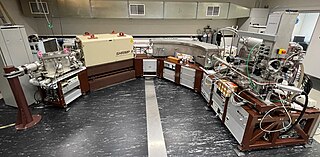
The sensitive high-resolution ion microprobe is a large-diameter,double-focusing secondary ion mass spectrometer (SIMS) sector instrument that was produced by Australian Scientific Instruments in Canberra,Australia and now has been taken over by Chinese company Dunyi Technology Development Co. (DTDC) in Beijing. Similar to the IMS 1270-1280-1300 large-geometry ion microprobes produced by CAMECA,Gennevilliers,France and like other SIMS instruments,the SHRIMP microprobe bombards a sample under vacuum with a beam of primary ions that sputters secondary ions that are focused,filtered,and measured according to their energy and mass.
Uranium–lead dating,abbreviated U–Pb dating,is one of the oldest and most refined of the radiometric dating schemes. It can be used to date rocks that formed and crystallised from about 1 million years to over 4.5 billion years ago with routine precisions in the 0.1–1 percent range.
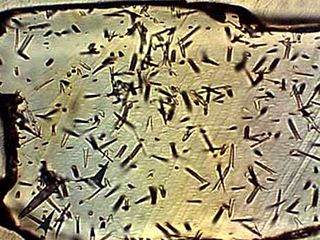
Fission track dating is a radiometric dating technique based on analyses of the damage trails,or tracks,left by fission fragments in certain uranium-bearing minerals and glasses. Fission-track dating is a relatively simple method of radiometric dating that has made a significant impact on understanding the thermal history of continental crust,the timing of volcanic events,and the source and age of different archeological artifacts. The method involves using the number of fission events produced from the spontaneous decay of uranium-238 in common accessory minerals to date the time of rock cooling below closure temperature. Fission tracks are sensitive to heat,and therefore the technique is useful at unraveling the thermal evolution of rocks and minerals. Most current research using fission tracks is aimed at:a) understanding the evolution of mountain belts;b) determining the source or provenance of sediments;c) studying the thermal evolution of basins;d) determining the age of poorly dated strata;and e) dating and provenance determination of archeological artifacts.
Thomas Edvard Krogh,FRSC was a geochronologist and a former curator for the Royal Ontario Museum. He revolutionized the technique of radiometric uranium-lead dating with the development of new laboratory procedures and analytical methodologies. His discoveries have yielded an unprecedented level of precision in the dating of Precambrian rocks. Krogh's techniques have become the international de facto standard. The application of these techniques has provided a detailed understanding of the evolution of the Earth's Precambrian shield areas.

The National Geophysical Research Institute (NGRI) is a geoscientific research organization established in 1961 under the Council of Scientific and Industrial Research (CSIR),India's largest Research and Development organization. It is supported by more than 200 scientists and other technical staff whose research activities are published in several journals of national and international interest.

Thermochronology is the study of the thermal evolution of a region of a planet. Thermochronologists use radiometric dating along with the closure temperatures that represent the temperature of the mineral being studied at the time given by the date recorded to understand the thermal history of a specific rock,mineral,or geologic unit. It is a subfield within geology,and is closely associated with geochronology.
George Tilton was an American geochemist who specialized in uranium-lead geochronology. He was the first to measure a U-Pb date on zircon and was instrumental in developing analytical techniques for the measurement of U,Th,and Pb in minerals and rocks,using isotope dilution and mass spectrometry.
The International Association of Geoanalysts (IAG) is an international not-for-profit learned society dedicated to the advancement and promotion of geoanalytical science,the analysis of geological and environmental materials.

Provenance in geology,is the reconstruction of the origin of sediments. The Earth is a dynamic planet,and all rocks are subject to transition between the three main rock types:sedimentary,metamorphic,and igneous rocks. Rocks exposed to the surface are eventually broken down into sediments. Sediments are expected to be able to provide evidence of the erosional history of their parent source rocks. The purpose of provenance study is to restore the tectonic,paleo-geographic and paleo-climatic history.
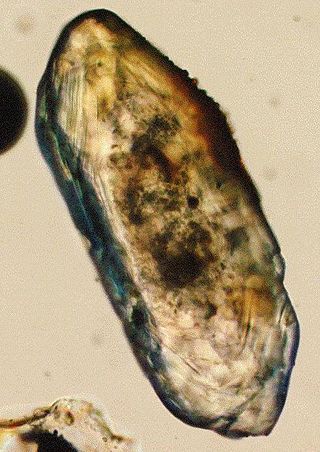
Titanium in zircon geothermometry is a form of a geothermometry technique by which the crystallization temperature of a zircon crystal can be estimated by the amount of titanium atoms which can only be found in the crystal lattice. In zircon crystals,titanium is commonly incorporated,replacing similarly charged zirconium and silicon atoms. This process is relatively unaffected by pressure and highly temperature dependent,with the amount of titanium incorporated rising exponentially with temperature,making this an accurate geothermometry method. This measurement of titanium in zircons can be used to estimate the cooling temperatures of the crystal and infer conditions during which it crystallized. Compositional changes in the crystals growth rings can be used to estimate the thermodynamic history of the entire crystal. This method is useful as it can be combined with radiometric dating techniques that are commonly used with zircon crystals,to correlate quantitative temperature measurements with specific absolute ages. This technique can be used to estimate early Earth conditions,determine metamorphic facies,or to determine the source of detrital zircons,among other uses.

Detrital zircon geochronology is the science of analyzing the age of zircons deposited within a specific sedimentary unit by examining their inherent radioisotopes,most commonly the uranium–lead ratio. Zircon is a common accessory or trace mineral constituent of most granite and felsic igneous rocks. Due to its hardness,durability and chemical inertness,zircon persists in sedimentary deposits and is a common constituent of most sands. Zircons contain trace amounts of uranium and thorium and can be dated using several modern analytical techniques.

Monazite geochronology is a dating technique to study geological history using the mineral monazite. It is a powerful tool in studying the complex history of metamorphic rocks particularly,as well as igneous,sedimentary and hydrothermal rocks. The dating uses the radioactive processes in monazite as a clock.

Eoarchean geology is the study of the oldest preserved crustal fragments of Earth during the Eoarchean era from 4.031 to 3.6 billion years ago. Major well-preserved rock units dated to this era are known from three localities,the Isua Greenstone Belt in Southwest Greenland,the Acasta Gneiss in the Slave Craton in Canada,and the Nuvvuagittuq Greenstone Belt in the eastern coast of Hudson Bay in Quebec. From the dating of rocks in these three regions,scientists suggest that the beginning of plate tectonics could have started as far back as early as the Eoarchean.
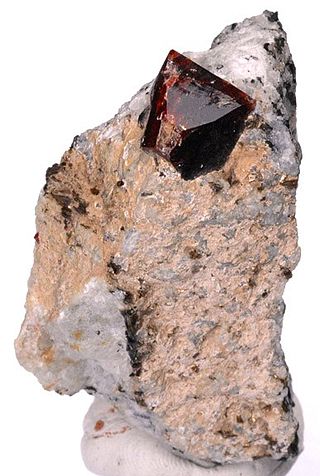
Lutetium–hafnium dating is a geochronological dating method utilizing the radioactive decay system of lutetium–176 to hafnium–176. With a commonly accepted half-life of 37.1 billion years,the long-living Lu–Hf decay pair survives through geological time scales,thus is useful in geological studies. Due to chemical properties of the two elements,namely their valences and ionic radii,Lu is usually found in trace amount in rare-earth element loving minerals,such as garnet and phosphates,while Hf is usually found in trace amount in zirconium-rich minerals,such as zircon,baddeleyite and zirkelite.

Hadean zircon is the oldest-surviving crustal material from the Earth's earliest geological time period,the Hadean eon,about 4 billion years ago. Zircon is a mineral that is commonly used for radiometric dating because it is highly resistant to chemical changes and appears in the form of small crystals or grains in most igneous and metamorphic host rocks.
Reinhardt Adolfo Fuck is a Brazilian geologist and professor emeritus at the University of Brasília. Fuck specializes on geochronology and petrology,having written extensively on Pre-Cambrian geology.

Archean felsic volcanic rocks are felsic volcanic rocks that were formed in the Archean Eon. The term "felsic" means that the rocks have silica content of 62–78%. Given that the Earth formed at ~4.5 billion year ago,Archean felsic volcanic rocks provide clues on the Earth's first volcanic activities on the Earth's surface started 500 million years after the Earth's formation.
Carol Denison Frost is an American isotope geologist,petrologist and professor. Her primary research focuses on the evolution of the continental crust and granite petrogenesis. She has spent over forty years investigating the geologic history of the Wyoming Province and the formation and geochemical classification of granite. Other contributions include isotopic fingerprinting of natural waters,including water associated with energy production. She served as Director of the Earth Sciences Division,National Science Foundation,from December 2014 to January 2018. Frost joined the British Geological Survey Board of Directors in 2023.
Janet Margaret Hergt is an Australian geochemist. She is a Redmond Barry Distinguished Professor in the School of Geography,Earth and Atmospheric Sciences at the University of Melbourne,Victoria,Australia. The main focus of her research has been in the chemical analysis of rocks and minerals to explore the exquisite record of Earth processes preserved within them. Hergt is best known for her geochemical investigations of magmatic rocks although she has employed similar techniques in interdisciplinary projects including areas of archaeological and biological science.

The Dharwar Craton is an Archean continental crust craton formed between 3.6-2.5 billion years ago (Ga),which is located in southern India and considered the oldest part of the Indian peninsula.
References
- 1 2 "Interview with Dr. Paul Sylvester, Former Editor-in-Chief of Minerals".
- 1 2 "The TTU MILL Mineral Isotope Laser Laboratory".
- 1 2 "Mineralogical Society of America" (PDF).
- ↑ "Texas Tech Faculty Members Rank Among Top 2% of Global Researchers".
- ↑ "October 2023 data-update for "Updated science-wide author databases of standardized citation indicators"".
- 1 2 "Paul Sylvester - Google Scholar Profile".
- ↑ "Reflections on Seven Years as Editor-in-Chief for Minerals".
- ↑ "Editorial Board - Joint Editors-in-Chief".
- ↑ "About this journal - Critical Insights in Geochemistry and Geophysics".
- ↑ "Geochemistry - Faculty".
- ↑ "Post-Collisional Alkaline Granites".
- ↑ "Post-collisional strongly peraluminous granites".
- ↑ "A simple method for the precise determination of ≥ 40 trace elements in geological samples by ICPMS using enriched isotope internal standardisation".
- ↑ "U–Pb dating of detrital zircons for sediment provenance studies—a comparison of laser ablation ICPMS and SIMS techniques".
- ↑ "Present Trends and the Future of Zircon in Geochronology: Laser Ablation ICPMS".
- ↑ "Further Characterisation of the 91500 Zircon Crystal".
- ↑ "U–Pb and Th–Pb dating of apatite by LA-ICPMS".
- ↑ "Community-Derived Standards for LA-ICP-MS U-(Th-)Pb Geochronology – Uncertainty Propagation, Age Interpretation and Data Reporting".
- ↑ "Analysis of Fe isotopes in sulfides and iron meteorites by laser ablation high-mass resolution multi-collector ICP mass spectrometry".
- ↑ "The effect of target lithology on the products of impact melting".
- ↑ "The origin of non-porphyritic pyroxene chondrules in UOCs: Liquid solar nebula condensates?".
- ↑ "Continent formation, growth and recycling".
- ↑ "THE GEOCHEMICAL NEWS - Newsletter of The Geochemical Society in cooperation with The European Association of Geochemistry" (PDF).
- ↑ "Emerging methods, instrumentation, software and reference materials for LA-ICP-MS".